
The Best Treatment Options for Stage 4 HER2-Positive Breast Cancer

HER2-positive breast cancer means that tumour cells produce too much of a protein called HER2, causing rapid growth. The HER2 protein activates a signalling pathway that helps cells grow and multiply, allowing cancer cells to proliferate rapidly. Many new targeted drugs specifically for HER2-positive breast cancer have now been developed. As the number of options grows, the question is which treatment is most effective for patients.
One notable oncology study of 2022 concerned 2 newer-generation targeted drugs used in HER2-positive breast cancer: trastuzumab deruxtecan (T-DXd, Enhertu) and trastuzumab emtansine (T-DM1, Kadcyla). These drugs were compared head-to-head in DESTINY-Breast03, whose updated results were presented at the 2022 San Antonio Breast Cancer Symposium.
Both Kadcyla and Enhertu are antibody–drug conjugates, medicines formed by joining an antibody to a chemotherapy molecule. Their general structure is illustrated below. HER2, the target antigen for Kadcyla and Enhertu, is found on cancer-cell surfaces. The antibody portion therefore binds to HER2 and thus the cancer cell, then releases the cytotoxic, or cell-killing, drug.

DESTINY-Breast03 enrolled patients with advanced HER2-positive breast cancer previously treated with trastuzumab and taxanes. It compared Kadcyla and Enhertu, newer-generation anti-HER2 treatments. Until this study, the most suitable treatment for patients in this situation remained uncertain.
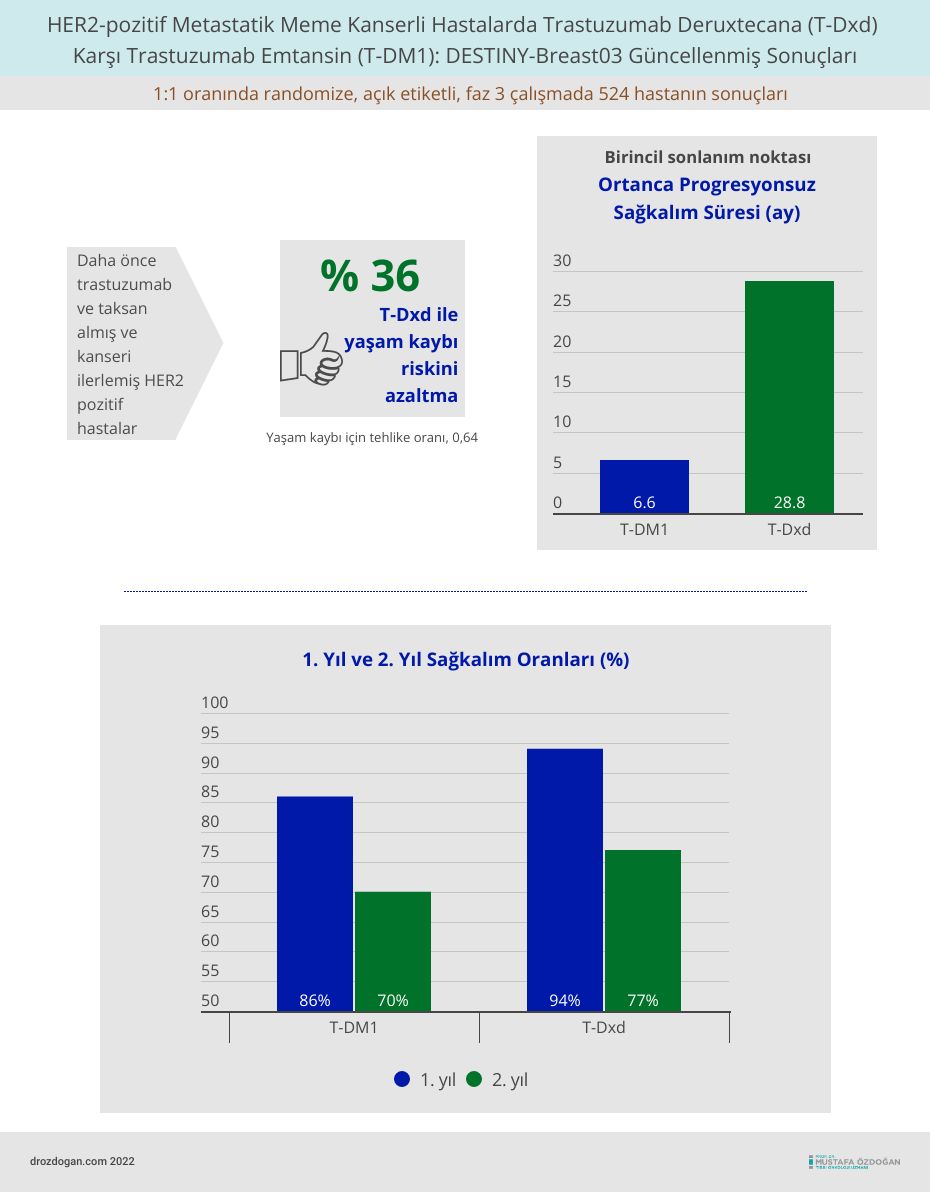
- In this study of 524 patients, median overall survival with trastuzumab deruxtecan (T-DXd, Enhertu) was significantly better than with trastuzumab emtansine (T-DM1, Kadcyla). T-DXd reduced the risk of death by 36% (hazard ratio 0.64).
- In the T-DXd group, survival rates at year 1 and year 2 were 94.1% and 77.4%, respectively; in the T-DM1 group, the corresponding year 1 and year 2 rates were 86% and 69.9%.
- Median progression-free survival was 4 times longer with T-DXd: 28.8 months versus 6.6 months.
- An objective treatment response occurred in 78.5% of patients receiving T-DXd, while one in every 5 patients (21.1%) had a complete radiological response.
- Rates of severe adverse effects (grade ≥3) with T-DXd and T-DM1 were 56% and 52%, respectively. Interstitial lung disease occurred in 15% and 3%, respectively.
In conclusion, this study indicates that T-DXd is a more effective treatment option than T-DM1 for patients with HER2-positive breast cancer whose cancer has progressed after taxane and trastuzumab treatment.
Related topic: A New Tumour-Agnostic Cancer Drug Makes a Difference: Trastuzumab Deruxtecan
Sources
Was this article helpful?
Your feedback helps us improve our content.




Reader comments
Share your comment
Your name and comment are published only after administrator approval. Your email address is never shown to visitors.
Be the first to comment.