
DKN-01 and Tislelizumab in Gastric or Gastroesophageal Junction Adenocarcinoma

In this article
Gastric and gastroesophageal junction adenocarcinoma is generally known as a disease that is difficult to treat once advanced and substantially shortens patients' lives. Studies of new treatment combinations are therefore particularly important.
A Treatment Approach with Three Different Active Components
On October 21, 2024, the Journal of Clinical Oncology published the phase IIa DisTinGuish study, which explores a promising approach: combining DKN-01, an antibody that neutralizes DKK1 (Dickkopf-1), with tislelizumab, an anti-PD-1 inhibitor immunotherapy, and chemotherapy. The results suggest that this combination could be an effective option for advanced gastric or gastroesophageal junction adenocarcinoma.
DKK1 (Dickkopf-1) is a protein that plays an important role in cellular signaling pathways, influencing cell growth and differentiation particularly by suppressing the Wnt signaling pathway. High DKK1 levels have been associated with tumor development and metastasis in certain diseases, including cancer. DKN-01 is a monoclonal antibody that targets the DKK1 protein and neutralizes its effects.
Anti-PD-1 inhibitors enable the immune system to work more effectively against cancer cells by blocking the PD-1 (Programmed Cell Death Protein 1) receptor, which prevents immune cells from recognizing and destroying tumor cells. Tislelizumab is an anti-PD-1 monoclonal antibody developed by BeiGene Ltd. It was approved by the United States Food and Drug Administration (FDA) on March 14, 2024 under the brand name Tevimbra as monotherapy for unresectable or metastatic esophageal squamous cell carcinoma in patients who had received chemotherapy but had not previously received immunotherapy.
The DisTinGuish Study
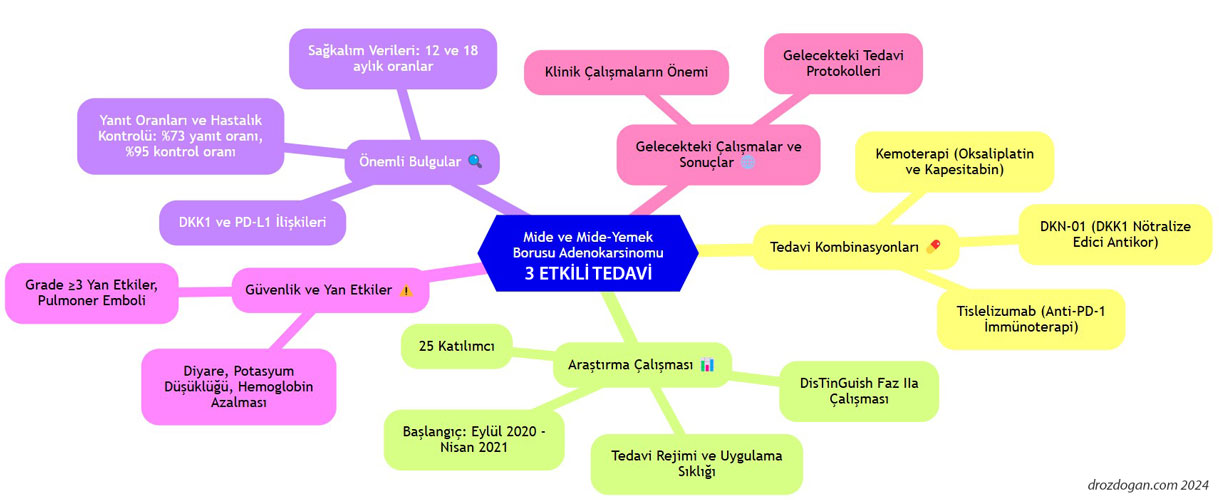
Based in the United States, the multicenter, single-arm phase IIa DisTinGuish clinical trial enrolled 25 patients between September 2020 and April 2021. Participants received the following treatment regimen:
- DKN-01: Administered intravenously at a dose of 300 mg every 2 weeks.
- Tislelizumab: Given at a dose of 200 mg every 3 weeks.
- Oxaliplatin: Administered at a dose of 130 mg/m² every 3 weeks.
- Capecitabine: Given at a dose of 1000 mg/m² twice daily from day 1 through day 15 of each 21-day cycle.
This treatment combination was designed particularly to observe response rates according to PD-L1 status and tumor DKK1 expression.
Key Findings:
-
Response Rates and Disease Control:
Among 22 evaluable patients, the objective response rate was 73% (95% confidence interval [CI] = 49.8%–89.3%). In addition, the disease control rate was 95%, a high rate. These findings indicate treatment activity, particularly in patients with high PD-L1 and DKK1 expression.-
Relationship with DKK1 Expression:
An analysis of tumor DKK1 status in 21 patients found an objective response rate of 90% (95% CI = 55.5%–99.7%) in the 12 patients with high DKK1 and 67% (95% CI = 29.9%–92.5%) in the 9 with low DKK1. These findings suggest that the response rate to DKN-01 may vary according to DKK1 levels. -
Relationship with PD-L1 Expression:
The objective response rate was 86% (95% CI = 57.2%–98.2%) among 16 patients with a PD-L1 combined positive score <5, compared with 67% (95% CI = 22.3%–95.7%) among 6 patients with a score ≥5. This finding suggests that the treatment combination may be effective regardless of PD-L1 expression.
-
-
Survival Data:
Across all patients in the study, median progression-free survival was 11.3 months (95% CI = 5.8–12.0 months). The 12-month progression-free survival rate was 33%. Median overall survival was 19.5 months (95% CI = 15.2–24.4 months), with 12- and 18-month survival rates of 76% and 55%, respectively. These data suggest that the DKN-01 combination could provide a long-term survival advantage in advanced gastric and gastroesophageal junction adenocarcinoma.
Safety Profile and Adverse Effects
Grade ≥3 (severe) adverse events occurred in 60% of patients during treatment. The most common included:
-
Diarrhea: Occurred in 20% of patients.
-
Decreased Potassium Levels: Reported in 16%.
-
Decreased Hemoglobin Levels: Recorded in 12% of patients.
One treatment-related death (due to pulmonary embolism) was reported. The most common adverse effects of any grade associated with DKN-01 included fatigue in 28%, diarrhea in 28%, decreased neutrophil levels in 28%, and nausea in 24%. The manageable nature of the adverse effects indicates that combining DKN-01 with the other agents is acceptable from a safety perspective.
What Lies Ahead?
According to this phase IIa study, combining DKN-01 with tislelizumab and oxaliplatin- and fluoropyrimidine-based chemotherapy offers a safe and effective treatment strategy. Its strong activity regardless of PD-L1 expression suggests that it could benefit a broad patient group. To better understand the combination's clinical effects, researchers eagerly await the results of the ongoing randomized phase II study to see whether they confirm these findings (ClinicalTrials.gov study identifier NCT04363801).
Final Thoughts
DisTinGuish suggests that a new treatment combination could be a safe and promising option for advanced gastric and gastroesophageal junction adenocarcinoma. In this patient group, for whom existing options are inadequate, DKN-01, tislelizumab, and chemotherapy represent an important step toward prolonging survival and achieving disease control. Ongoing studies may provide further data to confirm this activity, and the combination may feature in future treatment protocols.
Sources
DOI:10.1200/JCO.24.00410
Was this article helpful?
Your feedback helps us improve our content.




Reader comments
Share your comment
Your name and comment are published only after administrator approval. Your email address is never shown to visitors.
Be the first to comment.