
Durvalumab's Survival Benefit in Limited-Stage Small Cell Lung Cancer Is Reinforced

In this article
Small cell lung cancer (SCLC) is a faster-progressing, more difficult-to-treat form of lung cancer. Generally associated with smoking, it tends to spread quickly, even early on, because of its aggressive nature. SCLC has two stages: limited stage (LS) and extensive stage (ES). Limited-stage small cell lung cancer (LS-SCLC) is confined to one lung and nearby lymph nodes and is treatable. Treatment generally begins with chemoradiotherapy, after which additional therapy may be needed to prevent recurrence. This is where immunotherapy comes in.
Presented at the ESMO Congress 2024, updated ADRIATIC study data show important benefits from durvalumab immunotherapy as consolidation treatment in patients with limited-stage small cell lung cancer (LS-SCLC). The new findings suggest that durvalumab could become standard treatment for these patients.
The ADRIATIC Study: Improving Survival with Immunotherapy
Interim ADRIATIC results had shown statistically significant improvements in overall survival and progression-free survival (PFS) with durvalumab consolidation compared with placebo. Patients without progression after concurrent chemoradiotherapy received either durvalumab or placebo.
Overall Survival Results:
- Median overall survival was 55.9 months with durvalumab, compared with 33.4 months in the placebo group. This indicates that durvalumab extended survival by approximately 22 months .
- Progression-free survival (PFS) was 16.6 months with durvalumab, compared with 9.2 months in the placebo group.
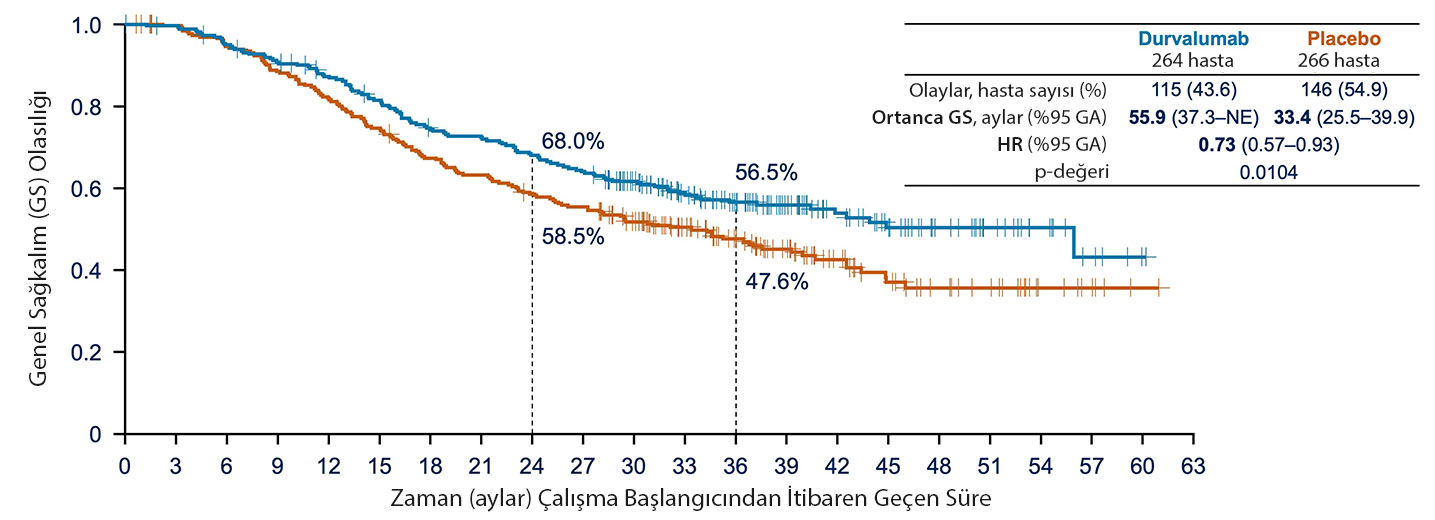
These results are considered a long-awaited milestone in LS-SCLC treatment. Durvalumab is the first new immunotherapy in years to offer an important treatment option for this patient group.
RELATED TOPIC: ADRIATIC Results Presented at ASCO 2024
ADRIATIC Subgroup Analyses: Outcomes by Prophylactic Cranial Irradiation and Radiotherapy Type
Subgroup analyses presented by Prof. Suresh Senan at ESMO 2024 were also notable. They examined outcomes according to variables such as prophylactic cranial irradiation (PCI) and radiotherapy type.
-
Among patients receiving PCI, median overall survival had not yet been reached with durvalumab, compared with 42.5 months with placebo. Without PCI, overall survival was 37.3 months with durvalumab and 24.1 months with placebo. These findings suggest that PCI may positively affect survival.
-
Progression-free survival among patients receiving PCI was 28.2 months with durvalumab and 13.0 months with placebo. Without PCI, it was 9.1 months with durvalumab and 7.4 months with placebo.
These data emphasize that durvalumab is an effective option for LS-SCLC regardless of whether patients receive PCI.
Adverse Effects and Safety Profile
Durvalumab was generally well tolerated, consistent with the known adverse-effect profile of immunotherapy. In subgroup analyses, among patients receiving prophylactic cranial irradiation (PCI) , grade 3-4 treatment-related adverse effects occurred in 28.4% of the durvalumab group and 29.6% of the placebo group. Without PCI, the respective rates were 19.8% and 17.9%.
Adverse effects leading to discontinuation of durvalumab occurred at similar rates in both groups. Dr. Stephen Liu, who presented the study, stated that the effects were generally within the expected range and that this was a safe option for patients receiving treatment after radiation.
Future Treatment Directions
ADRIATIC again highlights the importance of personalized approaches and immunotherapy in LS-SCLC. Dr. Liu emphasized durvalumab's potential for a complete cure in these patients and said the findings would substantially change clinical practice. “These data may make the possibility of a complete cure a reality for more patients with LS-SCLC,” he said, recommending immediate implementation of this approach.
In Summary: What Was Added to ASCO 2024?
At ESMO 2024, ASCO 2024 findings were supplemented with new data, examining in greater detail the benefits of durvalumab for patients with limited-stage small cell lung cancer (LS-SCLC). The interim ADRIATIC results presented at ASCO 2024 had shown significant improvements in overall and progression-free survival with durvalumab consolidation after chemoradiotherapy.
At ESMO 2024, the additional subgroup analyses showed the effectiveness of durvalumab in patients with and without prophylactic cranial irradiation (PCI) . In patients receiving PCI, median survival had not yet been reached with durvalumab, compared with 42.5 months with placebo. Without PCI, survival was 37.3 months with durvalumab and 24.1 months with placebo.
In conclusion, ADRIATIC is an important milestone for the future of immunotherapy in LS-SCLC. Durvalumab significantly extends survival after chemoradiotherapy in this group, and these findings are moving toward establishing a new treatment standard. They also provide important motivation to investigate immunotherapy's potential in other forms of small cell lung cancer.
Sources
Was this article helpful?
Your feedback helps us improve our content.


Reader comments
Share your comment
Your name and comment are published only after administrator approval. Your email address is never shown to visitors.
Be the first to comment.