
Hope for Children with High-Risk Neuroblastoma: CAR T-Cell Therapy and GD2-CART01

In this article
Neuroblastoma is the third most common childhood cancer, an aggressive tumor usually arising from nerve tissue. It most often begins in the adrenal glands or other nerve tissues along the sympathetic nervous system. It generally affects children younger than 5 and accounts for approximately 8-10% of childhood cancers. Depending on tumor size and location, symptoms can include abdominal swelling, loss of appetite and weight, pain, breathing difficulties, neurological problems and anemia. Neuroblastoma is divided into low-, intermediate- and high-risk categories. Advanced strategies such as immunotherapy and targeted treatment have recently offered new hope.
CAR (chimeric antigen receptor) T-cell therapy is an advanced cancer immunotherapy. A patient's own T cells are collected and genetically engineered to express a special receptor (CAR) against cancer cells. The modified cells are then returned to the patient to target and destroy cancer cells.
CAR T-cell therapy has shown promising results, particularly in blood cancers such as acute lymphoblastic leukemia and diffuse large B-cell lymphoma. It is also being studied in other cancers.
However, the treatment has potential adverse effects and has not yet been approved for solid cancers arising from tissues or organs. Risks include cytokine release syndrome (CRS) and neurological complications. Researchers are developing strategies to increase effectiveness while reducing adverse effects.
New Hope for Neuroblastoma Treatment
Research published on April 6, 2023 in NEJM suggests that CAR T-cell therapy could be an option for solid tumors such as neuroblastoma. Children with high-risk neuroblastoma received GD2-CART01, a special CAR T-cell therapy targeting GD2. The study represents an important step toward a new treatment option.
What Is GD2, and Why Was GD2 Selected for Neuroblastoma?
GD2 is a ganglioside known as a disialoganglioside. Gangliosides are complex cell-surface molecules important in interactions between cells. GD2 naturally occurs particularly in nerve tissue and peripheral nervous system cells.
GD2 was selected as a neuroblastoma target for several reasons:
-
High GD2 Expression: Neuroblastoma cells express high levels of GD2 on their surface. This makes GD2 a cancer-cell-specific target, increasing the selectivity of immunotherapies.
-
Immunogenic Properties of GD2: GD2 is immunogenic, meaning it can be recognized by the immune system and targeted. This enhances immune-cell activity against cancer cells and makes GD2 a suitable target for neuroblastoma treatment.
-
Low Expression in Healthy Tissues: GD2 is expressed at low levels in healthy tissues and cells, reducing the risk that GD2-targeted immunotherapies will harm healthy tissue.
-
Effectiveness Supported by Clinical Data: Previous studies have shown that GD2-targeting immunotherapies can be effective, particularly in neuroblastoma. These findings suggest that GD2 is a potential target for treating the disease.
For these reasons, GD2 was selected as a target for CAR T-cell therapy in neuroblastoma. GD2-targeted CAR T cells aim to enable effective immunotherapies by recognizing and destroying cancer cells.
Study Results
In the phase 1-2 trial, 27 children received GD2-CART01. Three dose levels were tested during phase 1, with no dose-limiting toxic effects. The recommended phase 2 dose was 10 million CAR T cells per kilogram. CRS occurred in 74% of patients but was mild in 95% of those affected. In only one patient, activating a special gene, a suicide gene, allowed rapid elimination of GD2-CART01.
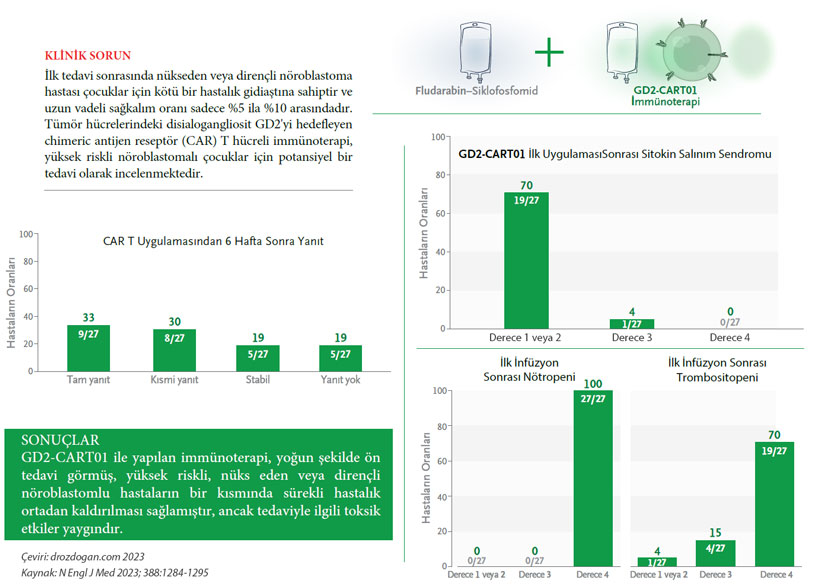
The response rate was 63%, with 9 complete and 8 partial responses. Among patients receiving the recommended dose, 3-year overall survival and disease-free survival were estimated at 60% and 36%, respectively.
Note: A suicide gene is a genetic construct designed as a safety measure in gene therapy to allow controlled cell destruction. Such genes are generally used in gene-edited treatments and immunotherapies, particularly CAR T-cell therapies, to prevent unwanted cell activation or proliferation and manage potential toxicity. One system, "inducible caspase-9" (iCasp9), activates a molecule capable of triggering cell death. In this system, the caspase-9 enzyme introduced into the cell is activated by a specific drug, causing programmed cell death, or apoptosis. Suicide genes help prevent complications from toxic CAR T-cell effects. If severe CRS or off-target effects occur, the system enables rapid, controlled elimination of CAR T cells, supporting patient safety and overall treatment success.
In conclusion, GD2-CART01 was feasible and safe in high-risk neuroblastoma. Treatment-related toxic effects occurred, but suicide-gene activation controlled adverse effects. GD2-CART01 may have sustained antitumor activity. The study is an important step in exploring CAR T-cell therapy for solid tumors.
*
Why Has CAR T-Cell Therapy Not Yet Achieved Major Success in Solid Cancers?
Several factors have limited success in solid cancers:
- Target Selection: Success depends on selecting target molecules specific to cancer cells. Blood cancers have specific, widely expressed targets such as CD19. In solid tumors, targets are generally less specific and more heterogeneous, making selective targeting more difficult.
- Tumor microenvironment: Solid tumors have a complex structure involving cancer cells, immune cells and other cell types. The microenvironment can contain immunosuppressive factors that limit treatment success by reducing CAR T-cell infiltration and activity.
- Tumor Penetration: Successful immunotherapy requires CAR T cells to reach cancer cells within solid tumors. Physical barriers and the extracellular matrix, however, can hinder entry into tumor tissue.
- CAR T-Cell Persistence: CAR T-cell persistence and sustained antitumor activity are limited in solid tumors. The microenvironment can suppress T-cell activation and proliferation, reducing effectiveness.
- Off-Target Effects and Toxicity: Targets used for CAR T cells in solid tumors may also be expressed at low levels in healthy tissue, potentially causing unwanted immune reactions and serious toxicity.
Researchers are developing strategies to overcome these challenges, including selecting more specific and effective targets, combining immunotherapies to modify the microenvironment, and using genetic engineering to improve CAR T-cell infiltration and persistence.
Sources
Was this article helpful?
Your feedback helps us improve our content.


Reader comments
Share your comment
Your name and comment are published only after administrator approval. Your email address is never shown to visitors.
Be the first to comment.