
Immunotherapy and targeted therapy studies offer hope for malignant mesothelioma

In this article
What is the cancer called Malignant Mesothelioma, and in which organ does it occur?
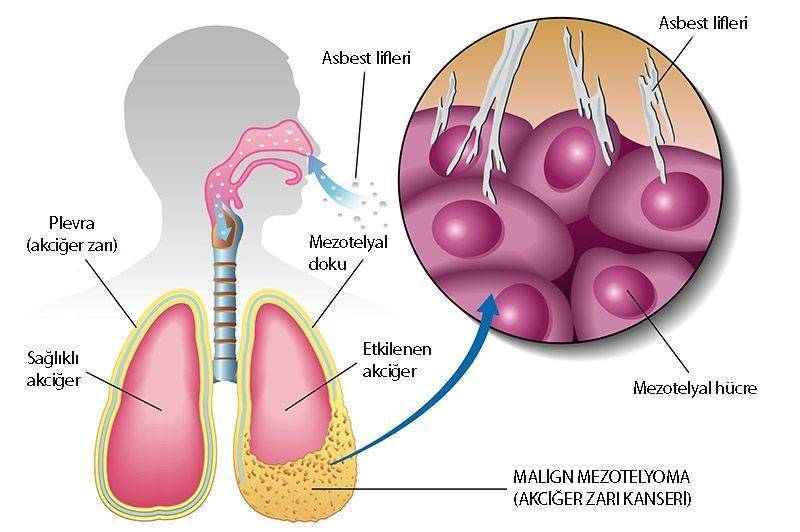
Our lungs are covered by a two-part membrane called the pleura, which acts as a protective cushion. Its inner layer, attached directly to the lung, is called the visceral pleura, and its outer layer the parietal pleura. The pleura consists of mesothelium and supporting tissues. A small amount of fluid lies between the visceral and parietal pleura, produced by mesothelial cells. Tissues similar to the lung’s pleural membrane occur elsewhere in the body: the peritoneum around the abdomen and the pericardium around the heart. Malignant mesothelioma is the name of cancer arising from these membranes. Malignant Mesothelioma originates in the pleural membrane in %80 of patients.
What causes Malignant Mesothelioma?
The most important cause is asbestos exposure. More rarely, genetic causes and a virus called Simian 40 cause it.
Asbestos is the common name for a group of naturally occurring fibrous minerals. It occurs naturally in the earth’s soil cover. This soil was widely used in rural areas for its heat- and waterproofing properties. It was also the most widely used industrial intermediate material of the twentieth century. It enters the body through inhalation. Following case series reported in the 1970s, the relationship between asbestos and Malignant Mesothelioma was established and its industrial use abandoned.
Malignant Mesothelioma is rare and more common in men in countries with occupational asbestos exposure; with environmental exposure, as in our country, rates are equal in women and men. Occupationally related disease occurs after the 50s. The interval between asbestos exposure and Malignant Mesothelioma is around 20-40 years. Because the disease develops through prolonged change, it is usually advanced and inoperable when symptoms appear. It may present with increased fluid between lung membranes (pleural effusion), membrane thickening and respiratory complaints, or be found incidentally on a chest image taken for another purpose. Diagnosis usually follows symptom onset, creating a strong tendency toward delayed diagnosis.
If Malignant Mesothelioma is not detected early and has passed the point of surgery, treatment aims to control disease and prolong life rather than eliminate it entirely. Looking back over the last 30 years, only two new chemotherapy drugs have been added to conventional chemotherapy for advanced Malignant Mesothelioma: Gemcitabine before the 2000s and Pemetrexed after the 2000s. Today these two newer drugs are combined with the conventional chemotherapy drug widely used in many cancers, Cisplatin .
Recently, adding the targeted drug Bevacizumab to the chemotherapy drugs described above was shown to contribute to treatment success in Malignant Mesothelioma, but results did not sufficiently satisfy the scientific community. With the search continuing, two promising studies were presented at the ASCO 2017 oncology congress.
Immunotherapy in mesothelioma treatment
New-generation immunotherapy drugs remove the blindness of our defense cells (T cells) to cancer, activating the immune system against cancer cells. Immunotherapy drugs have now demonstrated efficacy in many cancers and entered clinical practice.
What did results from Malignant Mesothelioma studies at ASCO 2017 teach us?
First study
This research involved advanced Malignant Mesothelioma patients previously treated with chemotherapy, for whom treatment success had greatly diminished. It compared the efficacy of two drugs activating the immune system by different routes, alone and together. The phase II study enrolled 125 previously chemotherapy-treated patients. Some received only the immunotherapy Nivolumab , while the other group received Nivolumab and Ipilimumab as a two-drug immunotherapy combination.
The disease control rate in Malignant Mesothelioma (the proportion responding or having stable disease) with Nivolumab (Opdivo) was % 44; with Nivolumab together with Ipilimumab (Yervoy), it was % 50. Meaningful tumor shrinkage was %10 more frequent in the combination group. Median overall survival with Nivolumab was 10 months; it could not be calculated in the combination group because patients were still living. These data greatly encouraged us for advanced, multiply treated Malignant Mesothelioma patients whose management is extremely difficult.
Serious side effects were more frequent with combined ipilimumab and nivolumab in Malignant Mesothelioma, but could be controlled.
Because of these drugs’ effective results, ongoing studies are evaluating their use in newly diagnosed Malignant Mesothelioma patients, and we await their efficacy results with great excitement. We will continue following these studies for you.
Second study
Nintedanib was evaluated in a phase II study asking whether adding it to chemotherapy for advanced Malignant Mesothelioma provides benefit.
Nintedanib is a targeted drug that works by disrupting vessels feeding the tumor. The study enrolled 87 newly diagnosed, untreated advanced Malignant Mesothelioma patients. Nintedanib was added to the well-known and frequently used two-drug chemotherapy Pemetrexed and Cisplatin . Patients receiving added Nintedanib achieved 10 months of disease control. It also contributed more than 5 additional months of overall survival compared with chemotherapy alone. The most common side effects with Nintedanib were infection and reduced blood cell counts (neutropenia), but they did not lead to treatment discontinuation.
We believe this study will establish a new treatment target in previously untreated, inoperable Malignant Mesothelioma. With these promising findings, we will follow the ongoing phase III study results for you.
What the world says about these studies
Anne Tsao, a medical oncologist at MD Andersen Cancer Center in Houston, said at ASCO 2017: “Immune checkpoint inhibitors (immunotherapies) will probably change our routine treatment approach to pleural Malignant Mesothelioma and may be used together with drugs that inhibit blood vessel formation.”
In brief, a new treatment option is being welcomed for Malignant Mesothelioma, universally known as difficult to treat, with currently only one approved first-line treatment and almost no treatment options when it recurs or progresses.
According to Dr. John Heymach, another medical oncologist at MD Anderson, “Having only one option limited in response duration and benefit for Malignant Mesothelioma patients was truly frustrating.” He added that the study results provided a clearer path to new treatment options. “These results may be sufficient to support immunotherapy use in Malignant Mesothelioma. However, it is too early to say whether Nivolumab alone or combined with Ipilimumab is better.”
Dr. Hongbin Chen of Roswell Park Cancer Institute in New York said, “The immunotherapy study in Malignant Mesothelioma and its results are promising, and I think they will lay the groundwork for new studies.”
As the Oncotrust team, we find both studies’ results highly promising. Remember that the studies presented at ASCO 2017 are still abstract data. We should await full publications and observe whether the FDA approves these drugs for use.
Sources
Second- or third-line nivolumab (Nivo) versus nivo plus ipilimumab (Ipi) in malignant pleural mesothelioma (MPM) patients: Results of the IFCT-1501 MAPS2 randomized phase II trial.
J Clin Oncol 35, 2017 (suppl; abstr LBA8507)
2. Anna K. Nowak, Federica Grosso, Nicola Steele, et al.
Mature overall survival (OS) results from the LUME-Meso study of nintedanib (N) + pemetrexed/cisplatin (PEM/CIS) vs placebo (P) + PEM/CIS in chemo-naïve patients (pts) with malignant pleural mesothelioma (MPM).
J Clin Oncol 35, 2017 (suppl; abstr 8506)
Was this article helpful?
Your feedback helps us improve our content.


Reader comments
Share your comment
Your name and comment are published only after administrator approval. Your email address is never shown to visitors.
Be the first to comment.