
Immunotherapy Found Effective in High-Risk Locally Advanced Cervical Cancer

In this article
Cervical cancer is an important cancer affecting women worldwide. Although it can be treated when detected early, there remains a major need to develop effective treatments for advanced disease. New treatment strategies may prolong patients' lives and improve their quality of life. The KEYNOTE-A18 study has the potential to fill this gap and reveal promising new approaches to cervical cancer treatment.
Findings of the KEYNOTE-A18 Study
Data presented at the ESMO Congress 2023 show for the first time that immune checkpoint inhibitor immunotherapies may improve outcomes in high-risk, locally advanced cervical cancer.
Below, the study design can be seen:
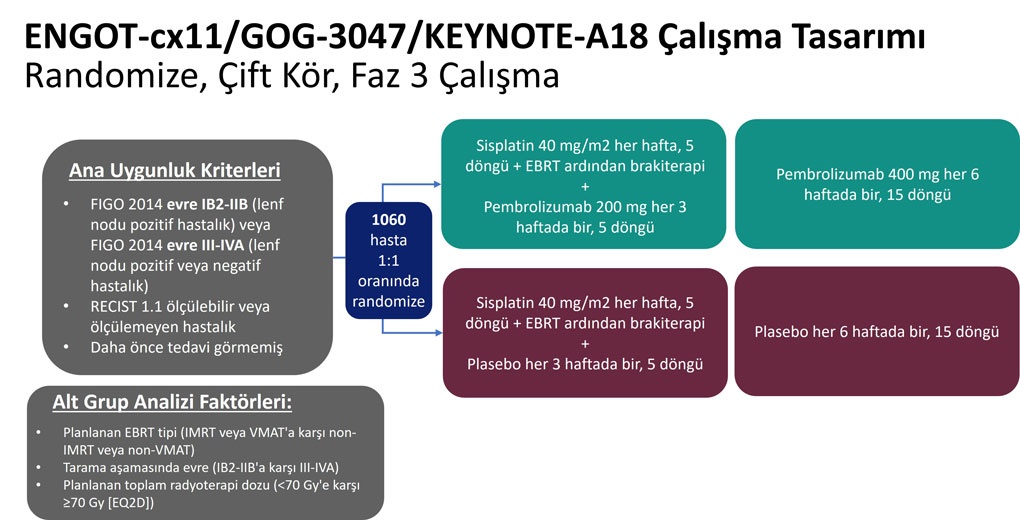
In the KEYNOTE-A18 trial, patients receiving the combination of pembrolizumab and concurrent chemoradiotherapy (CRT) had a risk of cancer progression that, compared with patients receiving placebo and CRT, was 30% lower (HR 0.70; 95% CI 0.55–0.89; p=0.0020).
Significant Improvement in Progression-Free Survival
Although overall survival data are currently immature, a favourable trend was reported in the pembrolizumab arm (HR 0.73; 95% CI 0.49–1.07). The combination of pembrolizumab and CRT also showed a manageable safety profile.

In locally advanced cervical cancer, this is, since 1999, our first positive study and represents a new opening for the use of immunotherapies in this disease.
Future Hopes and Strategies
In conclusion, the critical importance of immunotherapies in cervical cancer treatment has been established. We see that they are effective as both first- and second-line treatments in metastatic, recurrent or treatment-resistant cervical cancer, and that they work effectively with chemotherapy and radiotherapy in locally advanced disease. We urgently need new treatment options for patients whose cancer cannot be controlled with standard treatments. Antibody–drug conjugates targeting specific cell-surface molecules on cervical cancer cells, such as tissue factor or HER2, are emerging as promising new strategies.
Sources
Was this article helpful?
Your feedback helps us improve our content.


Reader comments
Share your comment
Your name and comment are published only after administrator approval. Your email address is never shown to visitors.
Be the first to comment.