
Liposomal Doxorubicin and Bevacizumab Treatment Protocol (Ovarian Cancer)

In this article
The Caelyx (liposomal doxorubicin) and Altuzan (bevacizumab) combination protocol is used in ovarian cancer, particularly platinum-resistant or platinum-sensitive recurrent disease.
Caelyx (pegylated liposomal doxorubicin) and Altuzan (bevacizumab) work through different but complementary mechanisms in ovarian cancer treatment.
Caelyx
Caelyx is a cytotoxic chemotherapy drug. Doxorubicin intercalates into DNA strands and inhibits topoisomerase II, disrupting DNA replication and RNA synthesis. This effect becomes prominent during proliferative phases of the cell cycle and initiates apoptosis (programmed cell death) in tumor cells. The pegylated liposomal formulation prolongs circulation, increases selective penetration into tumor tissue, and reduces healthy tissue exposure, lowering conventional doxorubicin side effects such as cardiotoxicity.
Altuzan
Altuzan is a targeted monoclonal antibody. It binds vascular endothelial growth factor-A (VEGF-A), preventing it from attaching to VEGF receptors on endothelial cells. This suppresses formation of new tumor blood vessels (angiogenesis). Inhibiting vessel formation limits the tumor's nutrient and oxygen supply and helps normalize its abnormal, permeable vessels, allowing chemotherapy drugs to reach the tumor more evenly and effectively.
In this combination, Caelyx directly kills tumor cells through DNA damage, while Altuzan targets the tumor's vascular network, cutting off its nourishment and facilitating effective chemotherapy delivery. Cell killing and inhibition of blood vessel growth thus combine synergistically, increasing treatment efficacy.
Treatment Goals
- Directly eliminate tumor cells: Caelyx triggers cell death in rapidly proliferating tumor cells through DNA damage and topoisomerase II inhibition.
- Prevent tumor nourishment and growth: Altuzan blocks VEGF-A, stopping new blood vessel formation and reducing the tumor's oxygen and nutrient supply.
- Improve chemotherapy delivery to the tumor: Altuzan's vascular normalization allows Caelyx to enter tumor tissue more evenly and effectively.
- Delay disease progression: The synergistic effect slows tumor growth and extends progression-free survival.
- Offer an additional option for platinum-resistant patients: An effective alternative, particularly for patients who do not respond to platinum-based treatment or relapse quickly.
Treatment Indications
- Caelyx (pegylated liposomal doxorubicin) and Altuzan (bevacizumab) combination treatment is indicated particularly in ovarian, fallopian tube, and primary peritoneal cancers resistant to or less sensitive to platinum-based chemotherapy.
- Platinum resistance is defined as disease progression or recurrence within six months of the last platinum-based treatment.
- The combination was approved after randomized clinical trials in Europe and the US (such as AURELIA) showed improved progression-free survival and objective response rates in platinum-resistant patients.
- It has also entered clinical practice for platinum-sensitive patients with multiple relapses and limited alternatives. It is suitable for previously treated patients whose general condition permits treatment, who have no bevacizumab contraindication, and whose organ function is adequate.
When Treatment Is Unsuitable
- Hypersensitivity to bevacizumab or doxorubicin: Patients with a history of serious allergic reactions to either active ingredient or its excipients.
- Serious cardiac disease: Because of Caelyx's cumulative cardiotoxicity risk, patients with advanced heart failure, serious arrhythmia, recent myocardial infarction, or marked left ventricular dysfunction.
- Active or high-risk bleeding disorders: Because bevacizumab increases bleeding risk, it is not used with active gastrointestinal bleeding, hemoptysis, or a history of intracranial bleeding.
- Recent major surgery or wound-healing problems: Because bevacizumab delays wound healing, it is generally not started within at least 28 days after major surgery; it is not used with open wounds, fistulas, or serious infection.
- History of gastrointestinal perforation or fistula: Contraindicated because bevacizumab increases perforation risk.
- Uncontrolled hypertension: Because bevacizumab may cause hypertension, treatment should not start unless blood pressure is controlled.
- Severe bone marrow suppression: Because Caelyx causes myelosuppression, treatment should not begin with significant neutropenia, thrombocytopenia, or anemia until blood counts recover.
- Advanced kidney or liver failure: Altered pharmacokinetics of both drugs may increase toxicity risk; particular caution is needed with elevated bilirubin or markedly increased creatinine.
- Pregnancy and breastfeeding: Both Caelyx and bevacizumab carry fetal toxicity risks; they are contraindicated in pregnancy and should not be used while breastfeeding.
SGK Reimbursement Status
Caelyx is included in the SGK reimbursement system and covered directly for eligible patients.
Altuzan has restricted SGK coverage, and use for ovarian cancer often falls outside the list. With off-label authorization, reimbursement can be made mandatory only through legal action and a court decision.
Dose Range
Altuzan (Bevacizumab)
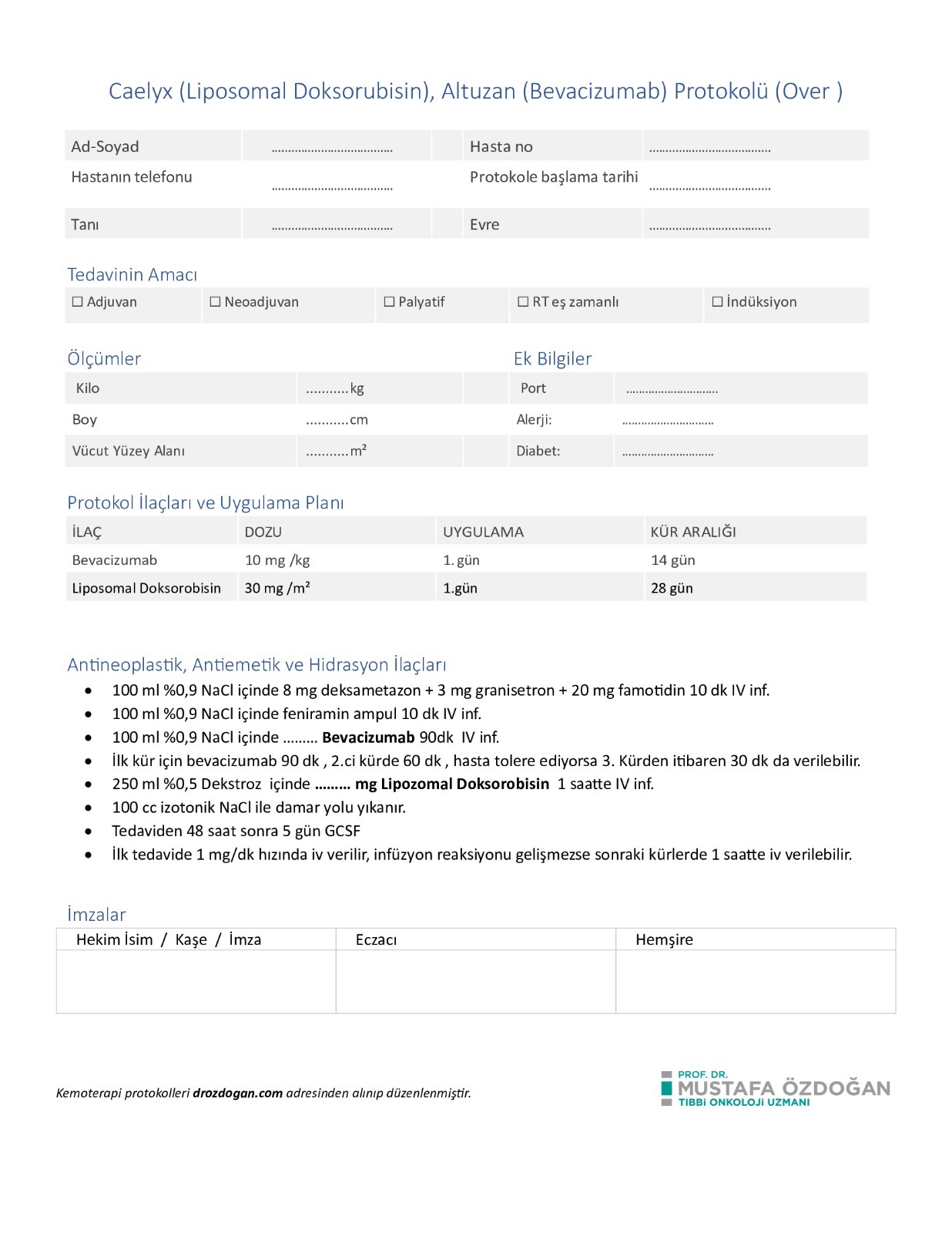
- Dose: 10 mg/kg intravenous infusion.
- Frequency: Every 14 days.
- Infusion duration: The first infusion is given over 90 minutes. If well tolerated, subsequent infusions may be shortened to 60 minutes, then 30 minutes.
- Premedication: Generally unnecessary; check blood pressure before administration because of hypertension risk.
Caelyx (Pegylated Liposomal Doxorubicin)
- Dose: 30 mg/m² intravenous infusion.
- Frequency: Every 28 days (may be given on the same day as Altuzan).
- Infusion duration: Usually over 60 minutes. Start the first infusion slowly and monitor closely for infusion reactions.
- Premedication: An antihistamine (e.g., diphenhydramine), antiemetic (e.g., ondansetron), and low-dose corticosteroid if necessary may be given.
Special Notes:
- Monitor for severe hypertension, bleeding, proteinuria, and infusion reactions during or after Altuzan.
- During Caelyx, closely monitor for hand–foot syndrome, mucositis, and myelosuppression.
- Both drugs may be given through central or peripheral IV access, but Caelyx is an irritant, so extravasation must be prevented.
Situations Requiring Caution
Cardiac Monitoring (Related to Caelyx)
- Doxorubicin carries cumulative cardiotoxicity risk.
- Measure left ventricular ejection fraction (LVEF) by echocardiography before and during treatment.
- Use caution with prior anthracycline exposure or a history of cardiac disease.
Hypertension Control (Related to Altuzan)
- Bevacizumab may cause hypertension.
- Control blood pressure before treatment.
- Severe hypertension may require treatment interruption or discontinuation.
Proteinuria and Kidney Function
- Altuzan may cause proteinuria.
- Screen for proteinuria with urinalysis before and during treatment.
- Treatment may be interrupted for severe proteinuria.
Bleeding and Thromboembolism Risk
- Bevacizumab increases bleeding tendency; do not use in patients with active bleeding or high risk.
- Monitor patients at risk of DVT, pulmonary embolism, or arterial thromboembolism.
Gastrointestinal Perforation Risk
- Rare but serious gastrointestinal perforation may occur with bevacizumab.
- Stop treatment immediately for signs such as peritonitis or severe abdominal pain.
Wound Healing and Surgical Planning
- Bevacizumab delays wound healing.
- Stop treatment at least 28 days before major surgery and do not restart until healing is complete.
Myelosuppression and Infection Risk (Related to Caelyx)
- There is a risk of neutropenia, thrombocytopenia, and anemia.
- Perform a complete blood count before treatment and before every cycle.
- For severe or febrile neutropenia, delay treatment and provide supportive care.
Hand–Foot Syndrome and Mucositis
- Caelyx may cause palmar–plantar erythrodysesthesia.
- Redness, pain, or peeling of the hands/feet requires topical support and dose reduction if needed.
Liver Function
- Caelyx is metabolized in the liver.
- Adjust the dose for markedly elevated bilirubin or transaminases.
Pregnancy and Breastfeeding
- Both drugs carry fetal toxicity risks.
- Do not use during pregnancy; use appropriate contraception during and after treatment.
- Do not use during breastfeeding.
Side Effects
- Fatigue
- Nausea
- Vomiting
- Reduced appetite
- Hand–foot syndrome (palmar–plantar erythrodysesthesia)
- Mucositis / Mouth sores
- Rash, dry skin, or itching
- Hair thinning or loss
- Anemia (reduced red blood cells)
- Neutropenia (reduced white blood cells)
- Thrombocytopenia (reduced platelets)
- Infection
- Hypertension
- Proteinuria (protein in the urine)
- Bleeding (such as nosebleeds or bleeding gums)
- Constipation or diarrhea
- Abdominal pain
- Joint or muscle pain
- Dry mouth
- Taste changes
- Tingling or numbness in the hands and feet (peripheral neuropathy)
- Serious allergic / Infusion reactions
- Cardiac dysfunction (particularly with cumulative doses)
- Thromboembolism (deep vein thrombosis, pulmonary embolism)
- Gastrointestinal perforation (rare)
- Delayed wound healing
Was this article helpful?
Your feedback helps us improve our content.


Reader comments
Share your comment
Your name and comment are published only after administrator approval. Your email address is never shown to visitors.
Be the first to comment.