
Of Every 8 Women, One Does NOT Have Breast Cancer!

In this article
In health and medicine, different types of risk exist. Knowing the basic risk types may help you understand your likelihood of breast cancer and adopt risk-reducing behaviors.
We prepared this article after witnessing posts made under the name of "awareness campaigns" that cause women excessive fear about breast cancer risk.
Absolute risk
The most basic medical risk type is absolute risk. It is a person’s chance of developing a particular disease within a given period.
Absolute risk is calculated as follows:
- Look at a large group of people similar in some way (for example, age), and
- Count how many develop a particular disease within a given period
Knowing a disease’s absolute risk can help you understand health risks in your life.
An example of 1-year absolute risk:
If we follow women aged 30-34, numbering 100.000, for one year, approximately 29 develop breast cancer.
Therefore, for a woman aged 30-34, the 1-year absolute breast cancer risk is, among 100.000 women, 29 (or among every 3448 women, 1). This risk is less than 1 percent.
This means that over the next 1 year, for a woman aged 30-34, the chance of breast cancer is less than 1 percent.
This example shows that a young woman’s 1-year absolute breast cancer risk is low.
Examples of 10-year absolute risk:
This expresses absolute risk over a longer period.
The table below shows 10-year breast cancer risk by age. Absolute risk is low in younger women and higher in older women.

Lifetime risk
One absolute risk you may encounter is lifetime breast cancer risk. For US women, this is, among every 8, 1 (or approximately 13 percent).
This means that among every 8 women in the USA, 1 will be diagnosed with breast cancer at some point in her lifetime.
Lifetime breast cancer risk is calculated by statistically summing a woman’s 1-year absolute risks throughout life. It is therefore much higher than 1- or 10-year absolute risks.
Lifetime breast cancer risk may vary by race / ethnicity.
Breast Cancer Risk Factors
Anything affecting a person’s risk of disease by increasing or decreasing it is called a risk factor .
A risk factor may relate to:
- Lifestyle (such as exercise)
- Reproduction (such as age at first period)
- Heredity (such as family history)
- Environment (such as radiation exposure)
Some factors increase risk. For example, older women have greater breast cancer risk than younger women. Therefore, age is a breast cancer risk factor.
Some factors reduce risk. For example, women who breastfeed have lower breast cancer risk than women who have never had children. Therefore, breastfeeding is also a breast cancer risk factor.
Relative risk
Relative risk shows how much higher or lower risk is—or whether there is no difference—for people with a particular risk factor compared with those without it.
Relative risk compares 2 absolute risks.
- The numerator (the top number) is the absolute risk among people with the risk factor.
- The denominator (the bottom number) is the absolute risk among people without it.
Dividing the absolute risk in those with the factor by the absolute risk in those without it gives relative risk.

Example of relative risk:
Suppose a study shows that women who do not exercise (inactive women) have a 25 percent greater breast cancer risk than women who exercise (active women).
This statistic is a relative risk (1.25). It means physically inactive women are 25 percent more likely to develop breast cancer than women who exercise.
Understanding Relative Risk
The effect of relative risk depends on the disease’s underlying absolute risk.
When a disease is rare (such as breast cancer in young women), even a relatively high risk causes only a few additional cases among people with the risk factor.
When a disease is more common (such as breast cancer in older women), even a small relative risk can produce many more cases among those with the factor.
For clarity, consider a monetary example:
If you have a single lira, this makes your lira "rare" . Doubling your money earns just 1 additional lira.
But if you have 1 million lira, your money is "common," and doubling it earns 1 million additional lira.
In both cases you double your money, but the increase in lira differs greatly.
The same applies to disease risk. The higher the risk of developing a disease—that is, the more common it is—the more additional cases occur for a given relative risk.
Example of the Effect of Relative Risk:
Using the exercise study above, we can show how absolute risks affect additional case numbers.
Inactive women have a 25 percent greater breast cancer risk than active women (relative risk 1.25).
Because older women are more likely to develop breast cancer, lack of exercise has a greater effect on their risk than in younger women.
First, consider a study of women aged 70-74.
Over 1 year, the study finds that among 100.000 inactive women, 500 develop breast cancer. This is the absolute risk for women with the risk factor, lack of exercise.
Among 100.000 active women, 400 develop breast cancer. This is the absolute risk for women without the risk factor.
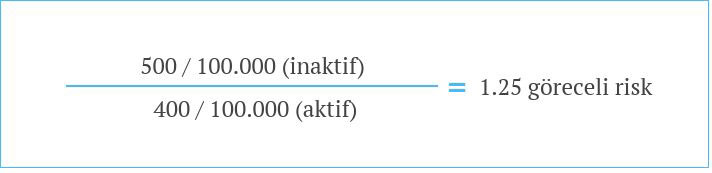
The relative risk for inactive compared with active women is therefore 1,25.
Among women aged 70-74, inactivity caused, for every 100.000 women over one year, 100 additional breast cancer cases (500 cases - 400 cases = 100 cases).
Now consider women aged 20-29 in the study.
Over one year, among 100.000 inactive women the study finds 5 breast cancers. Among 100.000 active women, 4 have breast cancer.

Here, relative risk is also 1.25.
However, among women aged 20-29, inactivity led to only, per 100.000 women, 1 additional breast cancer case (5 cases - 4 cases = 1 case).
Thus, the same relative risk of 1.25 produced more additional breast cancer cases in older women (100 extra) than younger women (1 extra).
The effect of the same relative risk (1.25) differed according to the underlying absolute risk.
Reading Relative Risks
Relative risks can be presented in many ways. The following examples may help you understand one when you see or hear it.
Relative risks greater than 1:
A relative risk between 1 and 1,99 may be presented in various ways. In the exercise study above, for example, it was 1.25.
The following 3 sentences mean the same thing:
- "Inactive women have a relative risk of 1.25 compared with active women."
- "Inactive women have a 25 percent higher breast cancer risk than active women."
- "Inactive women have 1,25 times the breast cancer risk of active women."
When relative risk is 2 or more, it is usually presented as the number of times risk increases.
For example, women with atypical hyperplasia (a benign breast condition) have a relative risk of approximately 4 compared with women without it.
The following 2 sentences mean the same thing:
- "Women with atypical hyperplasia have 4 times the breast cancer risk of women without it."
- "Among women with atypical hyperplasia, breast cancer risk increases 4-fold compared with women without it."
Cases Where Relative Risk Is Less Than 1:
A relative risk below 1 means the risk factor reduces disease risk.
For example, women who breastfeed for 1 year have a relative breast cancer risk of approximately 0,94 compared with women who do not.
- "Women who breastfeed have a 6 percent lower breast cancer risk than women who do not."
Conclusion
As we have tried to explain above, "Of Every 8 Women, One Has Breast Cancer!" is incorrect. If it were true, more than 3 million women in Turkey alone would currently have breast cancer. Yet annual new cases in our country number approximately 20 thousand. The correct statement is: "Of Every 8 Women, One Is at Risk of Developing Breast Cancer at Some Point in Her Life." That is the proper expression.
Healthy Lifestyle Choices Are Beneficial Whatever Your Risk.
Understanding absolute and relative risk helps you make informed health choices. Whatever your breast cancer risk, you can choose a healthy lifestyle through exercise, avoiding obesity and excess weight, not smoking or drinking alcohol, eating healthily, and undergoing age-appropriate cancer screening as part of that choice.
RELATED TOPIC:
Sources
ww5.komen.org - Updated 05/13/19
Was this article helpful?
Your feedback helps us improve our content.




Reader comments
Share your comment
Your name and comment are published only after administrator approval. Your email address is never shown to visitors.
Be the first to comment.