
Osimertinib Plus Chemotherapy Receives FDA Approval for EGFR-Mutated Lung Cancer

In this article
On 16 February 2024, the United States Food and Drug Administration (FDA) approved first-line treatment for patients with locally advanced or metastatic non-small cell lung cancer (NSCLC) whose tumors harbor EGFR exon 19 deletions or exon 21 L858R mutations detected by an FDA-approved test. The treatment combines osimertinib (Tagrisso, AstraZeneca) with platinum-based chemotherapy.
Lung cancer is a complex, multifaceted disease affecting millions worldwide each year and becoming an increasingly important health problem. Alongside breast cancer, it is among the most common cancers and presents a global challenge with 2 million new cases. Rather than a single disease, lung cancer comprises numerous subtypes marked by genetic diversity and biological complexity. This diversity increases the importance of individualized diagnosis and treatment, requiring strategies tailored to each patient.
Non-small cell lung cancers (NSCLC) account for most lung cancers. Detailed classification based on genetic profiling has made treatment increasingly targeted. Subgroups with EGFR mutations are particularly important in developing treatment strategies. These mutations have yielded promising results in patients sensitive to tyrosine kinase inhibitors (TKIs). However, drug resistance developing over time requires continual reassessment of treatments and individualized treatment plans.
FDA Approval Based on FLAURA 2
Efficacy was evaluated in FLAURA 2, an open-label, randomized study of 557 patients with EGFR exon 19 deletion- or exon 21 L858R mutation-positive NSCLC who had not previously received systemic therapy for advanced disease. Patients were randomized 1:1 to receive osimertinib with platinum-based chemotherapy or osimertinib alone.
The primary efficacy outcome was investigator-assessed progression-free survival (PFS) , and the main secondary outcome was overall survival (OS).
- Osimertinib combined with platinum-based chemotherapy significantly increased the time patients remained disease-free (PFS) compared with osimertinib alone. It reduced the risk of disease progression or death by 38 percent , reflected in a hazard ratio of 0.62. The 95% confidence interval ranged from 0.49 to 0.79, and the p-value was less than 0.0001, indicating strong statistical significance.
- The median time patients remained disease-free with the combination of platinum-based chemotherapy and osimertinib was 25.5 months, compared with 16.7 months with osimertinib alone. This shows that the combination delayed disease progression for longer than osimertinib monotherapy.
The PFS of 25.5 months is the best reported to date for advanced lung cancer.
At the current analysis, overall survival results were not yet fully assessable because only 45% of the deaths expected for the final analysis had occurred.
The most common adverse effects (in more than 20%) among patients receiving osimertinib with platinum-based chemotherapy were leukopenia, thrombocytopenia, neutropenia, lymphopenia, rash, diarrhea, stomatitis, nail toxicity, dry skin, and increased blood creatinine.
The recommended osimertinib dose is 80 mg orally once daily, with or without food, until disease progression or unacceptable toxicity. It may be used with pemetrexed and cisplatin or carboplatin regimens.
*
Comparing Osimertinib + Chemotherapy (FLAURA 2) With Amivantanab + Lezertinib (MARIPOSA)
FLAURA 2 and MARIPOSA currently offer the two most effective first-line treatment options for patients with advanced EGFR-mutated NSCLC. Both evaluate the effectiveness and safety of new combinations in this population, but compare different regimens and outcomes. Amivantanab + Lezertinib has not yet received FDA approval.
Related topic: Advances in EGFR-Positive Lung Cancer Treatment – 2023
MARIPOSA Study Summary:
MARIPOSA compared amivantamab plus lazertinib with osimertinib monotherapy in previously untreated patients with advanced EGFR-mutated NSCLC. The combination of amivantamab (an EGFR and MET receptor tyrosine kinase inhibitor) and lazertinib (a tyrosine kinase inhibitor specifically targeting EGFR mutations) significantly improved PFS compared with osimertinib alone. Median PFS was 23.7 months with amivantamab and lazertinib versus 16.6 months with osimertinib. These results highlight the combination's potential as a new option for patients with EGFR-mutated NSCLC.
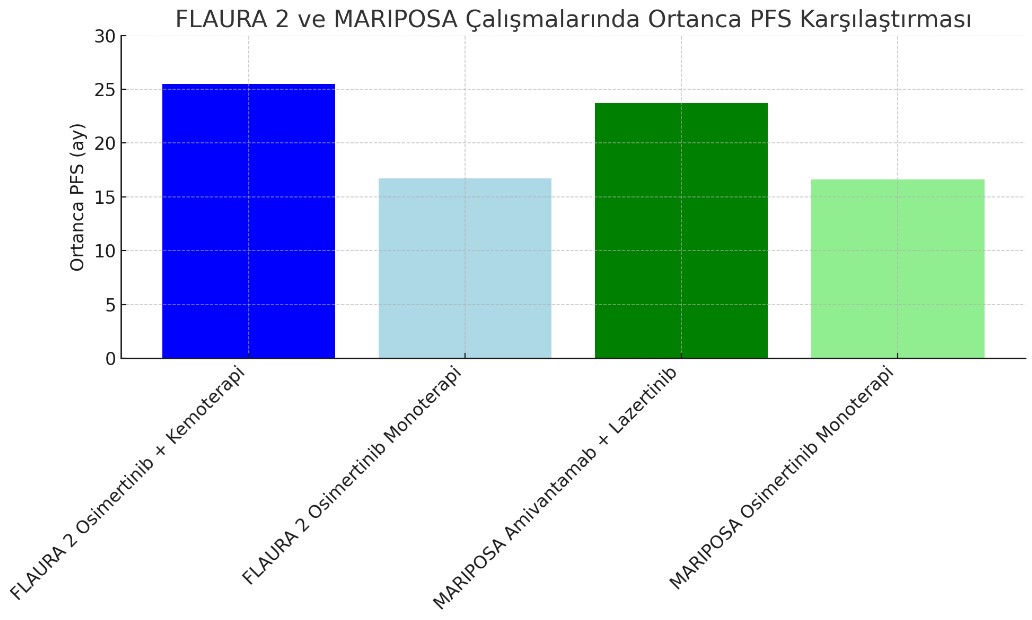
The chart above compares median PFS reported in FLAURA 2 and MARIPOSA. In FLAURA 2, median PFS was 25.5 months with osimertinib plus chemotherapy and 16.7 months with osimertinib alone. In MARIPOSA, median PFS was 23.7 months with amivantamab plus lazertinib, versus 16.6 months with osimertinib monotherapy. This visualization shows the effects of the combinations on PFS in each study.
Comparative Analysis:
-
Effectiveness: Both studies demonstrate the effectiveness of new combinations as alternatives to standard osimertinib monotherapy in advanced EGFR mutation-positive NSCLC. MARIPOSA reports a greater PFS improvement with amivantamab plus lazertinib compared with osimertinib alone, whereas FLAURA 2 highlights the effectiveness of combining osimertinib with chemotherapy.
-
Safety Profile: Both studies reported treatment-related side effects, but in MARIPOSA the amivantamab and lazertinib combination caused a higher rate of adverse events (AEs) than osimertinib monotherapy. Serious events such as venous thromboembolism (VTE) were particularly emphasized as occurring more frequently with combination treatment.
-
Management Considerations: FLAURA 2 evaluates osimertinib combined with chemotherapy as an addition to existing treatment options, whereas MARIPOSA investigates the potential of amivantamab plus lazertinib, a combination not yet broadly approved by the FDA.
Both studies have the potential to expand treatment options for patients with advanced EGFR-mutated NSCLC, but each combination's effectiveness and safety must be assessed carefully. MARIPOSA's new combination requires particular attention to managing treatment-related adverse events and helping patients remain on treatment.
Sources
Was this article helpful?
Your feedback helps us improve our content.




Reader comments
Share your comment
Your name and comment are published only after administrator approval. Your email address is never shown to visitors.
Be the first to comment.