
Osimertinib Reduces Mortality by 50% in Operable EGFR-Mutated Lung Cancer

In this article
Lung cancer remains the leading cause of cancer death worldwide, accounting for 18% of cancer-related deaths. Despite various treatment approaches, survival rates are generally low. In recent years, however, the development of targeted therapies has begun to change this picture. This article discusses treatment for early-stage lung cancer with EGFR mutations , focusing on the targeted drug Tagrisso, which contains osimertinib. Its impressive results in the ADAURA clinical trial reinforce its role in lung cancer treatment.
Approximately 15-30% of lung cancers are operable at diagnosis. The proportion of patients with EGFR mutations varies with geography, ethnicity and smoking status. NSCLC accounts for 85% of lung cancers; among patients with NSCLC (non-small cell lung cancer) , approximately 10-15% have EGFR mutations. In Asian populations and nonsmokers, however, this figure can reach 50%.
Among patients with EGFR-mutated early-stage non-small cell lung cancer (NSCLC), the use of adjuvant (postoperative preventive) osimertinib significantly improved overall survival. The findings were presented at the 2023 ASCO Annual Meeting and simultaneously published in NEJM as results of the ADAURA trial.
Osimertinib Is the First Targeted Therapy to Show a Survival Advantage as Adjuvant Treatment in Lung Cancer
Osimertinib, marketed as Tagrisso, is a tyrosine kinase inhibitor approved by both the FDA (US Food and Drug Administration) and Turkey's Ministry of Health for EGFR-mutated NSCLC. It was first approved in 2017 for stage 4 NSCLC progressing during or after other EGFR-targeted tyrosine kinase inhibitors. In 2020, it was approved as adjuvant treatment after surgery for early-stage (IB, II or IIIA) EGFR-mutated NSCLC.
At ASCO 2023, long-term ADAURA results were presented, confirming the initial findings that had previously led to FDA approval of osimertinib for early-stage lung cancer.
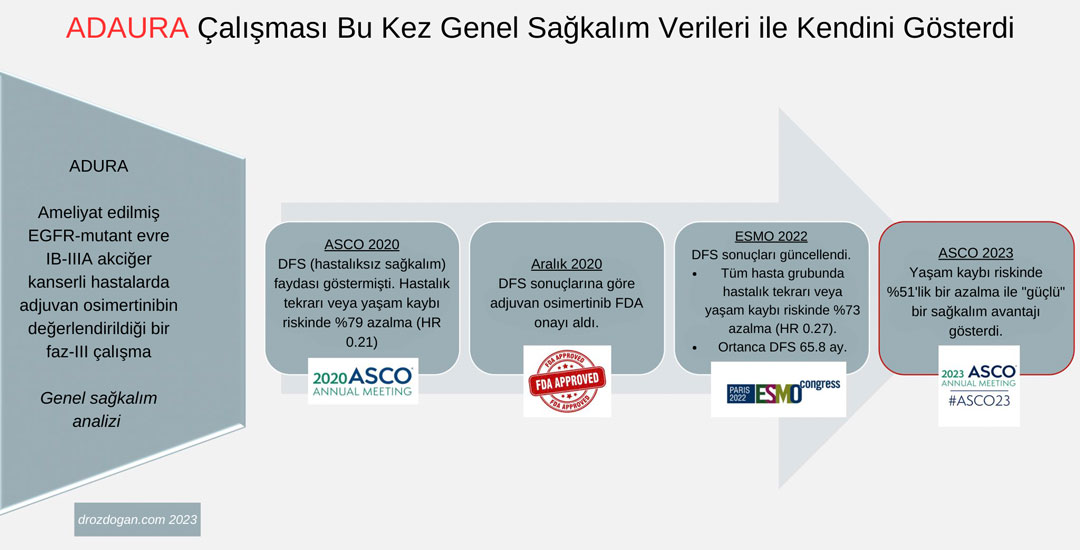
ADAURA included 682 patients with stage IB-IIIA NSCLC who had or had not received postoperative adjuvant chemotherapy. Patients were randomly assigned to adjuvant osimertinib 80 mg daily (339 patients) or placebo (339 patients), with treatment continuing for up to 3 years.
Earlier findings that led to FDA approval showed improved disease-free survival (DFS) with osimertinib. Median DFS was 65.8 months with osimertinib versus 28.1 months with placebo.
Updated Analysis Results:
- Median follow-up was 61.5 months. At data cutoff, 22% of patients in the osimertinib group and 54% in the placebo group had received subsequent cancer therapy, including osimertinib.
- Patients receiving osimertinib had a 51% lower risk of death than those receiving placebo (HR=0.49; 95% CI, 0.39-0.62; P<0.0001).
- Median overall survival was 11 years with osimertinib and 8.1 years with placebo.
- The 5-year overall survival rates were 88% with osimertinib and 78% with placebo. Among patients with stage II or III disease, 5-year overall survival was 85% in the osimertinib group and 73% in the placebo group.
- Among patients who received adjuvant chemotherapy, 5-year OS rates were 87% with osimertinib and 77% with placebo. Among those who did not, the corresponding 5-year rates were 88% and 79%.
- Grade 3 or higher adverse events occurred in 23% of patients in the osimertinib group and 14% in the placebo group. Neither arm had any treatment-related deaths.
The ADAURA findings are unprecedented and could substantially change current practice. They underscore that all patients diagnosed with early-stage NSCLC should be tested for EGFR mutations and that adjuvant osimertinib should be offered to all eligible patients.
In conclusion, osimertinib is a promising treatment for patients with EGFR-mutated lung cancer. These results show that it significantly improves survival rates and can halve overall survival durations.
Sources
2. Tsuboi M, Herbst RS, John T, et al. Overall survival with osimertinib in resected EGFR-mutated NSCLC. N Engl J Med. Published online June 4, 2023. doi:10.1056/NEJMoa2304594
Was this article helpful?
Your feedback helps us improve our content.


Reader comments
Share your comment
Your name and comment are published only after administrator approval. Your email address is never shown to visitors.
Be the first to comment.