
Polygenic Risk Scores (PRS): A New Genetic Tool for Predicting Disease

In this article
What Is a Polygenic Risk Score (PRS)?
A polygenic risk score (PRS) is a measure used to assess genetic predisposition to various conditions by calculating the combined effect of many genetic variants (changes) .
PRS estimates a person's genetic risk for a particular disease or trait. It combines the effects of multiple genetic variants identified through genome-wide association studies (GWAS).
The Role of Genomic Studies
Genome-wide association studies (GWAS) are large-scale genetic investigations of associations between genetic variation and particular diseases or traits. First used in 2005, they analyze millions of genetic markers in large samples to identify variants that increase disease risk or are linked to particular traits. These studies have advanced understanding of the genetic basis of complex diseases and revealed many new risk factors. GWAS is considered a revolutionary method in genetic research.
What Is a Genomic Variant?
Humans share almost identical DNA sequences across the estimated 6 billion letters of genetic code in their genomes.
Small differences between individuals make each of us unique. These differences, called genomic variants, occur at particular DNA locations.
DNA is read like a code made from four chemical building blocks: adenine, thymine, cytosine and guanine, abbreviated A, T, C and G, respectively. A genomic variant occurs where this code differs between people in a region of DNA.
For example, in the illustration below, Person One has a "C" base at a particular location, while Person Two has a "T" at the same location.
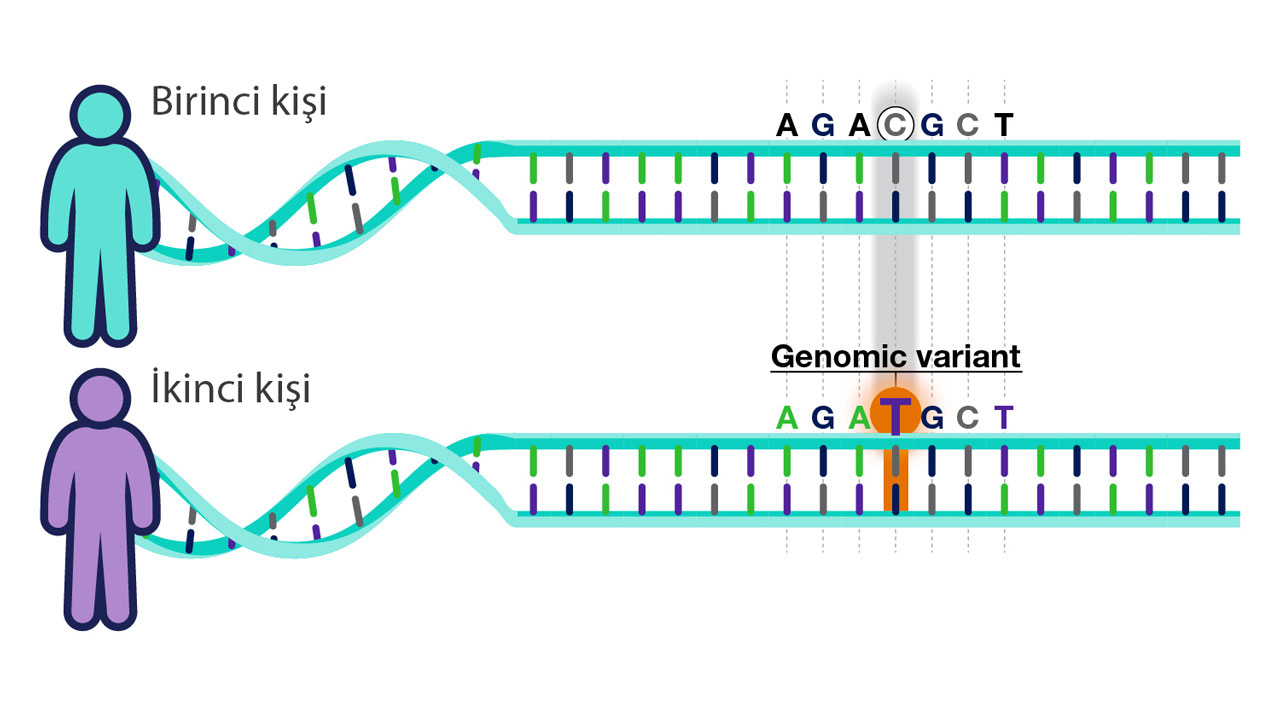
An individual's genome contains approximately 4 to 5 million genomic variants . These may be unique to that person or shared with others.
Some variants increase disease risk, others reduce it, and some have no effect on risk.
Question: How do these genomic variants affect the risk of particular diseases?

The image above shows genomic variants represented by "V." Some are shared between people, while others are unique to one individual.
Single-Gene and Complex Diseases
Researchers often divide genetic diseases into two categories: those associated with one gene and those influenced by multiple genes and environmental factors. Many diseases lie along the spectrum between these extremes.
Single-Gene Diseases
Many inherited diseases can be traced to variants in a single gene. Cystic fibrosis, a progressive genetic condition causing persistent lung infections and eventually limiting breathing, results from variants in the chromosome 7 cystic fibrosis transmembrane conductance regulator (CFTR) gene.

Each small "v" represents a genomic variant that is present but unrelated to cystic fibrosis. Each capital "V" represents a CFTR gene mutation.
Complex Diseases
Complex diseases result from many genomic variants combined with environmental influences such as diet, sleep, stress and smoking. They are also called "polygenic" diseases: "poly" means many and "genic" refers to genes.

Each red "v" represents a variant associated with coronary artery disease . Each small gray "v" is also present in the person's genome but is unrelated to the disease.
Coronary artery disease is complex. Researchers have identified approximately 60 genomic variants that occur more often in affected people. Most are scattered throughout the genome rather than clustered on a particular chromosome.
Cancer is an even more complex group of diseases.
How Is a Polygenic Risk Score Calculated?
Researchers identify variants associated with complex diseases by comparing the genomes of people with and without those diseases .
The vast amount of genomic data now available allows researchers to calculate which variants tend to occur more often in groups with a particular disease. Each disease may have hundreds or even thousands of variants.
Researchers examine this information using bioinformatics tools and statistical methods to estimate how a person's combined variants affect disease risk.
This produces polygenic risk scores.
All of this can be done without knowing the specific genes involved in a complex disease. Although all relevant genes may one day be known, researchers can already estimate risk without that connection.
Interpreting a Polygenic Risk Score
A polygenic risk score can describe only a disease's relative risk. The data used to construct it come from large genomic studies that identify variants by comparing groups with and without a particular disease.
A polygenic risk score compares a person's risk with that of people who have a different genetic makeup. It does not, however, provide a baseline or timeframe for disease progression. Consider two people with a high score for coronary heart disease: one is 22 and the other 98. Even with the same score, they will have lifetime risks of disease. Polygenic risk scores indicate correlation, not causality.
Absolute risk is different: it describes the probability that a disease will occur. BRCA1 mutation carriers have a 60-80% risk of breast cancer. This holds even without comparison with any other group.
Polygenic risk scores lie along a bell-shaped distribution. Most people will find their scores near the middle, indicating average disease risk. Others will be at the extremes, indicating lower or higher risk. People at the high-risk end may benefit from discussing further health assessment with their doctors and genetic counselors.

The graph above shows the distribution of polygenic risk scores (PRS). The horizontal axis represents scores and the vertical axis the number of people.
Risk Levels:
- Low-Risk Threshold (Green Line): Places people in the 33% segment of PRS scores in the low-risk category.
- High-Risk Threshold (Red Line): Places people in the 67% segment of PRS scores in the high-risk category.
Risk Categories:
- Low Risk: People with a PRS below the low-risk threshold belong here and have a low genetic likelihood of particular diseases.
- Intermediate Risk: This category includes scores between the low- and high-risk thresholds.
- High Risk: People with a PRS above the high-risk threshold belong here and have a high genetic likelihood of particular diseases.
Which Diseases Are Polygenic Risk Scores Used For?
PRS estimates genetic risk for various diseases, including:
- Cardiovascular Diseases: Coronary artery disease, hypertension
- Metabolic Diseases: Type 2 diabetes, obesity
- Neurological Diseases: Alzheimer's disease, Parkinson's disease
- Psychiatric Diseases: Schizophrenia, bipolar disorder, depression
- Cancers: Breast cancer, prostate cancer
Uses in Clinical Practice
Polygenic risk scores have begun to enter clinical screening and risk assessment for some diseases. Use is increasing particularly in heart disease and certain cancers.
Areas Not Yet in Clinical Practice
Potential applications that have not yet gained widespread acceptance include:
- Autoimmune Diseases: Rheumatoid arthritis, lupus
- Respiratory Diseases: Asthma, COPD
- Gastrointestinal Diseases: Irritable bowel syndrome (IBS), Crohn's disease
Advantages and Disadvantages of PRS
Advantages:
- Early Detection and Prevention: People at high disease risk can be identified early, enabling preventive action.
- Personalized Medicine: Treatment and follow-up can be tailored to genetic profiles.
- Large-Scale Application: Falling genetic testing costs make PRS accessible to wider populations.
Disadvantages:
- Insufficient Data: Genetic data needed to calculate PRS may be inadequate for some populations.
- Ethnic Differences: Variant effects may differ between ethnic groups.
- Psychological Effects: High risk scores may cause psychological problems such as anxiety and stress.
- Ethical and Privacy Issues: There are concerns about privacy and ethical use of genetic data.
Commonly Used, Commercially Available Polygenic Risk Scores (PRS)
Many genetic testing companies have developed polygenic risk scores for commercial use. Commonly used and commercially available examples include:
-
23andMe
- Heart disease
- Type 2 diabetes
- Breast cancer
- Prostate cancer
- Alzheimer's disease
-
Myriad Genetics
- BRACAnalysis®: Used to assess breast and ovarian cancer risk.
- MyRisk®: Assesses multiple cancer risks using more than 35 genes.
-
Color Genomics
- Cardiovascular diseases
- Cancers
- Metabolic diseases
-
Helix
- Heart disease
- Diabetes
- Obesity
- Osteoporosis
-
GenePlanet
- Cardiovascular diseases
- Metabolic syndrome
- Sport and exercise performance
-
Genomics Personalized Health (GPH)
- Heart disease
- Type 2 diabetes
- Alzheimer's disease
Applications of These Commercial PRS Tests
- Risk Prediction: Estimating an individual's likelihood of particular diseases.
- Preventive Measures: Taking preventive action and recommending lifestyle changes for people at high risk.
- Personalized Medicine: Developing treatment and follow-up plans based on genetic profiles.
- Family Planning: Assessing the likelihood of passing genetic risks to future generations.

The images above illustrate different ways of presenting PRS results for coronary artery blockage. They show how PRS is applied clinically and how genetic risk scores are presented to patients.
Insurance and the Use of Genetic Information
Use of genetic information in insurance is controversial because of ethical and privacy concerns. Some countries have introduced rules to prevent genetic discrimination. For example, Canada's Bill S-201, adopted in 2017, completely banned genetic discrimination in insurance and underwriting. In the United States, the Genetic Information Nondiscrimination Act (GINA), enacted in 2008, prevents genetic discrimination in health insurance and employment.
Economic Effects and Risk Selection
Understanding the economic effects of advances in genetics and genomics is essential for insurance-sector sustainability. The effect of genetic information on insurance risk selection depends on predictive accuracy. It is therefore important to understand how accurately genomic information predicts common disease risks.
Information Asymmetry and Risk Selection
The spread of direct-to-consumer genetic tests may increase information asymmetry and risk-selection problems. These tests provide detailed information about genetic disease risks. Because consumers are not required to disclose this information to insurers, they may conceal their risks. Insurers may consequently lack adequate customer information and be unable to set premiums fairly. They may fail to identify high-risk individuals and have to raise overall premium rates.
Education and Awareness
Education and awareness among doctors and the public should improve to support appropriate use and understanding of genetic information. As genomic medicine expands, preventive health measures based on genetic information will become more important.
Are Hereditary Cancer Tests the Same as PRS?
Screening for hereditary cancer genetic variants differs from polygenic risk score (PRS) testing, although both are forms of genetic risk assessment. The key differences are:
Screening for Hereditary Cancer Genetic Variants
Hereditary cancer screening looks for known mutations to assess predisposition to particular cancers. It usually focuses on specific, high-impact genes, for example:
- BRCA1 and BRCA2 mutations: Increase breast and ovarian cancer risk.
- MLH1, MSH2, MSH6 and PMS2 mutations: May cause Lynch syndrome and increase colorectal cancer risk.
- TP53 mutations: May cause Li-Fraumeni syndrome and increase the risk of several cancers.
These tests are widely used in high-risk families and are important tools for assessing individual cancer risk.
Polygenic Risk Score (PRS)
A polygenic risk score estimates genetic risk for a particular disease by calculating the combined effects of many small-effect variants. It uses common variants in a broad population to construct a score. Rather than focusing on one or a few genes, it accounts for the polygenic nature of risk.
Key Differences
- Target Genes and Variants:
- Hereditary Cancer Screening: Tests for specific high-risk mutations, such as BRCA1/2.
- PRS: Calculates an overall risk score using many small-effect genetic variants.
- Risk Prediction:
- Hereditary Cancer Screening: Determines whether people carrying specific mutations are at high risk.
- PRS: Assesses genetic risk variation across a broad population and provides individual scores.
- Applications:
- Hereditary Cancer Screening: Used in people with a high-risk family history.
- PRS: Can estimate genetic risk in the general population.
The Ideal Model for Disease Prediction: A Combined Approach

Combining hereditary cancer testing, polygenic risk scores (PRS), clinical history and family history can provide the most accurate estimate of a person's risk for a particular disease. This integrated approach considers genetic makeup, existing medical history and familial tendencies to personalize risk assessment. It may allow more precise, reliable assessment and appropriate preventive measures or interventions.
Sources
2. "Polygenic risk scores and the prediction of common diseases" - Torkamani A, et al. Nature Reviews Genetics, 2018.
3. "The predictive ability of polygenic risk scores for complex diseases" - Chatterjee N, et al. Genetics in Medicine, 2016.
4. "Polygenic prediction of complex phenotypes in humans" - Wray NR, et al. Cell, 2019.
5. "Genetic risk prediction of multifactorial diseases: statistical models and future directions" - Dudbridge F. Human Molecular Genetics, 2013.
Was this article helpful?
Your feedback helps us improve our content.




Reader comments
Share your comment
Your name and comment are published only after administrator approval. Your email address is never shown to visitors.
Be the first to comment.