
Preoperative Durvalumab Improves Survival in Muscle-Invasive Bladder Cancer

In this article
What Is Muscle-Invasive Bladder Cancer (MIBC)?
Approximately 20-25% of patients diagnosed with bladder cancer discover at their initial diagnosis that the cancer has spread into the bladder muscle. In other words, one in four patients has muscle-invasive disease at diagnosis. Tumors that have reached the bladder's muscle layer can require more challenging treatment than tumors detected earlier, and treatment may include surgery (radical cystectomy) and additional approaches such as immunotherapy.
Patients in this situation have stage 2 bladder cancer . At this stage, cancer cells have penetrated the inner bladder lining and reached the muscle layer of the bladder wall. However, the cancer has not yet spread to lymph nodes or more distant parts of the body.
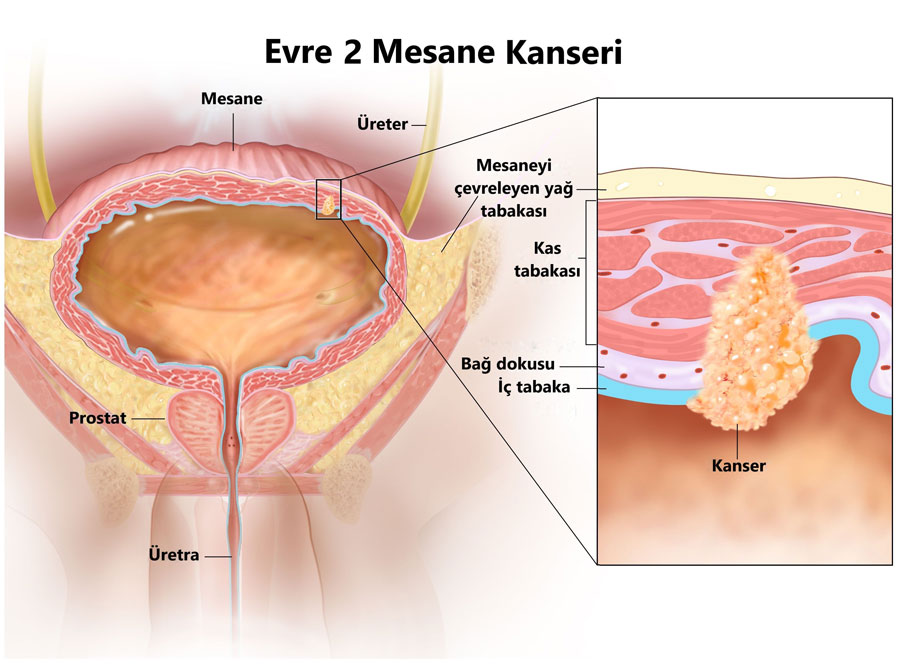
Standard treatment for muscle-invasive bladder cancer generally involves radical cystectomy, the complete removal of the bladder, followed by postoperative immunotherapy to reduce recurrence risk. In August 2021, the FDA took an important step by approving nivolumab immunotherapy as postoperative preventive treatment. However, bladder removal can substantially reduce quality of life for many patients, so this treatment option is not always desired. In light of these concerns, NIAGARA explores new treatments with the potential to preserve the bladder by examining the benefits of adding immunotherapy to neoadjuvant (preoperative) chemotherapy.
The Most Notable Study of Day 2 at ESMO 2024
NIAGARA results provide practice-changing findings on event-free and overall survival
Results presented at the 2024 ESMO Congress show that adding Imfinzi immunotherapy, containing durvalumab, to neoadjuvant chemotherapy prolongs survival in patients with muscle-invasive bladder cancer (MIBC), for the first time. The trial provides important findings demonstrating the survival benefits of immunotherapy.
In a prespecified interim analysis of the phase III NIAGARA trial, adding durvalumab to neoadjuvant chemotherapy (NAC) before radical cystectomy, followed by durvalumab monotherapy after surgery, produced statistically significant and clinically meaningful improvements in event-free and overall survival compared with NAC alone. Importantly, adding neoadjuvant durvalumab did not prevent completion of radical cystectomy.
Event-free survival (EFS) describes how long a patient lives during a particular course of treatment without adverse events such as disease progression, recurrence or death.
Study Design
The trial enrolled 1063 patients eligible for cisplatin therapy who were scheduled for radical cystectomy. Patients were randomly assigned to two groups (1:1): neoadjuvant durvalumab plus NAC (cisplatin and gemcitabine), followed by radical cystectomy and adjuvant durvalumab monotherapy; or NAC alone followed by radical cystectomy.
Results
- Compared with NAC and surgery, the durvalumab group had significantly longer event-free survival, the primary endpoint (hazard ratio [HR] 0.68; 95% confidence interval [CI] 0.56–0.82; p<0.0001), and significantly longer overall survival (HR 0.75; 95% CI 0.59–0.93; p=0.0106).
- An HR of 0.68 for event-free survival indicates that, compared with the NAC and surgery group, patients in the durvalumab group had a risk of disease progression or death that was 32% (1 - 0.68) lower.
- An HR of 0.75 for overall survival means that patients in the durvalumab group had a risk of death that was 25% (1 - 0.75) lower.

Radical cystectomy was completed in 88% of patients in the durvalumab group and 83% in the NAC and surgery group.
Commentary
NIAGARA is a practice-changing trial for patients with muscle-invasive bladder cancer: it met its primary event-free survival endpoint and also significantly improved overall survival, a more difficult endpoint to achieve.
There is active debate about whether immunotherapy should be used as neoadjuvant and/or adjuvant treatment. We also need to understand whether patients achieving a pathological complete response require adjuvant immunotherapy, and the clinical use of circulating tumor DNA in this setting. CheckMate 274 and AMBASSADOR phase III adjuvant trial updates, together with results from ongoing perioperative phase III trials in this population, such as NCT03661320, KEYNOTE-866, KEYNOTE-905/EV-303, KEYNOTE-B15/EV-304 and VOLGA, will shape this debate and provide crucial future data.
Sources
Was this article helpful?
Your feedback helps us improve our content.


Reader comments
Share your comment
Your name and comment are published only after administrator approval. Your email address is never shown to visitors.
Be the first to comment.