
Terminal Cancer: What Matters to Patients and Caregivers?
A study led by Dr. Semra Özdemir suggests that patients with terminal cancer and their caregivers generally prefer symptom control over extending life, while often seeking a balance between the two.

In this article
Patients at the end of life are described as people in the final stages of illness whose care generally focuses on symptom management or palliative care rather than curative treatment. They are usually nearing the end of life, with treatment goals centered on quality of life and relief of suffering.
What Matters Most to Patients with Terminal Cancer and Their Caregivers?
At the Lien Centre for Palliative Care, Duke-NUS Medical School in the United States, Dr. Semra Özdemir was lead author of research stating, "Our research found that patients and caregivers generally have similar end-of-life goals, with one notable exception: patients tend to place greater priority on controlling costs".
When patients and caregivers better understand the patient's prognosis, however, they may be more inclined to avoid expensive life-prolonging treatments and prioritize symptom management.
The survey suggests that understanding prognosis helps patients and families establish realistic expectations and prepare adequately for end-of-life decisions.
On April 11, 2024, JAMA Network Open published the study online.
Extending Life or Improving Quality of Life?
Patients with advanced cancer often face difficult choices: pursue treatments that may or may not extend life, or focus more on symptom control?
Family members also play an important role. Some research suggests caregivers prioritize life-prolonging treatment while patients favor symptom management. How these priorities change over time and how patients and caregivers influence each other are less clear.
Researchers examined care goals during the final two years of life in patients with stage four solid tumors and their caregivers. They focused on balancing life extension against symptom management and cost control.
The survey included 210 patient-caregiver pairs recruited from outpatient clinics at two major cancer centers in Singapore. Patients' mean age was 63 and approximately half were men. Caregivers' mean age was 49, and nearly two thirds (63%) were women.
The first aim was to examine patterns in care goals during the final two years of life, focusing on life extension versus symptom management and life extension versus controlling treatment costs. The second was to explore associations with patient and caregiver characteristics using an actor-partner interdependence framework.
Figure: Conceptual Model Using the Actor-Partner Interdependence Framework for Patient-Caregiver Care Goals
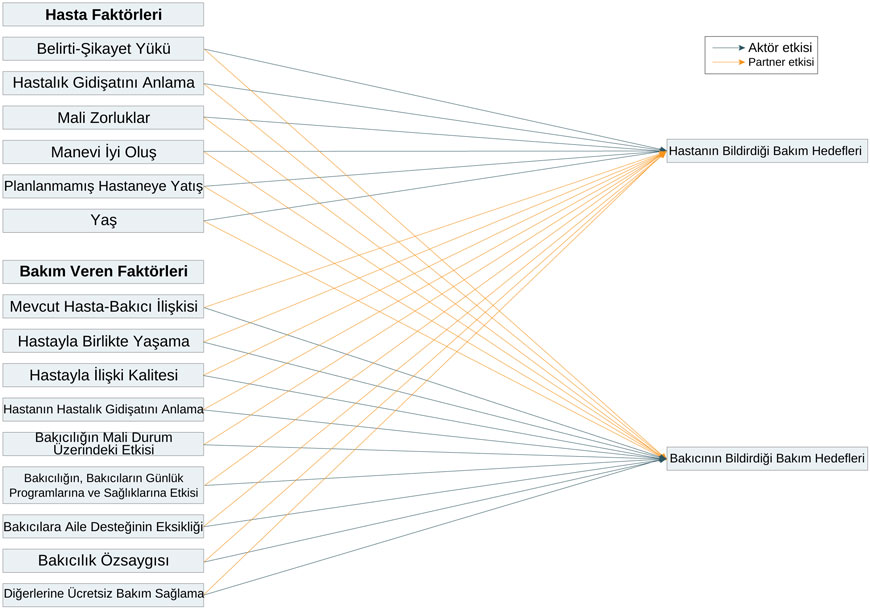
In the image, actor effects (blue arrows) represent how a person's characteristics affect their own goals; partner effects (orange arrows) show how one person's characteristics affect the other's goals. The framework enabled detailed examination of mutual influences on care goals.
Results
-
Prioritizing Symptom Treatment or Life Extension:
- Symptom treatment was preferred over life extension by 34% of patients and 29% of caregivers.
- Life extension was preferred over symptom treatment by 24% of patients and 19% of caregivers.
-
Preferring a Balance:
- Between 34% and 47% of patients and between 37% and 69% of caregivers favored balancing the two approaches.
-
Balancing Costs and Treatment Decisions:
- Cost control was prioritized by 28% of patients and 17% of caregivers.
- Life extension was prioritized by 26% of patients and 35% of caregivers.
Cost control was a greater priority for older patients, those with a higher symptom burden and those with less family caregiver support. Caregivers placed greater priority on cost control when finances were heavily affected, when they rated their caregiving ability poorly and when caring for older patients.
The findings highlight the importance of open, comprehensive discussions about resource allocation to align patient and caregiver cost priorities. Such discussions can address both parties' expectations and prevent potential conflict.
Semra Özdemir said, "Patients, families and doctors often avoid discussing prognosis," adding that these conversations are vital for realistic care expectations and preparation for end-of-life decisions.
Related topic: Cancer caregivers must not be forgotten: 4 ways to support them
Managing Unrealistic Expectations
Patients approaching the end of life and their caregivers often still prioritize life extension rather than managing distressing symptoms.
Dr. Semra Özdemir says, "This suggests that many patients have unrealistic care expectations and highlights the need for ongoing dialogue and reassessment of care goals as illness progresses."
Özdemir also notes, "The limited change in preferences over time may mean that initial treatment decisions are deeply rooted, or that there is inadequate communication about care needs and options as circumstances change."
People often hope a treatment or cure will change their situation, without believing that a devastating diagnosis will end their life.
Helping patients and caregivers understand prognosis realistically is important and requires more than providing a diagnosis.
We need to think about planning for the end of life and what it may look like. We often do not do this well enough early in the illness.
Every patient and situation is different, so it is important to understand what matters in each case. End-of-life care requires an approach tailored to individual needs, even for people with the same diagnosis.
*
Who Is Dr. Semra Özdemir?
Having earned a bachelor's degree in economics from METU (Middle East Technical University) in 2001, Dr. Semra Özdemir is an Assistant Professor at Duke-NUS Medical School's Lien Centre for Palliative Care and Health Services and Systems Research Signature Programme. She completed a doctorate in public health and economics at the University of North Carolina at Chapel Hill. Her main research areas are medical decision-making and health economics. She is particularly interested in decisions among patients, family caregivers and doctors in advanced illness, and in preferences for healthcare services and technologies. Her research also develops interventions and decision-support tools to help people make choices aligned with their preferences and treatment goals. She has developed many discrete-choice experiment surveys in different therapeutic areas and developed and tested decision aids for older patients with end-stage kidney disease.
Sources
2. Terminal Cancer: What Matters to Patients and Caregivers - Medscape - May 06, 2024.
Was this article helpful?
Your feedback helps us improve our content.




Reader comments
Share your comment
Your name and comment are published only after administrator approval. Your email address is never shown to visitors.
Be the first to comment.