
The Strength of Active Surveillance for Early-Stage Prostate Cancer

In this article
Choosing treatment for newly diagnosed early-stage prostate cancer remains an important question in oncology. Patients often move between different doctors and departments as they consider it.
There are 3 main options for early-stage prostate cancer that has not spread beyond the prostate: surgery, radiotherapy and active surveillance. Earlier studies suggested that doctors and patients choosing surveillance over radical treatments such as surgery or radiotherapy were not making a mistake. Now, strong evidence from a large study called ProtecT (Prostate Testing for Cancer and Treatment) supports a high likelihood of good long-term outcomes in early-stage prostate cancer even when patients choose active monitoring.
ProtecT aimed to identify the most appropriate treatment for early-stage prostate cancer. Patients with low- and intermediate-risk localized disease, confined to the prostate, were randomly assigned to surgery, radiotherapy or active surveillance.
Active surveillance (monitoring) for prostate cancer is recommended for low-risk and sometimes intermediate-risk disease. It closely monitors progression so treatment can begin when needed. The approach recognizes that not every patient needs aggressive treatment. Because prostate cancer generally progresses slowly, some patients can avoid treatment side effects. Surveillance involves regular PSA tests and repeat biopsy when necessary. Sudden PSA rises or a persistently upward trend may indicate progression and a need for another biopsy. If signs of progression emerge during surveillance, doctors may recommend more aggressive treatment, such as surgery (prostatectomy), radiotherapy or hormone therapy. Active surveillance protects patients’ quality of life and avoids unnecessary treatment complications, making it an important approach to consider in prostate cancer management.
The Most Comprehensive Long-Term Study
In this study in England, more than 82000 men underwent prostate-specific antigen (PSA) screening between 1999 and 2009.
Of those screened, 2664 were diagnosed with localized prostate cancer. From this group, 1643 men were selected for random assignment to radical prostatectomy, radiotherapy or active monitoring.
Localized prostate cancer includes low- and intermediate-risk patients:
- Low-risk prostate cancer: stage T1-T2a and Gleason score ≤6 and PSA ≤10
- Intermediate-risk prostate cancer: stage T2b and/or Gleason score =7 and/or 10< PSA ≤20
RELATED TOPICS
Study Results
Over an average follow-up of 15 years, there were no significant differences between treatment groups in prostate cancer mortality or all-cause mortality.
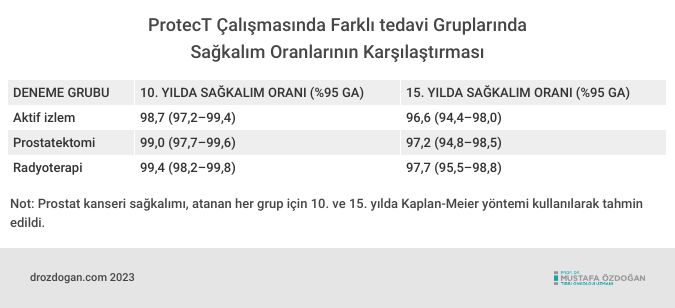
Active surveillance allowed patients to avoid treatment side effects and preserve quality of life. Side effects of radical treatments such as surgery and radiotherapy—including incontinence, sexual dysfunction and bowel problems—can impair quality of life. Surveillance is an important prostate cancer management approach that protects quality of life and avoids unnecessary treatment complications.
Radical treatments (prostatectomy or radiotherapy) halved the frequency of metastasis, regional progression and long-term androgen suppression compared with active monitoring. However, these reductions did not produce differences in mortality at 15 years, emphasizing the disease’s long natural history.
The study was published online on 11 March 2023 in the New England Journal of Medicine, with data presented simultaneously at the European Association of Urology (EAU) Congress in Milan, Italy.
Conclusion and Commentary
The finding that progression during active monitoring did not lead to higher mortality is surprising and encouraging for doctors and patients.
ProtecT’s findings are important for informed decisions about prostate cancer treatment. The study shows that active surveillance is safe for early-stage patients and does not adversely affect their survival. The implications include:
- Evaluating treatment options: Doctors and patients can make better-informed choices between surgery, radiotherapy and active surveillance for early-stage prostate cancer. Where progression is slow and has no significant effect on survival, surveillance is a safe option for avoiding radical treatment side effects.
- Protecting quality of life: Active surveillance allows patients to preserve quality of life by avoiding side effects of radical treatments, including urinary incontinence, sexual dysfunction and bowel problems.
- Individualized treatment approaches: ProtecT helps doctors and patients tailor treatment to personal factors, disease stage and risk. This enables selection of the most appropriate treatment based on each patient’s quality of life, health and preferences.
- The importance of surveillance protocols: The study highlights the importance of managing surveillance with regular PSA testing and repeat biopsy when needed. If progression is detected, doctors can recommend more aggressive treatment.
ProtecT therefore provides important guidance for doctors and patients reassessing prostate cancer management and making decisions that affect survival and quality of life.
Sources
Was this article helpful?
Your feedback helps us improve our content.




Reader comments
Share your comment
Your name and comment are published only after administrator approval. Your email address is never shown to visitors.
Be the first to comment.