
The Urothelial (Bladder and Ureter) Cancer Treatment Study That Received a Standing Ovation

In this article
After years of research and clinical trials, scientists and doctors have finally identified an effective new treatment combination for urothelial (bladder and ureter) cancer.
ESMO (European Society for Medical Oncology) Congress 2023 featured a particularly striking presentation: enfortumab vedotin (Padcev) and pembrolizumab (Keytruda) were shown to be a new first-line standard for advanced urothelial cancer in a phase-3 study called EV-302/KEYNOTE-A39. I was at the ESMO Congress for this presentation, and the standing ovation lasting about 5 minutes afterward was very impressive.
This development is seen as an important milestone in urological cancer treatment, and the combination is thought to have the potential to transform treatment pathways.
The most common subtype of urothelial cancer is bladder (urinary bladder) cancer. According to Turkey's 2020 Cancer Statistics, bladder cancer is the 4th most common cancer in men, with 10426 cases, and the 14th most common in women, with 1772 cases. Bladder cancer accounts for about 7% of all new cancers in men and about 2% in women. About 30% of patients with bladder cancer have locally advanced or metastatic disease at diagnosis.
Previously, on 3 April 2023, platinum-based chemotherapy was not suitable for patients with advanced urothelial cancer for whom the combination of enfortumab vedotin and pembrolizumab received accelerated FDA approval for first-line treatment based on the EV-103/KEYNOTE-869 study.
Enfortumab Vedotin + Pembrolizumab Doubled the Results Achieved with Chemotherapy
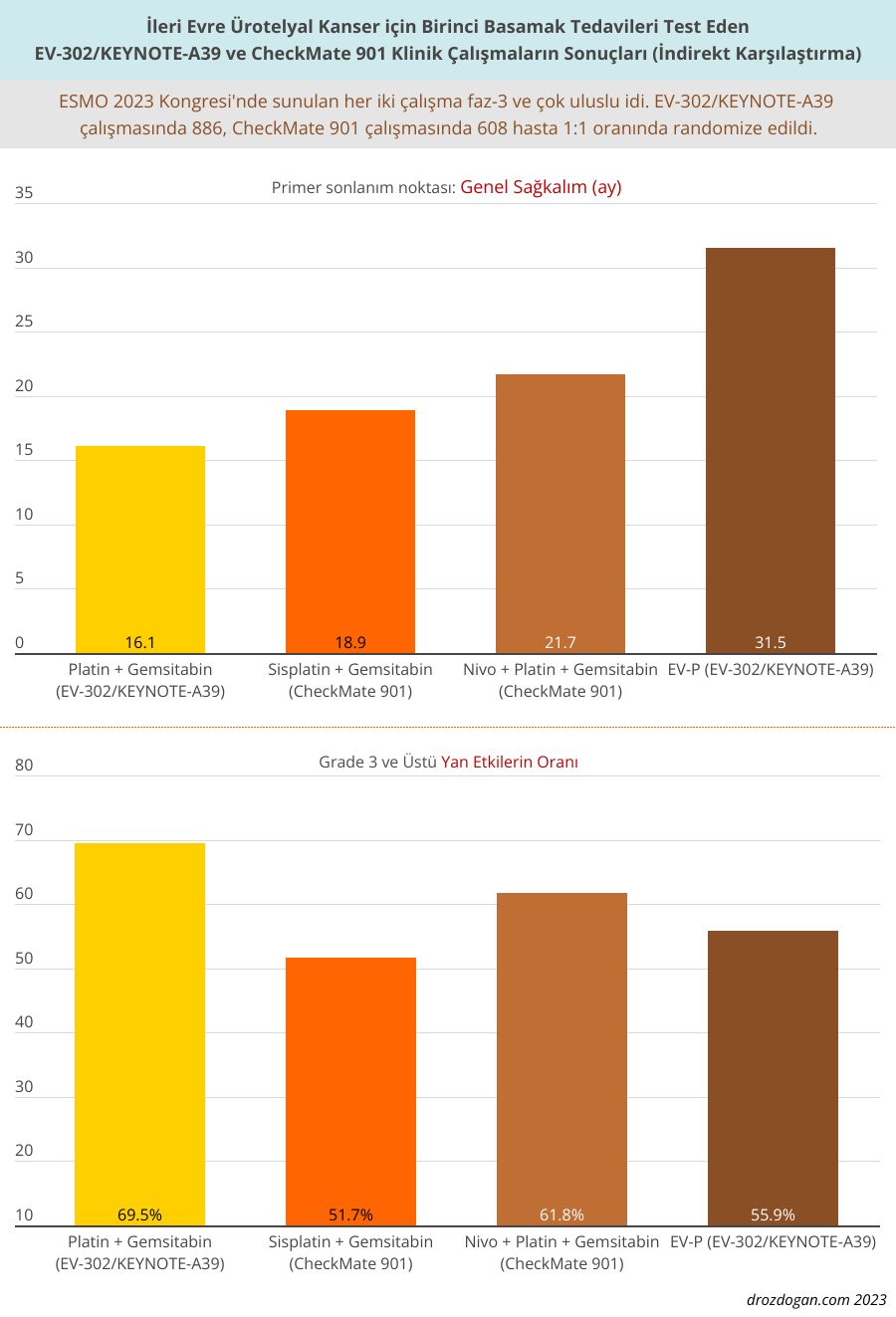
In tests involving 442 participants, the combination achieved a median overall survival of 31.5 months, markedly outperforming the current standard of care, platinum-based chemotherapy. In comparison, tests involving 444 participants receiving gemcitabine with cisplatin or carboplatin recorded a median overall survival of 16.1 months, representing a 53% reduction in the risk of death (P < 0.00001).
Removing chemotherapy allowed the new combination to substantially reduce grade 3 or higher adverse effects.
This is the first time we have managed to outperform chemotherapy for overall survival in first-line treatment. In stage 4 solid (tissue/organ-derived) cancer, enfortumab vedotin plus pembrolizumab produced an unprecedented 30% remission rate. (Remission refers to a period when the signs of a disease disappear and its progression stops.)
This development overshadowed CheckMate 901, another study presented immediately after EV-302/KEYNOTE-A39, which showed an improvement in overall survival compared with standard platinum-based chemotherapy.
In CheckMate 901, nivolumab was added rather than eliminating chemotherapy altogether. With 304 patients randomized to each arm, adding nivolumab improved median overall survival from the 18.9 months achieved with gemcitabine/cisplatin to 21.7 months, representing a reduction in the risk of death of 22% (P = 0.0171).
This was the first demonstration that adding immunotherapy to first-line chemotherapy improves survival in metastatic urothelial cancer.
After years of stagnation in first-line treatments for advanced bladder cancer, these studies represent a very valuable advance: both managed to outperform chemotherapy in initial treatment.
However, the much better survival rates achieved with enfortumab vedotin/pembrolizumab mean that the combination is now “the best first-line treatment regimen for advanced urothelial cancers.”
Major Changes in the Treatment Pathway
Establishing a new first-line standard for locally advanced or metastatic urinary tract cancer brings important changes to current treatment approaches and raises a series of new questions.
One major question is whether platinum-based chemotherapy, previously the first-line standard, should now be considered a second-line option. If pembrolizumab fails in the first line, do the previously established second-line roles of pembrolizumab and other immunotherapies still apply?
It will also be necessary to determine whether enfortumab vedotin plus pembrolizumab is suitable for earlier-stage disease, particularly muscle-invasive bladder cancer, and whether the dose and duration of enfortumab vedotin can be reduced to lessen specific adverse effects, such as those affecting the eyes.
Finally, of course, we must discuss cost. Enfortumab vedotin plus pembrolizumab (EV+P) is a very expensive treatment. How much of this can countries and reimbursement agencies cover?
Dr. Thomas Powles, lead investigator of EV-302/KEYNOTE-A39, said he did not know how reimbursement negotiations were progressing, but hoped action would be swift. On the problems of treatments receiving approval for use without reimbursement, he said: “We are seeing very meaningful results even for patients with very advanced cancer. It will be hard not to talk to patients about these data.”
EV-302/KEYNOTE-039 Details
In this clinical trial, pembrolizumab (P) was given at 200 mg on the first day of each 3-week treatment cycle, for a maximum of 35 cycles. Enfortumab vedotin (EV) was administered on the first and eighth days until disease progression or unacceptable toxicity, without a limit on the number of cycles.
In the control arm, cisplatin or carboplatin (C) was given on the first day, and gemcitabine (G) on the first and eighth days, for a maximum of six 3-week cycles.
Two arms were formed according to patients' performance status, and most patients in both arms were assessed as having a performance status of 0 or 1; fewer than 4% of patients in either group had a performance status of 2.
Results
In parallel with overall survival, progression-free survival (PFS) rates also showed significant differences.
- Patients treated with EV-P had a 55% reduction in the risk of progression or death (P < 0.00001).
- Median overall survival in the EV-P arm was 31.5 months, compared with 16.1 months in the GC arm.
- Median progression-free survival in the EV-P group was 12.5 months, compared with 6.3 months in patients treated with GC.
These results were consistent regardless of PD-L1 positivity, cisplatin eligibility, or the presence or absence of visceral (internal organ) metastases.
Almost 60% of patients treated with GC in the study switched to immunotherapy as subsequent maintenance treatment or after disease progression. About a quarter of those treated with EV+P subsequently switched to platinum-based chemotherapy.
Grade 3 or higher adverse effects occurred in 55.9% of participants treated with EV+P, compared with 69.5% in the GC arm.
The most common adverse effects in the chemotherapy arm were anemia, neutropenia, thrombocytopenia, fatigue, and nausea. In the EV+P group, the most common were skin reactions, hyperglycemia, neutropenia, peripheral neuropathy, diarrhea, and anemia.
CheckMate 901 Details
In this phase 3, multinational, open-label study, patients with previously untreated, unresectable or metastatic urothelial cancer were randomly assigned to two groups. The first received nivolumab (360 mg) plus gemcitabine-cisplatin (the nivolumab combination) every 3 weeks for up to six cycles, followed by nivolumab (480 mg) every 4 weeks for a maximum of 2 years. The second received gemcitabine-cisplatin alone every 3 weeks for up to six cycles. The primary endpoints were overall and progression-free survival.
Results
A total of 608 patients were randomized (304 in each group).
- After a median follow-up of 33.6 months, overall survival was longer with the nivolumab combination than with gemcitabine-cisplatin alone, with a reduction in the risk of death of 22% (hazard ratio for death, 0.78; 95% confidence interval [CI], 0.63 to 0.96; P=0.02).
- Median survival was 21.7 months (95% CI, 18.6 to 26.4) and 18.9 months (95% CI, 14.7 to 22.4), respectively.
- Progression-free survival was also longer with the nivolumab combination than with gemcitabine-cisplatin alone (hazard ratio for progression or death, 0.72; 95% CI, 0.59 to 0.88; P=0.001).
- Median progression-free survival was 7.9 months and 7.6 months, respectively.
- At 12 months, progression-free survival was 34.2% and 21.8%, respectively.
- The overall objective response rate was 57.6% (complete response, 21.7%) with the nivolumab combination and 43.1% (complete response, 11.8%) with gemcitabine-cisplatin alone.
- The median duration of complete response was 37.1 months with the nivolumab combination and 13.2 months with gemcitabine-cisplatin alone.
- Grade 3 or higher adverse effects occurred in 61.8% and 51.7% of patients, respectively.
*
The article's image was created using the prompt: “An illustration of a gathering of both male and female oncologists enthusiastically clapping their hands to celebrate an important moment in oncology research.” with DALL-3.
Sources
2. Van der Heijden MS, et al. Nivolumab plus Gemcitabine–Cisplatin in Advanced Urothelial Carcinoma. NEJM 22 October 2023.
3. Enfortumab Vedotin/Pembrolizumab Hailed As New Standard for Upfront mUC - Medscape - Oct 25, 2023.
Was this article helpful?
Your feedback helps us improve our content.


Reader comments
Share your comment
Your name and comment are published only after administrator approval. Your email address is never shown to visitors.
Be the first to comment.