
Trodelvy (Sacituzumab Govitecan-hziy): FDA Approval, Turkish Authorization and Reimbursement

In this article
About the Drug
- FDA approved: Yes (first approval: 22 April 2020)
- Brand name: Trodelvy
- Active ingredient: Sacituzumab govitecan-hziy
- Administration: Intravenous injection
- Class: Antibody-drug conjugate
- Category: Biological response modifier, chemotherapy drug
- Manufacturer: Immunomedics, Inc.
- Distribution in Turkey: Gilead Sciences İlaç LTD. ŞTİ.
- Approved cancers: Breast cancer, urothelial cancer (urinary tract and bladder)
How Does Sacituzumab Govitecan-hziy Work?
- Sacituzumab is a humanized monoclonal antibody targeting Trop-2, conjugated to the topo I inhibitor SN-38 to form an antibody-drug conjugate. Approximately 7-8 SN-38 molecules are attached to each antibody.
- After binding Trop-2, sacituzumab govitecan is rapidly internalized into lysosomes, releasing SN-38 within the cell to target and inhibit topo I. This causes double-stranded DNA breaks and eventual cell death.
- Trop-2 promotes cell growth, proliferation, invasion, survival and carcinogenesis as a 46-kDa transmembrane calcium-signaling protein acting through ERK/MAPK and cyclin D1 pathways.
- Trop-2 is overexpressed in many epithelial solid tumors, including breast cancer, and is detected in more than 85% of triple-negative breast cancers.

Trodelvy FDA Approval Timeline
- 3 February 2023: Sacituzumab Govitecan Receives FDA Approval for Hormone-Positive, HER2-Negative Advanced Breast Cancer
- 13 April 2021: Sacituzumab Govitecan Receives FDA Approval for Advanced Urothelial (Bladder/Urinary Tract) Cancer
- 22 April 2020: Sacituzumab Govitecan-hziy Receives FDA Approval for Advanced Triple-Negative Breast Cancer
Trodelvy Authorization in Turkey
Trodelvy first received authorization from Turkey’s Ministry of Health on 25.01.2023 for the following indication.
Therapeutic indications
- Indicated for adults without active brain metastases who have unresectable locally advanced or metastatic triple-negative breast cancer and previously received at least two chemotherapy lines, including at least one in the metastatic setting.
- Indicated for adults with unresectable locally advanced or metastatic hormone receptor (HR)-positive, human epidermal growth factor receptor 2 (HER2)-negative breast cancer (IHC0, IHC1+ or IHC2+/ISH–) who received endocrine-based treatment containing a CDK4/6 inhibitor and at least two systemic chemotherapy lines in the metastatic setting.
Is Trodelvy Reimbursed?
Turkey’s Social Security Institution (abbreviated GSK in the source) has included Trodelvy in reimbursement for the following indication.
“Used until progression in patients without active brain metastases who have unresectable locally advanced or metastatic triple-negative breast cancer and previously received at least two chemotherapy lines.”
June 2026 Price: Trodelvy 200 mg vial: 74282.50TL
Cost per cycle: In practice, for a patient weighing around 70 kg, 1 cycle costs approximately 594260 TL.
- This is general information, not a substitute for a doctor or pharmacist. Ask your pharmacist about prices.
Resistance Mechanism
Not yet well defined.
Distribution
Moderate plasma protein binding (77%). Steady-state drug levels are reached within 21 days.
Metabolism
No formal metabolism study has been performed, but the antibody-drug conjugate is expected to break down into small peptides and amino acids. SN-38 is metabolized in the liver by UGT1A1. Median terminal half-life of sacituzumab govitecan is 16 hours, and that of free SN-38 is around 18 hours.
Dose and Administration
| Heading | Details |
|---|---|
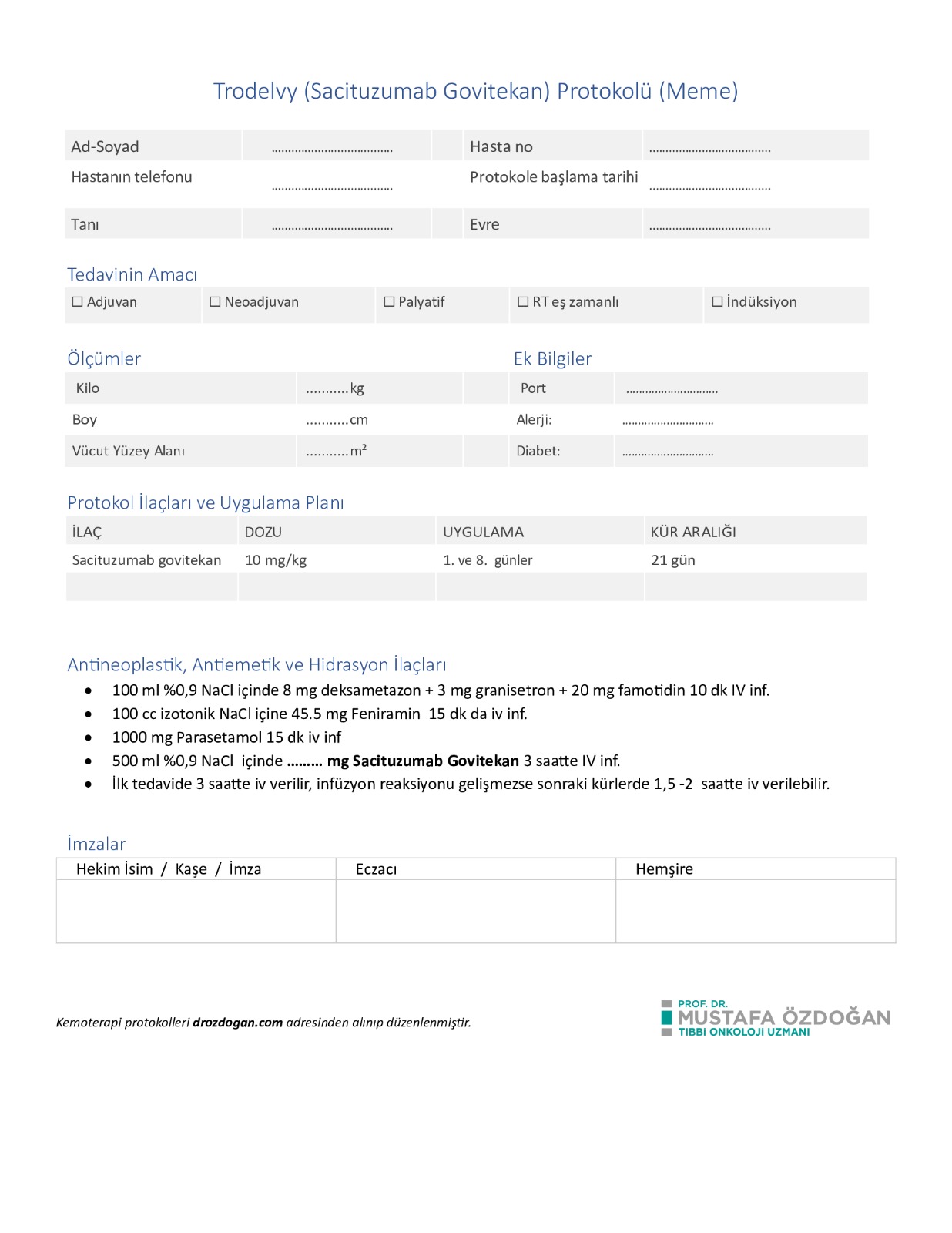
| Standard dose | 10 mg/kg IV, days 1 and 8; repeated every 21 days per cycle. |
| Infusion duration | First dose ≈ 3 hours; if well tolerated, subsequent doses 1–2 hours. |
| Administration | Slow IV infusion; strictly NOT IV push/bolus. After the first dose, observe for ≥ 30 minutes. |
| Premedication | Antiemetic + H1/H2 blocker ± antipyretic; if there was a prior infusion reaction, a steroid may be added. |
Side Effects
Myelosuppression / Neutropenia
The most common side effect. Severe/life-threatening neutropenia may occur. Close blood-count monitoring and, when needed, dose delays/reductions and G-CSF are considered.
Diarrhea (Early and Late)
Early: during infusion/≤24 hours (flushing, sweating, cramps) → atropine may be considered. Late: >24 hours, generally beginning within 3–10 days; G3–4 ≈ 10%, all grades ≈ 60%. At the first loose stool, loperamide; if not improved within 24 hours, an oral fluoroquinolone; if refractory, IV hydration/antibiotics and hospitalization.
Gastrointestinal / Other
Nausea-vomiting (generally dose-related), anorexia, fatigue, loss of appetite, alopecia.
Hypersensitivity / Infusion Reactions
Premedication (H1/H2 ± antipyretic, steroid if needed). For reactions, reduce the rate, pause temporarily or take medical measures.
Special Considerations
- UGT1A1*28 (7/7) genotype: high risk of myelosuppression and diarrhea—more frequent complete blood counts and early supportive measures.
- Hepatic impairment: Mild impairment usually needs no dose adjustment; moderate/severe impairment has limited study data, so use should be avoided.
- Renal impairment: Limited data; in end-stage kidney disease, use caution.
- Pregnancy and Breastfeeding: Risk of fetal toxicity; for people of reproductive potential, women should use contraception during treatment and after the last dose for at least 2 months; for male partners 4 months of contraception. Breastfeeding is not recommended.
- Infusion technique: Only slow IV infusion ( notpush/bolus); observe for ≥30 minutes after the first dose.
- Drug interactions: UGT1A1 inhibitors (SN-38 ↑ → toxicity ↑) and inducers (SN-38 ↓ → efficacy ↓): concurrent use should be avoided or closely monitored.
References
Sources
Was this article helpful?
Your feedback helps us improve our content.




Reader comments
Share your comment
Your name and comment are published only after administrator approval. Your email address is never shown to visitors.
Be the first to comment.