
What is a biosimilar drug? Its importance and frequently asked questions

In this article
What is a biosimilar drug?
Biosimilar drugs are similar versions of reference biological products produced after their patents expire. Biological and biosimilar drugs are large molecules, and organisms and living systems are used in their production instead of chemical compounds. The best examples of biological and biosimilar drugs are monoclonal antibodies, frequently used in cancer treatment, and chemotherapy-related leukopenia/neutropenia treatments using biosimilars of filgrastim or pegfilgrastim.
What is the history of biosimilars?
The first biosimilar in the United States received, in 2015, FDA approval. In Europe, the history of biosimilars goes back further: the European Medicines Agency (EMA) first approved a biosimilar in 2006, and 47 biosimilars had entered use in Europe by 2018. Initially, many were used for supportive care in oncology or in fields such as endocrinology and rheumatology. After 2017, biosimilars of biological drugs widely used in cancer treatment (bevacizumab and trastuzumab) began receiving approval.
In 2010, 10% of all drug development expenditure worldwide was allocated to biosimilars; by 2015, this had risen to 15%.
The first relevant regulation in Turkey was issued under the title Guideline on Biosimilar Medicinal Products in 2008. In Turkey, after a biosimilar molecule is produced, an application for licensing is submitted and evaluated.
Understanding biosimilars can help expand access to high-quality treatment options for doctors and patients and can also reduce healthcare system costs. Healthcare providers, payers, regulatory agencies, policymakers, patient advocates, and patients need clear, unbiased, evidence-based information to better understand biosimilars and make informed decisions about policy and use.
These frequently asked questions (FAQs) cover the answers to the most common questions, including how biosimilars are developed and manufactured and the regulatory practices surrounding approval and use.
What is a biological drug?
Biological drugs, also known as biological therapies or "biologics," are drugs produced by living organisms, including human, animal, or microorganism cells. Today, they are generally produced through biotechnology. Biologics may include proteins, sugars, and nucleic acids, as well as living entities such as gene therapies.
Most drugs available today are known as "small-molecule drugs," which are chemically synthesized medicines. Biologics form a smaller subset of drugs and generally work in the patient's body by supplementing or interrupting natural processes and signals to treat a particular disease or disorder.

What is a biosimilar drug?
A biosimilar drug is a biological medicine shown through clinical studies to be highly similar to an approved biological medicine known as the reference product. Authorized bodies (FDA, EMA, Republic of Turkey: Ministry of Health) must determine that a biosimilar is highly similar to the reference product despite minor differences in clinically inactive components, and that it has no clinically meaningful differences from the reference product in safety, purity, and potency.
Some biosimilars may be virtually indistinguishable from their reference biologics at a particular time, while others may justifiably show some differences in structure or biological function. As long as biosimilars are highly similar and have no clinically meaningful differences, they do not have to be completely identical to the reference biologic, which itself has natural variability.
How long do drug patents last?
A patent is a legal right granted to protect the value of an invention and encourages inventors to share their inventions with society.
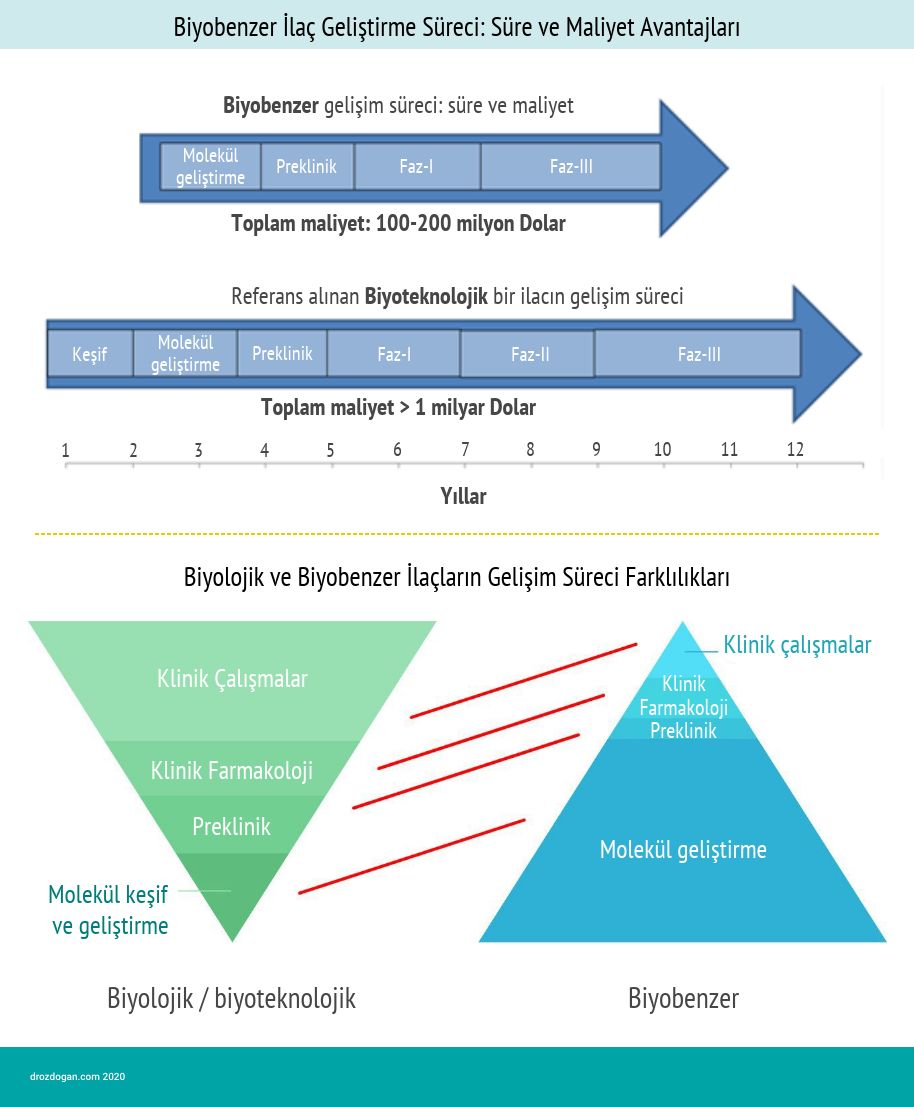
In the pharmaceutical industry, patent rights provide 20 years of protection from the discovery of the molecule. However, considering that it takes pharmaceutical companies approximately 12-15 years to turn a patented molecule into a marketable drug, the period during which patent protection is actively used falls to 5-8 years.
What are the benefits of biosimilars?
Some of the most difficult diseases to treat, such as cancer, anemia, and autoimmune disorders (e.g., multiple sclerosis, rheumatoid arthritis, psoriasis, and inflammatory bowel disease), are best treated with biological drugs. Many biological treatments are given in a healthcare setting in an injectable form or as a solution for intravenous administration. Although biologics account for a small percentage of the total number of drugs on the market, they still represent a significant healthcare cost, accounting for 23 percent of global pharmaceutical spending in 2014 (which is 9.3 percent of total US healthcare spending). These biotechnological drugs, which emerged in the 1980s, reached a market of 179 billion dollars in 2014. This impact is expected to increase because many new drugs in development are biologics.
What are the benefits for healthcare providers?
Growth in the biosimilar market may allow patients faster and earlier access to these important treatment options. These therapies have the potential to improve patient access by reducing financial and administrative barriers.
What are the benefits of biosimilars for patients?
If both the reference biological product and biosimilars are available in a country or used medically in first-line treatment, lower drug prices may provide a range of benefits for patients, including insurance coverage for these drugs for more patients (FTC Report, June 2009).
This may lead to increased access to high biotechnological drugs, allow patients to receive the specified biological medicines, and increase the likelihood that these biologics are prescribed earlier, leading to better patient outcomes and significant savings for the healthcare system.
What are the benefits for reimbursement bodies and healthcare systems?
The introduction of biosimilars means more treatment options and increased competition by providing relatively effective treatments. This competition can lead to high-value treatments at lower prices. Savings achieved with biosimilars are known to be able to fund new drugs.
Do biosimilars work in the same way as their biological reference products?
Yes. There are no clinically meaningful differences between a biosimilar and its reference product in safety, purity, and efficacy.
A biosimilar will work in the same way as its reference product; in other words, their mechanisms of action are the same.
Approval agencies will approve a biosimilar only when:
• It has been found to be biosimilar
• It uses the same mechanism(s) of action for the intended condition(s) of use (to the extent that these are known for the reference product)
• The conditions of use have previously been approved for the reference product
• The route of administration, dosage form, and strength of the biological product are the same as the reference product.
• The facility where the biosimilar is manufactured, processed, packaged, or held meets standards designed to ensure that the biological product remains safe, pure, and potent.
In conclusion, biosimilars work in the same way as the biological reference product with which they are compared; they have no clinically meaningful differences from the reference product in safety and efficacy.
How are biosimilars prescribed?
A biosimilar is prescribed by a doctor in place of the reference product using the biosimilar's specific/brand name. Once approval agencies have approved a biosimilar as an interchangeable biologic, a pharmacist may substitute it without prior notification to the prescribing physician if the country's legislation allows this.
Are biosimilars generic versions of their reference biological products?
No. Biosimilars are unlike generic (equivalent) drugs because most generics are chemically synthesized, whereas biosimilars are produced using living systems. Generics are copies of branded drugs and are considered equivalent. This means they have the same active ingredient and are the same in dosage form, safety, strength, administration, quality, performance characteristics, and intended use. By contrast, biosimilars are derived from living systems. Biosimilars are highly similar to their respective reference products despite minor differences in clinically inactive aspects.
How are biosimilars approved?
The "totality of evidence" for a biosimilar is assembled by analyzing publicly available information, testing the reference product, and developing the biosimilar "step by step" in comparison with the reference product. Once satisfied that the totality of evidence is both substantial and sensitive enough to detect any potential difference, the FDA, EMA, or the Turkish Medicines and Medical Devices Agency under the Ministry of Health in Turkey will approve the biosimilar for one or more indications/diseases based on its high similarity to the reference product.
What is extrapolation?
A biosimilar may be approved for one or more conditions of use (known as "indications and usage") for which its reference biological product is licensed but for which there is no direct clinical comparison. This approval is based on direct comparison of the totality of data obtained with biosimilars and the reference product.
For example, Zirabev, a bevacizumab biosimilar, received FDA approval in July 2019 and a Turkish Medicines and Medical Devices Agency license in March 2020 through a phase III study in non-small cell lung cancer (NSCLC). In addition to NSCLC, Zirabev's FDA approval covers colorectal cancer, the brain tumor glioblastoma, renal cell cancer, and the cervix; in Turkey, this biosimilar's license covers colorectal cancer, glioblastoma, and cervical cancer.
Approval agencies review extrapolation requests case by case and indication by indication. Each indication for which extrapolation is sought must be scientifically justified. Approval of an additional indication through scientifically valid extrapolation accelerates biosimilar development and eliminates unnecessary clinical studies, thereby increasing patient access to important treatments.
What does interchangeable mean?
An interchangeable biologic is a biosimilar that produces the same clinical result as its reference product in any patient. This must be demonstrated for a product.
Essentially, an individual experiences the same level of safety and efficacy using either the interchangeable product or its reference product.
The term “interchangeable,” referring to a biological product shown to meet additional standards described in the relevant laws, means that a pharmacist may substitute the biosimilar for the reference product, or vice versa, without intervention by the prescribing doctor.
What is automatic substitution?
Automatic substitution occurs when one drug is dispensed in place of another at pharmacy level without consulting the doctor.
Early substitution laws in medicine were written for generic drugs. In the United States, laws explaining how and when pharmacists may substitute one drug for another vary by state; in the European Union, this practice is not recommended for biological drugs.
FDA-approved biosimilar drugs in oncology (through September 2020)
- Zirabev (bevacizumab-bvzr): June 2019: for treating metastatic colorectal cancer, advanced non-small cell lung cancer, recurrent glioblastoma, metastatic renal cell cancer, and treatment-resistant recurrent or metastatic cervical cancer.
- Herzuma (trastuzumab-pkrb): December 2018. HER2-positive breast cancer treatment.
- Truxima (rituximab-abbs): November 2018. The first drug approved as a biosimilar for treating adult lymphoma. It is a biosimilar of the anti-CD20 monoclonal antibody rituximab.
- Udenyca (pegfilgrastim-cbqv): November 2018. Treatment of chemotherapy-related leukopenia/neutropenia.
- Nivestym (filgrastim-aafi): July 2018. Treatment of chemotherapy-related leukopenia/neutropenia.
- Fulphila (pegfilgrastim-jmdb): June 2018. The first FDA-approved biosimilar of Neulasta (pegfilgrastim), which is used to reduce the risk of infection during cancer treatment.
- Retacrit (epoetin alfa-epbx): May 2018. The first FDA epoetin-alfa biosimilar for treating anemia.
- Ogivri (trastuzumab-dkst): December 2017. The first biosimilar drug approved by the FDA for treating HER2-positive breast and stomach cancers (details).
- Mvasi (bevacizumab-awwb): September 2017. The first biosimilar drug approved for cancer treatment (details).
- Zarxio (filgrastim-sndz): March 2015. The first biosimilar drug approved by the FDA. It is a biosimilar of the injection Neupogen (filgastrim), used to reduce infection risk during cancer treatment.
Which biosimilar drugs drugs are available in Turkey?
The licensed biosimilar drugs available and used in oncology in Turkey are:
- Zirabev (bevacizumab)
- Canhera (trastuzumab)
- Neulastim (pegfilgastrim)
- Lonquex (lipefilgatrim)
Below is the summary infographic poster we have prepared about biosimilars:


Sources
Was this article helpful?
Your feedback helps us improve our content.




Reader comments
Share your comment
Your name and comment are published only after administrator approval. Your email address is never shown to visitors.
Be the first to comment.