
What Is an Inherited APC Mutation? Cancer Surveillance and Treatment Guide for Carriers
Reading tools
Sources

In this article
General Information About Inherited APC Mutations
- The APC (adenomatous polyposis coli) geneis a tumor suppressor genethat regulates cell growth, division, and structure. Mutations in APC can lead to uncontrolled cell proliferation and play a role particularly in the development of colorectal cancer.
- Some APC mutations are inherited and familial adenomatous polyposis (FAP) is one of the genetic syndromes associated with them. However, most APC mutations are somatic and are acquired during life because of environmental factors or cellular processes. Inherited APC mutations are rarer, whereas somatic mutations occur in most colorectal cancers.
- Germline variants in the APC gene that are classified as pathogenic (including class 4 likely pathogenic and class 5 pathogenic variants) are associated with familial adenomatous polyposis (FAP) . FAP follows an autosomal dominant pattern of inheritance.
- Classic FAP usually results in >100 adenomatous polyps in the large bowel, and 95% of patients develop polyps by age 35. If untreated, these polyps become malignant.
- In untreated patients, the average age at colorectal cancer diagnosis is 39, and malignancy develops before age 21 in 7% of cases. However, there is a broad range of phenotypes, with some people developing fewer polyps and colorectal cancer at a later age.
Which Cancer Risks Are Increased?
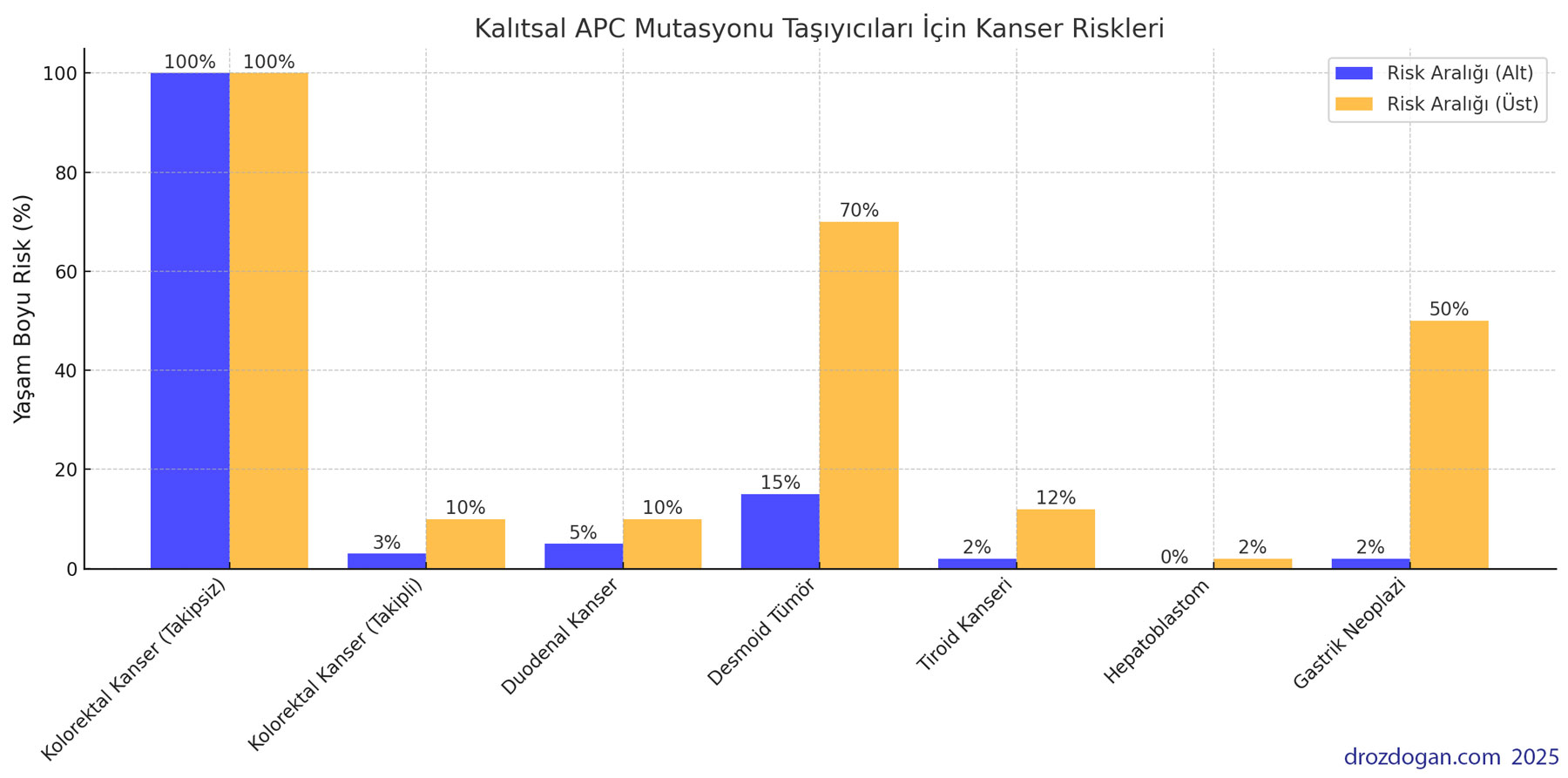
Carriers of inherited APC mutations have an increased risk of the following:
Colorectal Cancer:
- In patients with classic FAP who are not in a surveillance program, the incidence is thought to be close to 100% .
- In patients undergoing surveillance, the incidence is between 3-10%.
Duodenal Cancer:
- Without surveillance, the lifetime risk of duodenal cancer is 5-10%. The probability is estimated using the Spigelman score during upper gastrointestinal (GI) endoscopy, and management is guided accordingly.
Desmoid Disease:
- 15% of patients develop a desmoid tumor , and 70% of these tumors are intra-abdominal, particularly in the small-bowel mesentery (connective tissue). Desmoid tumors are more likely when the APC pathogenic variant lies beyond codon 1399 or there is a family history.
Other Cancers:
- Thyroid Cancer: It occurs in 2-12% of patients (12% was observed in screened cohorts). It is usually papillary thyroid cancer of the cribriform-morular type.
- Hepatoblastoma: The risk is below 2%, but substantially higher than in the general population. It develops before age three.
- Gastric Cancer: Fundic gland polyps are very common in FAP, affecting 50% of patients. Gastric cancer rates are low in Western populations (2%) but are increasing. Rates are much higher in Japan.
Management Recommendations
Surveillance:
- Colorectal: Following genetic testing, colonoscopy every 1-3 years from age 12-14. The surveillance interval depends on the polyp burden. Surveillance should continue until surgery becomes necessary.
- Upper GI (Gastrointestinal): Upper gastrointestinal endoscopy from age 25. New guidelines emphasize that gastric cancer risk should be managed more carefully. For example, gastric endoscopy every 2-3 years when there is also a family history.
- Other: Routine surveillance for hepatoblastoma or thyroid cancer is not currently recommended. Awareness of symptoms and their timely assessment should be encouraged.
Surgical Management:
- Most patients with FAP require total colectomy. The timing depends on the polyp burden and social, educational, and work-related factors.
- Depending on the polyp burden and genotype, surgery may involve colectomy with an ileorectal or distal sigmoid anastomosis. Rectal surveillance will be required for 6-12 months after surgery.
- Another option is restorative proctocolectomy (pouch formation), followed by pouch surveillance.
- Surgery should be performed at an experienced center.
Desmoid Disease:
- Desmoid disease presents complex management issues. Patients should be followed at centers specializing in FAP and desmoid disease.
- Management may include sulindac, a nonsteroidal anti-inflammatory drug, anti-estrogens, and radiofrequency ablation.
Family Considerations:
- Refer to clinical genetics services to facilitate genetic testing of at-risk relatives. Testing is generally performed at the age when screening begins, often between 10-12 years.
- Refer to clinical genetics services for discussion of reproductive options.
*
Related topic: Changing Genetic Inheritance Is Possible: A Way to Stop Hereditary Cancer
Sources
1. Monahan et al. Guidelines for the management of hereditary colorectal cancer from the British Society of Gastroenterology (BSG)/Association of Coloproctology of Great Britain and Ireland (ACPGBI)/ United Kingdom Cancer Genetics Group (UKCGG) Gut 2020: 69;411-444
2. Yen et al APC- associated polyposis Gene reviews https://www.ncbi.nlm.nih.gov/books/NBK1345/
3. https://polyposisandlynch.com/health-care-professional-guidelines/polyposis-registry-updated-guidelines-2019/
4. https://www.bsg.org.uk/news/rare-disease-collaborative-network-hereditary-gastrointestinal-polyposis-syndromes/
Was this article helpful?
Your feedback helps us improve our content.




Reader comments
Share your comment
Your name and comment are published only after administrator approval. Your email address is never shown to visitors.
Be the first to comment.