
What Is Entrectinib (Rozlytrek)? FDA Approval, Licensing in Turkey, and Reimbursement

In this article
- FDA Approved: Yes (Initial Approval: 15 August 2019)
- Brand Name: Rozlytrek
- Active Ingredient: Entrectinib
- Route of Administration: Oral, Capsule
- Class: Signal transduction inhibitor, TRK inhibitor
- Category: Targeted agent
- Manufacturer: Roche
- Distribution in Turkey: Roche
- Cancers for Which It Is Approved: NTRK gene fusion-positive solid tumors and ROS1 mutation-positive non-small cell lung cancer (NSCLC).
What Is Entrectinib?
Entrectinib is a targeted medicine used to treat cancers with specific gene fusions or rearrangements.
How Does It Work?
- It potently inhibits the tropomyosin receptor kinases TRKA, TRKB, and TRKC. These kinases are encoded by NTRK1, NTRK2, and NTRK3, respectively.
- NTRK gene fusions involve chromosomal rearrangements between an expressed 5’ partner and a 3’ partner. These fusions are considered a new oncogenic driver and have been identified in approximately 1% of all solid tumors.
- It also inhibits JAK2 and TNK2, in addition to ROS1 and ALK.
- It was designed to cross the blood-brain barrier to treat brain metastases. It is effective against cancers with NTRK1, NTRK2, NTRK3, ROS1, and ALK rearrangements.
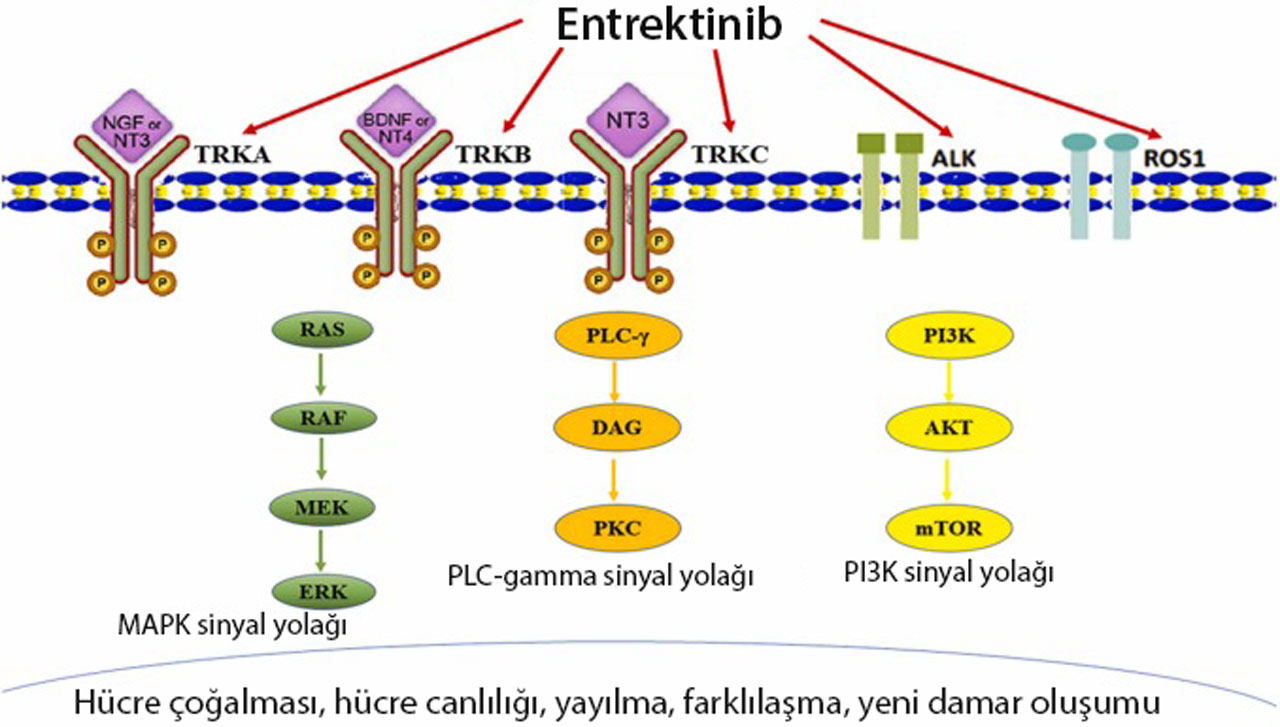
The image above shows the signaling pathways targeted by entrectinib (Rozlytrek). The medicine inhibits TRKA, TRKB, TRKC, ROS1, and ALK receptors to prevent cell proliferation, metastasis, and blood vessel formation. It achieves these effects by blocking pathways such as MAPK, PLC-gamma, and PI3K/AKT/mTOR, thereby stopping tumor growth.
FDA (United States Food and Drug Administration) Approval History
-
20 October 2023: The FDA expanded the pediatric indication for entrectinib (Rozlytrek) and approved a new pellet formulation.
Licensing in Turkey
The conditions/therapeutic indications for which entrectinib is licensed in Turkey are listed as follows:
- Entrectinib (Rozlytrek) is indicated as monotherapy for pediatric and adult patients aged 12 years and older with neurotrophic tyrosine receptor kinase (NTRK) fusion-positive locally advanced or metastatic solid tumors, progression after at least one line of treatment, and ECOG performance status 0-2.
- Entrectinib (Rozlytrek) is indicated as monotherapy until progression for patients with ROS1-positive locally advanced or metastatic non-small cell lung cancer (NSCLC), ECOG performance status 0-2, and no prior ROS1 inhibitor treatment.
Is Entrectinib Reimbursed?
It is not reimbursed by SGK.
Price in March 2026: Pharmacy selling price of ROZLYTREK (entrectinib) hard capsules, 200 mg, 90 capsules: 271975.53 TL. 90 capsules correspond to a 1-month supply.
Resistance Mechanisms
- Mutations in the TRK kinase domain (e.g., TRKA-G595R, TRKA-G667C, TRKC-G623R).
- Activation of RAS and ERK signaling. In particular, KRAS G12C mutations have been identified.
- Activation of IGF1R signaling through IGF1R mutations.
Pharmacokinetic Properties
-
Absorption
-
Oral bioavailability is 34%. Time to Cmax is 4–6 hours. Food does not affect absorption.
-
-
Distribution
-
Plasma protein binding is >99%. Steady-state levels are reached in approximately 2 weeks.
-
-
Metabolism
-
Primarily metabolized in the liver by CYP3A4 enzymes. M5 is an active metabolite and the main active metabolite detected in peripheral blood.
-
-
Excretion
-
Of the drug dose, 83% is excreted in feces (36% as the parent compound and 22% as the M5 metabolite). Urinary excretion is 3%.
-
-
Half-Life
-
Entrectinib: 20–22 hours; M5: 40 hours.
-
Dosage
-
ROS1-positive NSCLC
-
600 mg PO once daily.
-
-
NTRK gene fusion-positive tumors
-
600 mg PO once daily.
-
Drug Interactions
-
CYP3A4 inhibitors
-
Medicines such as ketoconazole, itraconazole, erythromycin, and clarithromycin may reduce entrectinib metabolism and increase toxicity.
-
-
CYP3A4 inducers
-
Medicines such as rifampin, phenytoin, and carbamazepine may increase entrectinib metabolism and reduce efficacy.
-
Precautions
-
No dose adjustment is needed in mild liver impairment. It has not been studied in moderate or severe impairment.
-
No dose adjustment is needed in mild/moderate kidney impairment. There are no studies in severe impairment.
-
Avoid CYP3A4 inducers and inhibitors where possible.
-
Monitoring Heart Function
-
Monitor ECG and QT interval during treatment.
-
-
Monitoring Liver Enzymes
-
Perform liver function tests periodically during treatment to help control the risk of hepatotoxicity.
-
What Are the Side Effects?
- Neurotoxicity: Cognitive impairment, confusion, dizziness, and sleep disturbance.
- Hepatotoxicity: Increased SGOT (AST) and SGPT (ALT).
- Gastrointestinal effects: Nausea, vomiting, constipation, and abdominal pain.
- Fatigue and anorexia.
- Heart failure.
- Vision disorders: Blurred vision, photophobia, and double vision.
- QT prolongation.
- Increased fracture risk.
- Hyperuricemia.
Was this article helpful?
Your feedback helps us improve our content.


Reader comments
Share your comment
Your name and comment are published only after administrator approval. Your email address is never shown to visitors.
Be the first to comment.