
Why Does the KRAS Oncoprotein Matter in Cancer? Its Role in Cellular Signaling

In this article
Oncoproteins and Signaling Pathways in Cancer
What Is an Oncoprotein?
Oncoproteins generally regulate cell growth, division, and survival. In a normal cell, however, the balance of these proteins is carefully controlled. Oncogenes are mutated genes that can turn normal cellular proteins into "oncoproteins," causing uncontrolled cell growth and cancer.
What Are Some Known Oncoproteins?
KRAS is one of the most frequently mutated oncoproteins.
In addition, EGFR (epidermal growth factor receptor), HER2, MYC and BRAF are among the oncoproteins commonly seen in cancer. Each contributes to uncontrolled cell growth by activating different signaling pathways.
What Is an Intracellular Signaling Pathway?
Intracellular signaling pathways are complex protein chains that transmit messages from the cell's surroundings to its nucleus and determine its response. They regulate division, differentiation, and programmed cell death (apoptosis). Healthy cells maintain balanced signaling, but oncoproteins disrupt these pathways, giving cells excessive growth or immortality.
Discovery of Oncoproteins and Evolving Research
Oncoprotein discovery dates to the 1970s. Identifying RAS genes from rat sarcoma (RAS) viruses and their cellular counterparts transformed cancer biology. Studies at that timerevealed links between cellular signaling and oncogenic mutations. Genetic analyses in the 1980s identified other oncoproteins, including EGFR, HER2, and BRAF, each becoming a new cancer treatment target.
Understanding how oncoproteins such as KRAS cause cancer and how new treatments target them is now crucial for both basic science and clinical research.
Every Year, 3.4 Million RAS-Mutant Cancers Are Diagnosed
RAS-family gene mutations occur in approximately 20% to 30% of human cancers. RAS mutations have been detected in 90% of pancreatic cancers, 50% of colon cancers, and 30% of lung adenocarcinomas. How was their significance recognized, and what does new research show? An article published on January 15, 2025, in NEJMby Dr. Piro Lito, entitled "KRAS Oncoprotein Signaling in Cancer," offers important, accessible insights.
The KRAS Oncoprotein
The discovery of DNA encoding RAS guanosine triphosphatases (GTPases) in rat sarcoma viruses, followed by identification of oncogenic RAS mutations in patients, launched a 50-year effort to study and therapeutically target RAS.
In particular, inhibitors targeting KRAS G12C (replacement of glycine with cysteine at codon 12) have brought major advances in KRAS-mutant cancers such as lung, colon, and pancreatic adenocarcinoma. Their development also helped clarify how KRAS mutations contribute to cancer.
The old model held that mutant KRAS continuously stimulated growth and division signals. New findings show that KRAS actually switches between active and inactive states. Two new studies, by Jeffrey Klomp's and Jennifer Klomp's teams, suggest that KRAS influences growth-controlling pathways differently from what was previously thought.
KRAS Signaling: Is RAF the Only Pathway?
Earlier genetic studies suggested mutant RAS could activate many pathways, including RAF, PI3K, and RALGDS. Jeffrey Klomp's team analyzed KRAS signaling output in pancreatic adenocarcinoma models using RNA sequencing. The results showed that its effects were transmitted largely through RAF-MEK-ERK .
- Blocking the RAF-MEK-ERK signaling pathway can stop cell proliferation.
- Making ERK continuously active abolished the growth-suppressing effect of KRAS inhibitors on tumors.
- In contrast, activating AKT in the PI3K pathway produced no significant change in proliferation.
These findings suggest that mutant KRAS depends mainly on RAF-MEK-ERK to sustain tumor growth.
The figure belowis an important visual guide to the cellular effects of KRAS mutations and treatment approaches. It illustrates mutant KRAS interactions with different effector proteins and signaling diversity. Panel A presents the traditional model, while Panel B shows a more current, refined model. It also visually supports ERK's pleiotropic effects discussed in the section "The Diverse Effects of ERK."
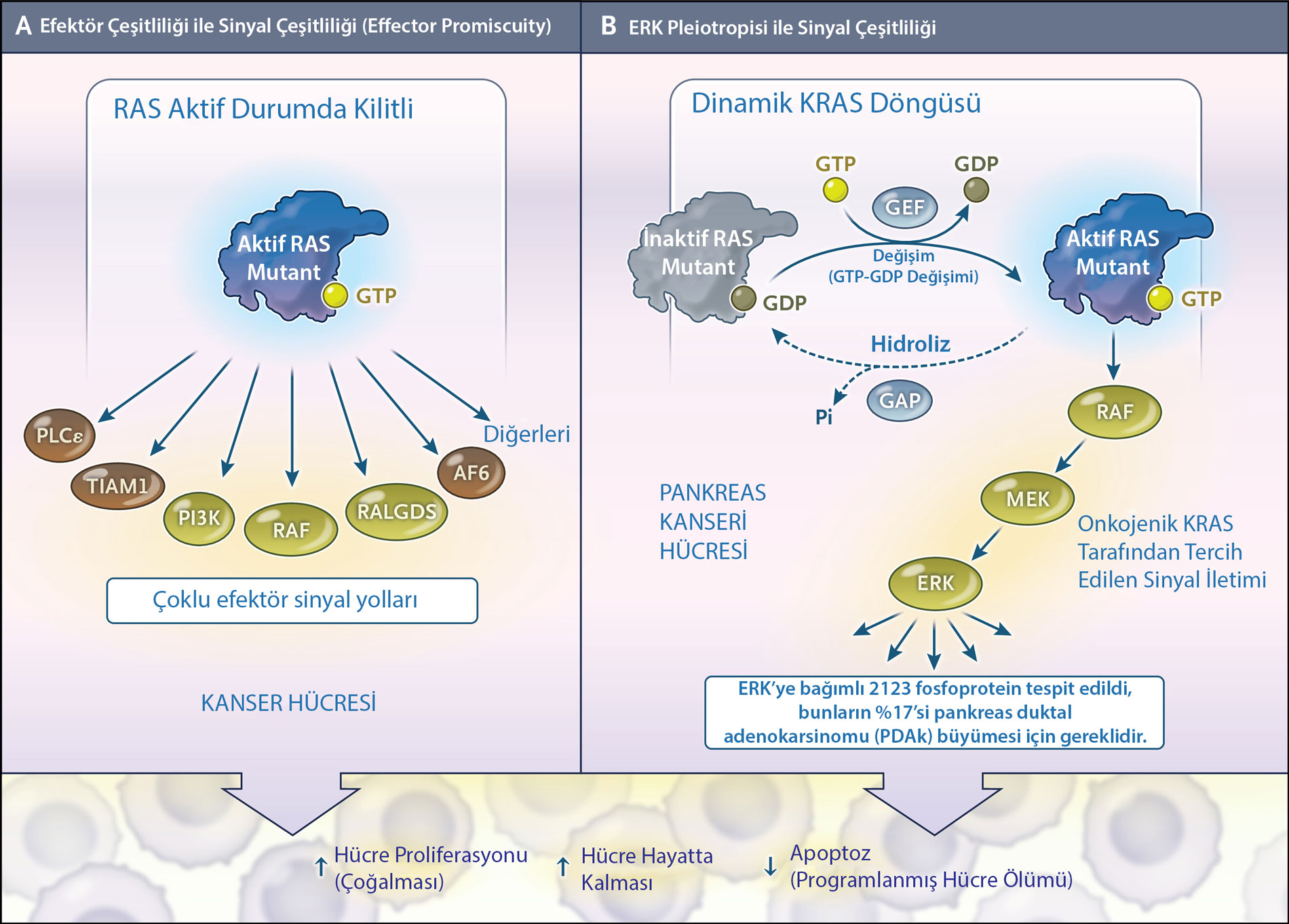
Figure Explanation:
The figure explains KRAS oncoprotein effects through two models:
- Panel A: The traditional model, in which oncogenic RAS proteins (KRAS, NRAS, HRAS) regulate cellular processes through many effector pathways.
- Panel B: A refined model developed in light of new KRAS inhibitors. Mutant KRAS cycles between an active GTP-bound and inactive GDP-bound state, providing a window for inhibitors to act when KRAS is "off."
The Diverse Effects of ERK
Using mass spectrometry, Jennifer Klomp's team analyzed ERK signaling effects on protein phosphorylation and identified 2123 ERK-dependent phosphoproteins . Two thirds had not previously been reported.
ERK was found to influence processes throughout the cell cycle, from DNA replication and RNA processing to intercellular communication and cell death. Key findings include:
- 17% of ERK phosphoproteins were critical for cellular proliferation.
- This suggests that KRAS-mutant pancreatic cancers depend heavily on ERK signaling for survival.
Resistance Mechanisms and Alternative Pathways
Tumors can sometimes develop resistance to treatments targeting KRAS-RAF-MEK-ERK. Studies also identified potential adaptation mechanisms against KRAS inhibitors:
- RHO proteins and other members of the RAS family may take over signaling.
- Other kinases capable of acting on the same target proteins as ERK may become activated.
Clinical validation of these findings is therefore important. Tissue samples from patients treated with KRAS inhibitors may help clarify these adaptation mechanisms.
KRAS Inhibitors and Clinical Success
Clinical trials of small molecules directly targeting KRAS have so far shown limited benefit. Two mechanisms may explain this:
- Effector diversity: KRAS activates several signaling pathways simultaneously.
- Multiple effects through one pathway: KRAS regulates many cellular processes mainly through ERK.
The Klomp teams' studies suggest that different nodes of ERK signaling need to be targeted simultaneously. However, if parallel pathways also support tumor growth or become resistance mechanisms, they may need targeting as well.
Conclusion: A Multifaceted Approach to More Effective Treatments
Each year, approximately 3.4 million patients are diagnosed with RAS-mutant cancers. Improving treatment of KRAS-mutant cancers requires strategies targeting several pathways simultaneously. New medicines that disrupt PI3K–RAS interactions may play an important role in improving outcomes.
New clinical-trial molecules such as BBO-10203 offer promising results for closing gaps in KRAS signaling. Ultimately, understanding cancer's biological diversity and signaling mechanisms is critical for more durable responses and better patient outcomes.
Sources
Was this article helpful?
Your feedback helps us improve our content.




Reader comments
Share your comment
Your name and comment are published only after administrator approval. Your email address is never shown to visitors.
Be the first to comment.