
Advances in Ovarian Cancer Treatment – 2023

In this article
Ovarian cancer is a major health problem for women worldwide and is often diagnosed at an advanced stage. One of the greatest treatment challenges is that cancer recurs after initial treatment in most patients, becomes resistant to chemotherapy over time, and available treatments generally have limited, temporary effectiveness. Finding more effective, tolerable strategies is therefore vital for women affected by ovarian cancer.
The most important advance in ovarian cancer treatment over the past 20 years has been the PARP inhibitor olaparib (Lynparza), approved by the FDA in 2014. Its success led other PARP inhibitors through FDA approval. After 2020, however, different drug classes and combinations began to emerge. These approaches could accelerate progress and offer patients more promising treatment options.
Results from trials such as MIRASOL, DUO-O and RAMP 201, presented at ASCO 2023, represent promising developments for ovarian cancer patients. These studies are important steps toward improving existing options or identifying new treatment approaches.
The MIRASOL Study
MIRASOL is a phase 3 trial evaluating the effectiveness and safety of mirvetuximab soravtansine (Elahere) in patients with platinum-resistant, advanced high-grade epithelial ovarian, primary peritoneal or fallopian tube cancer and high folate receptor alpha (FRα) expression. It was among the notable studies presented at the 2023 ASCO Annual Meeting.
Note: Elahere, developed by Immunogen and containing mirvetuximab soravtansine-gynx, based on the SORAYA clinical trial results, received accelerated FDA (US Food and Drug Administration) approval on November 14, 2022 for patients with platinum-resistant, folate receptor-alpha (FRa)-positive, advanced epithelial ovarian, fallopian tube or primary peritoneal cancer who had received 1 to 3 prior treatment lines. It was the first FDA-approved antibody-chemotherapy conjugate for platinum-resistant ovarian cancer.
MIRASOL showed that mirvetuximab soravtansine, compared with investigator-selected chemotherapy, significantly improved progression-free survival (PFS) and overall survival (OS). Median PFS was 13.8 months with mirvetuximab soravtansine versus 4.8 months with chemotherapy. Median OS had not yet been determined in the mirvetuximab soravtansine group, compared with 21.9 months in the chemotherapy group.
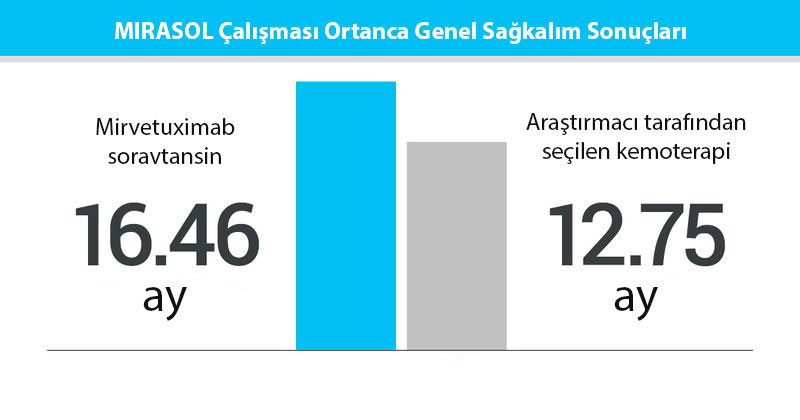
MIRASOL represents important progress in platinum-resistant ovarian cancer. Mirvetuximab soravtansine is the first drug to show statistically significant improvements in PFS and OS in this group. It is now being evaluated in a phase 3 trial as first-line treatment for platinum-sensitive ovarian cancer.
Some additional study details:
- The study enrolled 453 patients with platinum-resistant, advanced high-grade epithelial ovarian, primary peritoneal or fallopian tube cancer and high FRα (folate receptor-alpha) expression.
- Patients were randomized to mirvetuximab soravtansine (6 mg/kg adjusted ideal body weight on day 1 of a 21-day cycle) or chemotherapy (paclitaxel, pegylated liposomal doxorubicin or topotecan).
- The primary endpoint was progression-free survival.
- Secondary endpoints included overall survival, the safety profile of mirvetuximab soravtansine and quality of life.
| Outcome | Mirvetuximab soravtansine | Investigator-selected chemotherapy | |
| Objective response rate | 42% | 16% | |
| Median progression-free survival | 5.62 months | 3.98 months | |
| Hazard ratio= 0.65 (p< 0.0001) | |||
| Median overall survival | 16.46 months | 12.75 months | |
| Hazard ratio= 0.67 (p< 0.0046) | |||
MIRASOL is an important step toward new treatments for platinum-resistant ovarian cancer. Mirvetuximab soravtansine is a promising drug with the potential to improve outcomes in this aggressive disease.
The DUO-O Study
DUO-O is a phase 3 trial evaluating the effectiveness and safety of adding durvalumab (Imfinzi) and olaparib (Lynparza) to standard treatment in newly diagnosed advanced ovarian cancer without BRCA mutations. It was another notable study at the 2023 ASCO Annual Meeting.
Interim findings showed significantly longer progression-free survival (PFS) with durvalumab and olaparib than with standard treatment alone. Median PFS was 20.2 months with the combination versus 11.9 months with standard treatment alone.

The combination also showed a trend toward improved overall survival, but data are not mature enough for definitive conclusions.
The combination was generally well tolerated. The most common side effects were fatigue, nausea and vomiting.
DUO-O represents an important development for advanced ovarian cancer without BRCA mutations. Durvalumab and olaparib appear to offer a safe, effective way to improve progression-free and possibly overall survival in this group.
Related Topic: What Is HRD? How Is It Tested, and Why Does It Matter in Cancer?
Some additional study details:
- The study enrolled 1,130 patients with newly diagnosed advanced ovarian cancer without BRCA mutations.
- Patients were randomized to durvalumab (10 mg/kg every 2 weeks) and olaparib (300 mg twice daily) plus standard treatment (paclitaxel/carboplatin and bevacizumab), or standard treatment alone.
- The primary endpoint was progression-free survival.
- Secondary endpoints included overall survival, the combination's safety profile and quality of life.

DUO-O is an important step toward new treatments for advanced ovarian cancer. More data will be needed to confirm these findings, but the results are promising.
The RAMP 201 Study
RAMP 201 is a phase 2 clinical trial evaluating the effectiveness and safety of avutometinib (VS-6766) plus defactinib in recurrent low-grade serous ovarian cancer (LGSOC). It was presented in a poster discussion session at the 2023 ASCO Annual Meeting.
Interim results from Part A showed a confirmed objective response rate of 28% with avutometinib plus defactinib in heavily pretreated recurrent LGSOC. Median progression-free survival had not yet been determined, while median response duration was 10.4 months.
Avutometinib and defactinib target different parts of the same signaling pathway, MAPK. MAPK pathways are a series of proteins transmitting signals from the cell surface to the nucleus. These signals control important processes including cell growth, differentiation and apoptosis (programmed cell death).
Avutometinib is a RAF/MEK inhibitor. It works by blocking a protein called RAF. RAF activates MEK, which activates ERK, another protein controlling cell growth and proliferation. By blocking RAF activity, avutometinib can prevent ERK activation and inhibit cell growth.
Defactinib is a FAK inhibitor. FAK is a protein involved in cell adhesion and migration. By inhibiting FAK, defactinib may prevent cancer cells from spreading.
Avutometinib and defactinib are being studied in clinical trials for various cancers, including breast, ovarian and lung cancer. Results are not yet available, but the trials are expected to provide important information about effectiveness and safety.
Overall response rates from RAMP 201 are shown below:
| Patient group | Avutometinib plus defactinib | Avutometinib alone |
| All patients | 45% | 10% |
| KRAS-mutant | 60% | 7% |
| KRAS-wild | 29% | 0% |
No new safety signals emerged, and most side effects were mild to moderate. The most common were fatigue, nausea and vomiting.
The promising interim RAMP 201 results suggest that avutometinib plus defactinib could offer a new option for recurrent LGSOC. The trial continues, and more data will become available.
Some additional study details:
- The study enrolled 69 patients with recurrent LGSOC who had received at least two prior treatment lines.
- Patients were randomized to receive either avutometinib (300 mg twice daily) or placebo with defactinib (100 mg twice daily).
- The primary endpoint was objective response rate.
- Secondary endpoints included median progression-free survival, response duration and the combination's safety profile.
RAMP 201 is an important step toward new treatments for recurrent LGSOC. Avutometinib plus defactinib appears to be a safe, effective option for patients with this aggressive disease. More data are needed to confirm these findings, but RAMP 201 results are promising.
HIPEC Studies
Hyperthermic IntraPeritoneal Chemotherapy (HİPEK in Turkish, HIPEC in English= Hyperthermic IntraPeritoneal Chemotherapy) is a specialized treatment used for certain cancers. It is generally used for cancers with peritoneal (intra-abdominal) spread, including ovarian, colon and stomach cancers and mesothelioma.
HIPEC generally has two stages. First, as much tumor as possible is removed surgically, a procedure called "cytoreductive surgery." Chemotherapy drugs are then applied directly into the abdominal cavity at a temperature above normal body temperature (around 42°C). This may help them penetrate and kill cancer cells more effectively. The two-stage approach aims to remove large tumors and kill remaining microscopic cancer cells.
Ovarian cancer is often diagnosed at an advanced stage, when disease has generally spread into the peritoneum. By targeting these disseminated cancer cells, HIPEC may offer a treatment option.
More research is needed into HIPEC's effectiveness and side effects. Some studies show longer survival, while others have limited wider use because of side effects and cost. At ASCO 2023, 2 notable studies evaluated HIPEC in ovarian cancer.
The OVHIPEC-1 Study
Phase 3 OVHIPEC-1 was the first randomized clinical trial of HIPEC and included newly diagnosed stage 3 ovarian cancer. The ten-year follow-up results are shown below.

An overall survival advantage was observed with a risk ratio of 0.7, and median overall survival increased from 33 to 44.9 months, a 30 percent improvement.
The CHIPOR Study
CHIPOR is a phase 3 randomized trial of HIPEC at first platinum-sensitive relapse. It examined chemotherapy response followed by surgery with or without HIPEC. More than 400 women participated, and the results showed improved overall survival with a risk ratio of 0.69.
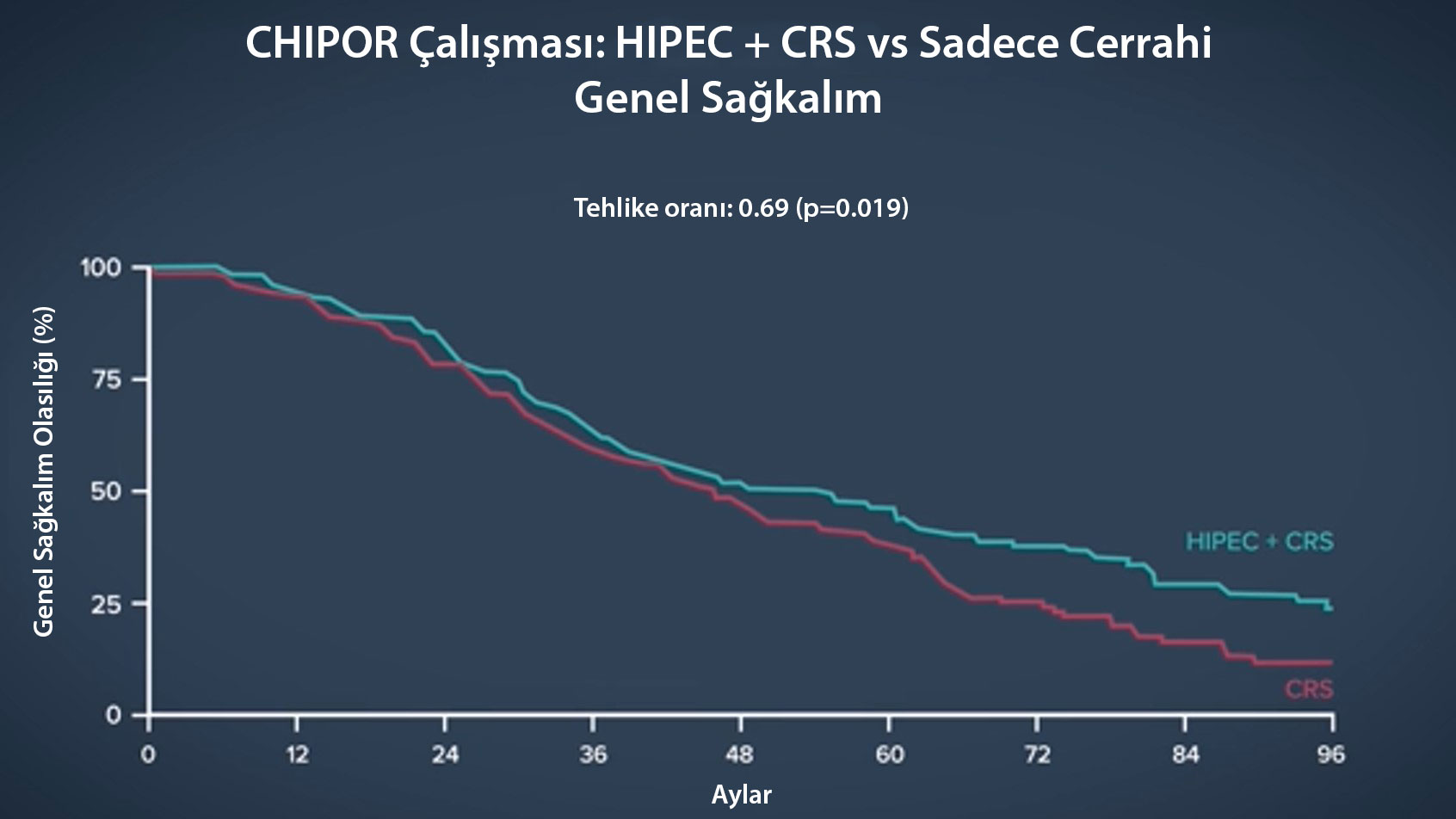
Taken together, the two studies suggest that HIPEC may have an important role early in ovarian cancer treatment. The full publications of these presentations should be reviewed. We must also recognize that we are in the era of adding bevacizumab and PARP inhibitors to standard treatment.
Sources
Was this article helpful?
Your feedback helps us improve our content.


Reader comments
Share your comment
Your name and comment are published only after administrator approval. Your email address is never shown to visitors.
Be the first to comment.