
An Important Development in a Lung Cancer Vaccine

In this article
Lung cancer remains the leading cause of cancer deaths worldwide, making any progress in this field a new source of hope for patients. The French biotechnology company OSE Immunotherapeutics has developed a therapeutic cancer vaccine candidate called Tedopi, which could be an important step in lung cancer treatment.
Cancer vaccines are medicines designed to help prevent or treat cancer. There are two main types:
- Preventive cancer vaccines are designed to prevent infections that can cause cancer. The hepatitis B vaccine, for example, helps prevent hepatitis B virus infection, which can cause liver cancer. The HPV vaccine helps prevent human papillomavirus (HPV), which can cause cervical cancer.
- Therapeutic cancer vaccines are designed to stimulate the immune system to destroy cancer cells. Sipuleucel-T, approved for prostate cancer treatment only in the United States, trains the immune system to recognize and destroy prostate cancer cells.
The Phase 3 Atalante-1 Trial: Positive Results for Tedopi
OSE Immunotherapeutics, having shared phase 1 and 2 clinical trial data a few months earlier, announced positive results for its therapeutic cancer vaccine. The company-funded phase 3 Atalante-1 trial showed benefits of Tedopi (code name OSE2101) in patients receiving second- or third-line treatment for advanced non-small cell lung cancer. Tedopi stands out as the most advanced therapeutic cancer vaccine.
Data from Atalante-1 were presented at the 2023 World Conference on Lung Cancer and simultaneously published in Annals of Oncology.
Mechanism of Action of Tedopi
Tedopi is a therapeutic cancer vaccine designed particularly for patients carrying the HLA-A2 gene. This gene occurs in approximately half the population and can help identify patients who may be candidates for this treatment, serving as a biomarker. Patients can have a blood test to determine whether they carry this gene.
The vaccine works by activating tumor-specific T lymphocytes (a type of white blood cell). This activation involves synthetic tumor neo-epitopes (peptide fragments) targeting five different tumor antigens. These peptides are specific protein fragments found on cancer cell surfaces but not on normal cells.
Combining these five antigens in the vaccine aims to prevent cancer cells from “escaping” the immune system. Cancer cells can sometimes deceive it and become unrecognizable, allowing them to evade immune defenses and spread. The vaccine “trains” the immune system to recognize and target them, thereby preventing their escape.
This is a form of cancer immunotherapy in which the immune system is “boosted” or “modified” to fight cancer.
The illustration below shows the mechanism of action of this neo-peptide vaccine:
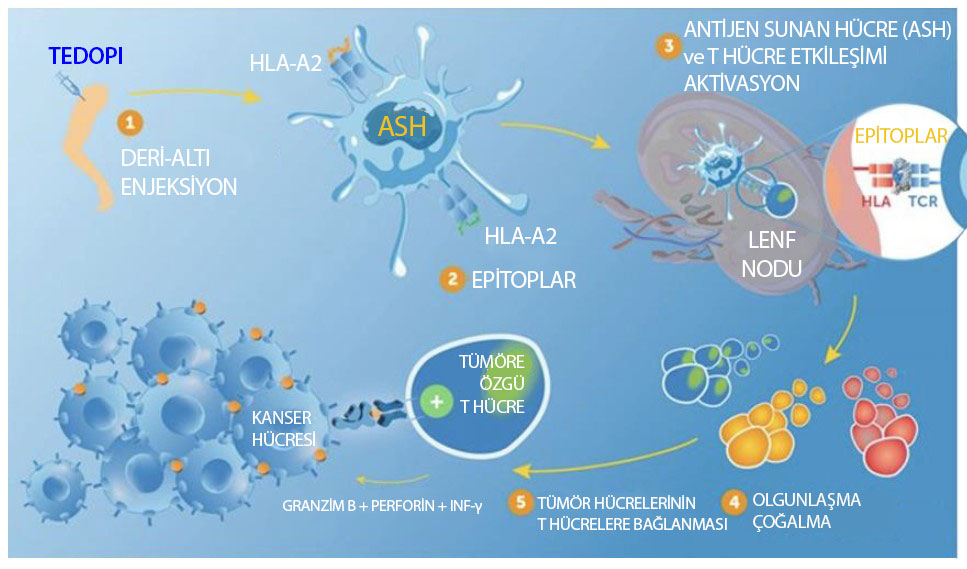
The vaccine contains neo-peptides. This therapeutic lung cancer vaccine candidate is an immunotherapy that stimulates an antitumor immune response by activating specific T cells.
- A unique neo-epitope combination: small peptides derived from tumor-specific antigens expressed in various cancers.
- Strong binding to the HLA A2 receptor (45% of the population).
- Unlike checkpoint inhibitors, which release the brakes on the immune response, it directly activates tumor-specific T cells.
Details of the Atalante-1 Study
Participants had locally advanced or metastatic non-small cell lung cancer resistant to prior immunotherapy and an HLA-A2 phenotype.
Experimental (vaccine) group:
- The vaccine was given subcutaneously on day 1 every 3 weeks for six cycles.
- It was then given every 8 weeks during 1 year of treatment, and subsequently every 12 weeks.
Control (standard treatment) group:
- This arm received standard care or chemotherapy. Most control patients in the study—about 80%—received the chemotherapy drug docetaxel.
The primary endpoint was overall survival.
Results
Because of the COVID-19 pandemic, the planned enrollment of 363 patients could not be completed, and the study stopped with 219 patients enrolled.
Overall Survival Rates
- Of patients treated with Tedopi, 44% were alive after one year.
- Of those treated with docetaxel, 27.5% were alive after one year.
Reduction in the Risk of Death
- Tedopi reduced patients' risk of death by 41% compared with chemotherapy.
Median Overall Survival
- Median overall survival was 11.1 months in patients treated with Tedopi.
- Median overall survival was 7.5 months in those treated with docetaxel.
Positive Response Rate
- The objective response rate to Tedopi was 54%.
Secondary Resistance
- The vaccine showed a positive signal in patients who had previously responded to immunotherapy. These patients have “secondary resistance” to immunotherapy.
Adverse Effects
- Tedopi caused fewer serious adverse effects than docetaxel (11.4% versus 35.1%).
- Tedopi allowed patients to maintain a better quality of life.
Below is the study's subgroup analysis:

The study's lead author, Dr. Benjamin Besse, explained: “This study showed a signal of improved overall survival in the selected patient group. In this study of 219 patients, we realized that only half truly benefited from the vaccine: those who had previously responded to immunotherapy. The study requires confirmation in a larger phase 3 trial with more than 300 patients to provide statistical power and convince regulators.”
The Near Future
Tedopi's clinical development continues, with three trials currently underway. Results of both trials are expected in 2025. OSE Immunotherapeutics is also working on a companion biomarker called the HLA-A2 test.
These developments could open a new era in lung cancer treatment, offering patients better quality of life and longer survival. Tedopi has the potential to complement existing treatment approaches and improve patient outcomes.
Sources
Was this article helpful?
Your feedback helps us improve our content.




Reader comments
Share your comment
Your name and comment are published only after administrator approval. Your email address is never shown to visitors.
Be the first to comment.