
An Important Step in Uterine Cancer Treatment – Dostarlimab Immunotherapy Receives FDA Approval

In this article
For mismatch repair-deficient (dMMR) or microsatellite instability-high (MSI-H) advanced or recurrent endometrial cancer, dostarlimab-gxly (Jemperli, GlaxoSmithKline), initially given with carboplatin and paclitaxel and then alone, is an immunotherapy that received FDA (United States Food and Drug Administration) approval on 31 July 2023. This is an approval for first-line systemic treatment of advanced endometrial cancer.
Endometrial cancer, the most common uterine cancer subtype, is one of the few cancers with rising incidence and mortality. It is the third most common cancer among women worldwide and the fourth leading cause of cancer-related death.
More than half of patients are diagnosed early because endometrial cancer typically causes noticeable symptoms, such as abnormal vaginal bleeding. These often prompt women to seek medical attention, leading to earlier diagnosis. Nevertheless, approximately 25-30% of patients are diagnosed at stages 3 and 4. For women with advanced or metastatic endometrial cancer, survival has changed little in the past 40 years, reflecting limited advances in systemic treatment.
What Are dMMR and pMMR?
These terms concern DNA repair mechanisms in endometrial tumors. MMR means “mismatch repair,” a mechanism that corrects mismatched DNA base pairs.
dMMR (Mismatch Repair-deficient) tumors have lost this mechanism's function and cannot correct mismatched base pairs. This leads to a genetic alteration called high microsatellite instability (MSI-H). These tumors tend to be more aggressive and more susceptible to the immune system, so they may respond better to immunotherapy.
pMMR (Mismatch Repair-proficient) tumors have a functioning repair mechanism that corrects mismatched DNA base pairs. They are called microsatellite stable (MSS) and tend to provoke a lower immune response. Understanding how immunotherapy works in them is therefore important.
About 30% of endometrial cancers are known to be dMMR, and these tumors are generally MSI-H.
The Study That Led to FDA Approval of Dostarlimab in Endometrial Cancer
Dostarlimab's efficacy was assessed in RUBY, a randomized, multicenter, double-blind, placebo-controlled trial. Efficacy was evaluated in a prespecified subgroup of 122 patients with advanced or recurrent dMMR/MSI-H endometrial cancer.
Patients were randomized (assigned at random) 1:1 to dostarlimab-gxly plus carboplatin and paclitaxel or placebo plus carboplatin and paclitaxel. Randomization was stratified by MMR/MSI status, prior radiotherapy, and disease status: recurrent, primary stage III, or primary stage IV.
The primary efficacy outcome was progression-free survival (PFS).
Study Results
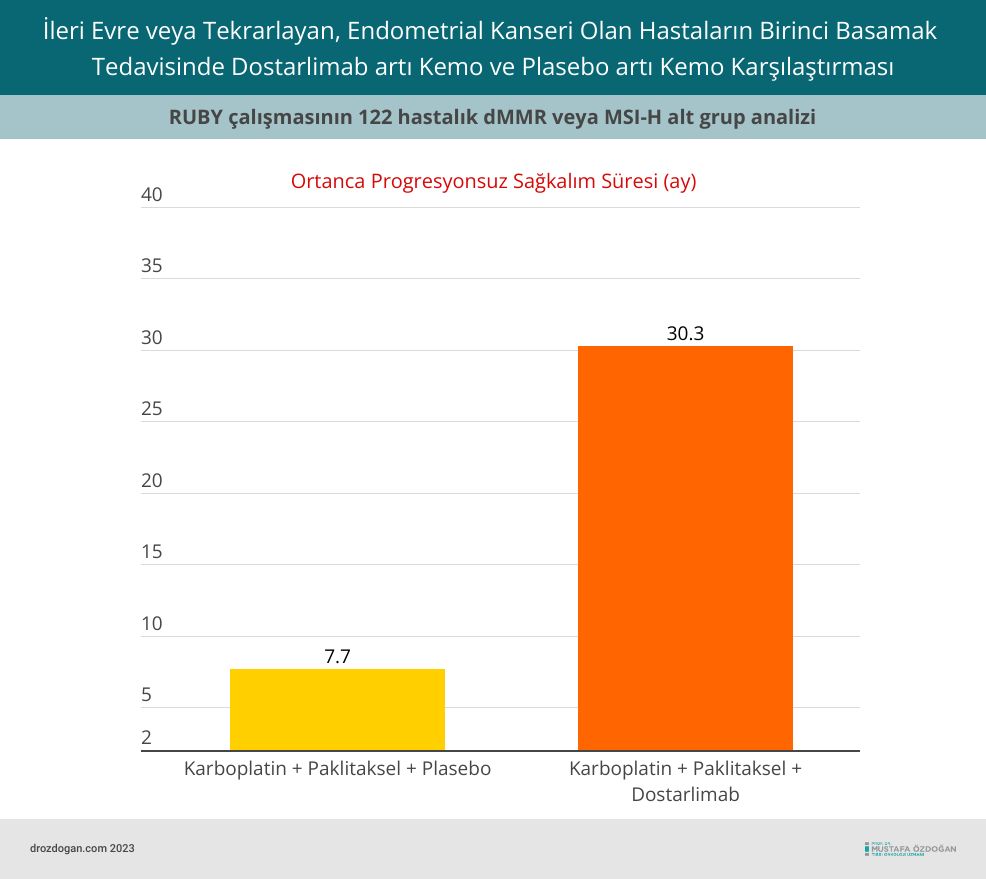
A statistically significant PFS improvement was seen in the dMMR/MSI-H group. Median PFS was 30.3 months with the dostarlimab-gxly regimen and 7.7 months with placebo (hazard ratio=0.29 [95% CI: 0.17, 0.50]; p-value<0.0001).
Immune-mediated adverse effects with dostarlimab-gxly included pneumonia, colitis, hepatitis, endocrinopathies, hypothyroidism, nephritis with renal dysfunction, and skin reactions. The most common adverse effects (more than 20%) with dostarlimab-gxly plus carboplatin and paclitaxel were rash, diarrhea, hypothyroidism, and hypertension.
The recommended dostarlimab-gxly dose is 500 mg every 3 weeks for 6 doses with carboplatin and paclitaxel, followed by monotherapy at 1,000 mg every 6 weeks until disease progression or unacceptable toxicity, or for a maximum of 3 years. When given on the same day, dostarlimab-gxly should precede chemotherapy.
*
How Is dMMR Tested?
Testing for dMMR (mismatch repair-deficient) tumors usually involves taking tissue samples for examination in molecular pathology or genetic laboratories. Two main methods are used:
-
Immunohistochemistry (IHC): This detects absent or reduced proteins associated with dMMR. IHC uses antibodies to target specific proteins and show whether they are present or absent. The MMR proteins are MLH1, MSH2, MSH6, and PMS2. Absence or low levels of one or more may indicate a dMMR tumor.
-
Microsatellite Instability (MSI) Testing: MSI testing compares DNA samples from tumor and normal tissue, looking for changes in microsatellites—short repeated DNA sequences. Such changes may indicate impaired MMR. Results are generally divided into MSI-high (MSI-H), MSI-low (MSI-L), and microsatellite stable (MSS). MSI-H indicates dMMR tumors.
The methods are often used together because results from one can be confirmed by the other, helping achieve more accurate and reliable dMMR tumor diagnosis.
Sources
2. Mansoor R. Mirza, Dana M. Chase, Brian M. Slomovitz, et al. Dostarlimab for Primary Advanced or Recurrent Endometrial Cancer. NEJM March 27, 2023
Was this article helpful?
Your feedback helps us improve our content.




Reader comments
Share your comment
Your name and comment are published only after administrator approval. Your email address is never shown to visitors.
Be the first to comment.