
Darolutamide Plus Docetaxel Receives FDA Approval for Stage 4 Hormone-Sensitive Prostate Cancer

In this article
Darolutamide tablets (Nubeqa, Bayer), combined with docetaxel chemotherapy for metastatic, stage 4, hormone-sensitive prostate cancer, received US Food and Drug Administration (FDA) approval on 5 August 2022.
For metastatic, hormone-sensitive prostate cancer, standard treatment adds either docetaxel chemotherapy or an androgen receptor pathway inhibitor—abiraterone, enzalutamide, apalutamide or darolutamide—to testosterone suppression. Either addition is known to substantially improve survival compared with testosterone suppression alone.
Although adding either docetaxel or an androgen receptor inhibitor improves survival, the effect of adding both docetaxel and an androgen receptor inhibitor simultaneously was unclear until ARASENS, the study supporting this approval.
FDA Approval Based on ARASENS
In March 2022, NEJM published results from the international, randomised, double-blind, placebo-controlled phase III ARASENS trial involving 1306 patients.
The experimental group’s 651 patients received darolutamide in addition to hormone suppression and docetaxel; the 655 controls received placebo with standard treatment. Adding darolutamide substantially improved survival. This was similar to the benefit previously seen when abiraterone was added to hormone suppression plus docetaxel in the phase III PEACE-1 trial.
The researchers reported that darolutamide reduced the risk of death by 32.5%.
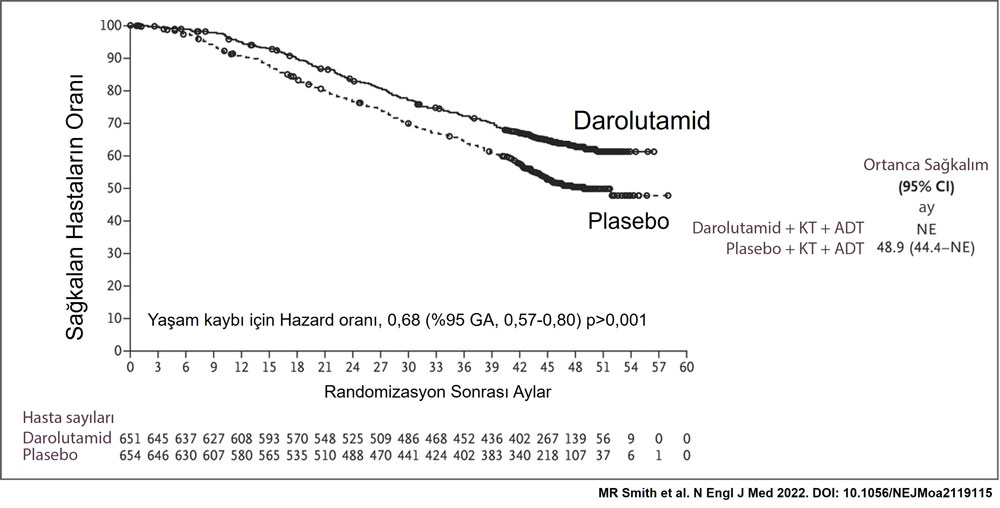
Figure Description: Median survival was not reached in the darolutamide group because more than half remained alive, compared with 48.9 months in the standard-treatment group. CT: chemotherapy; ADT: androgen deprivation therapy.
No greater toxicity was observed with the three-component versus two-component regimen. In both the abiraterone and darolutamide studies, the frequency of common androgen receptor inhibitor-related adverse effects differed from placebo by at most 2%.
The most common (≥10%) adverse effects were constipation, reduced appetite, rash, bleeding, weight gain and hypertension. The most common laboratory abnormalities (≥30%) were anaemia, hyperglycaemia, decreased lymphocytes, decreased neutrophils, increased AST, increased ALT and hypocalcaemia.
Most participants had bone metastases, visceral metastases or both at diagnosis. Information on benefit–risk assessment is therefore limited for patients with recurrent disease, nodal-only metastases or both, who have a better prognosis.
The recommended darolutamide dose for metastatic hormone-sensitive prostate cancer is 600 mg orally twice daily, as two 300 mg tablets, until progression or unacceptable toxicity. Docetaxel is given intravenously at 75 mg/m2 every 3 weeks for up to 6 cycles. Its first dose should be administered within 6 weeks of starting darolutamide.
*
What Is Darolutamide?
Darolutamide, marketed as Nubeqa, first received FDA approval in 2019 for the treatment of patients whose prostate cancer had not yet metastasised but had become resistant to hormone suppression. It is a structurally distinct androgen receptor inhibitor with low blood–brain barrier penetration and a relatively lower risk of drug interactions.
Below are simplified mechanisms for newer prostate cancer drugs: abiraterone, enzalutamide, apalutamide and darolutamide. Abiraterone inhibits enzymes involved in androgen production. Androgen receptor blockers such as darolutamide prevent androgen binding, movement into the nucleus and binding to DNA there.

*
Sources
2. Matthew R. Smith, et al. Darolutamide and Survival in Metastatic, Hormone-Sensitive Prostate Cancer. NEJM, February 17, 2022
Was this article helpful?
Your feedback helps us improve our content.




Reader comments
Share your comment
Your name and comment are published only after administrator approval. Your email address is never shown to visitors.
Be the first to comment.