
Does Polyp Size Affect Cancer Risk? A Colon Polyp Size Chart

In this article
Colon polyps are clusters of cells that grow in the colon. They vary in size and shape and may be benign or cancerous. Larger polyps generally carry a greater risk of becoming cancerous, making size important (see What Are Polyps, and How Should Colon Polyps Be Treated?)
There is no specific size at which a polyp can be declared cancerous. Most experts nevertheless consider a polyp reaching 1 centimeter (cm) in diameter to have a high cancer risk.
Colon Polyp Sizes
The illustration below shows colon polyp sizes and how they may relate to cancer:
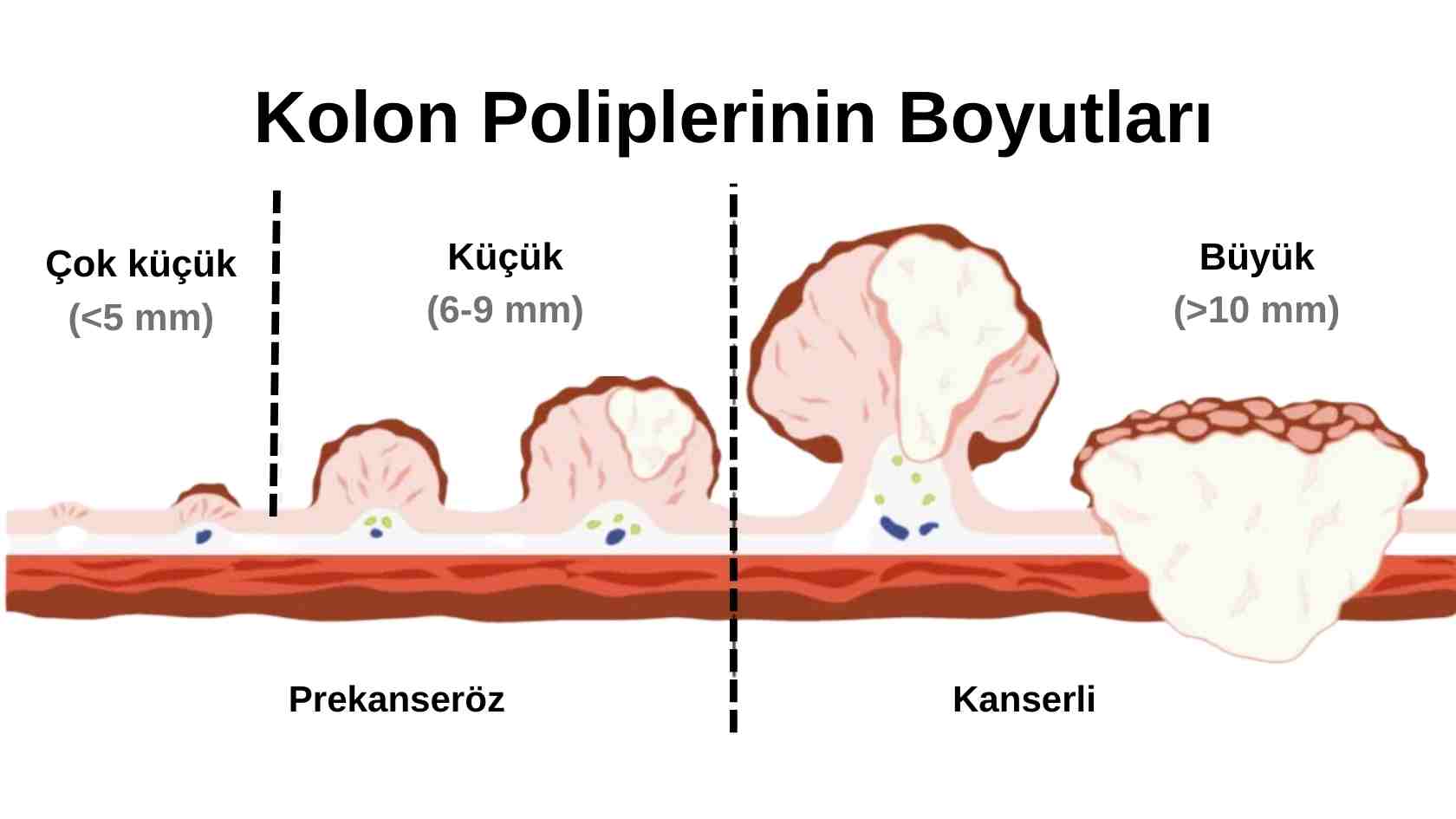
Classifying Colon Polyps by Size
Experts classify polyp sizes according to the following factors:
|
Colon polyp size |
Diameter |
Cancer Risk |
|
Diminutive |
5 mm or smaller |
Low cancer risk. A paper published in 2020 stated that 75% of all polyps are 5 mm or smaller and rarely become colorectal cancer. |
|
Small |
6 - 9 mm |
Low cancer risk. A 2017 study reported no cancer in 6523 small polyps. |
|
Large |
1 cm or larger |
Larger colon polyps may carry greater cancer risk. Experts call polyps larger than 1 cm “advanced.” Early monitoring should begin while polyps are still small. |
Colon Polyp Types and Cancer Risk
There are different types of colon polyps, each potentially carrying a different cancer risk:
|
Description |
Cancer Risk |
|
|
Inflammatory |
Inflammatory polyps may occur with inflammatory bowel disease (IBD). |
They are unlikely to become cancerous, but IBD increases colorectal cancer risk. |
|
Hamartomatous |
Hamartomatous polyps may occur in people with genetic conditions such as Peutz-Jeghers syndrome, Cowden syndrome, or juvenile polyposis. |
These polyps are unlikely to become cancerous. In people with a polyposis syndrome, however, they may carry a colorectal cancer risk. |
|
Hyperplastic |
Hyperplastic polyps are common and usually occur in the distal colon. |
Those on the right side of the colon may carry a cancer risk. Unless associated with an inherited condition, the risk is generally low. |
|
Adenoma |
Adenomas account for about two-thirds of colon polyps. |
They are precancerous: polyps with a high risk of becoming cancerous. |
|
Sessile Serrated Adenoma and Traditional Serrated Adenoma |
Sessile and traditional serrated polyps take their names from their rough, uneven edges. |
These polyps are precancerous, meaning they carry a high risk of becoming cancerous. |
How Are Colon Polyps Diagnosed?
Colon polyps are generally diagnosed through colonoscopy, an endoscopic procedure. Colonoscopy is the most common and accurate way to diagnose them. A doctor inserts a thin, flexible tube (colonoscope) into the colon. A camera and light at its tip allow visual examination of the colon and rectum. If a polyp is found, it can generally be removed during the same procedure (polypectomy) and sent to a laboratory for pathological examination.
The Shapes and Growth of Colon Polyps
Colon polyps grow slowly. It may take about ten years for a small polyp to form.
They may be flat or depressed in shape and can grow in two forms: sessile (without a stalk) or pedunculated (with a stalk).
- Sessile Polyps: These have no stalk and attach flat to the colon wall.
- Pedunculated Polyps: These grow on a narrow stalk, like a mushroom.
Such polyps may be noncancerous, precancerous, or cancerous.
The Shapes and Growth of Adenomas
Adenomas, accounting for about 66% of colon polyps, are precancerous. Their growth patterns and shapes include:
- Tubular Growth: Tube-shaped adenomas smaller than half an inch (approximately 1.27 cm).
- Villous Adenoma: Larger adenomas growing in an irregular, cauliflower-like pattern.
- Tubulovillous Adenoma: Adenomas combining tubular and villous growth patterns.
Polyp growth patterns can affect how frequently colonoscopy is needed. Adenomas may take about 10 years to become cancerous, although this varies and can be shorter in people with an inherited syndrome.
Should All Detected Polyps Be Removed?
According to the American Society for Gastrointestinal Endoscopy (AGED), detected polyps should generally all be removed.
Specialists can usually remove them during colonoscopy. Screening can remove all precancerous polyps, eliminating their risk of becoming cancerous. Any polyp left in place may cause bleeding, bowel obstruction, or cancer.
Related Topic: Incompletely Removed Colon and Rectal Polyps Often Recur
Colonoscopy Screening for Colorectal Cancer Risk
People at moderate colorectal cancer risk need periodic colonoscopy checks for colon polyps:
- Colorectal cancer screening begins at 45 and continues regularly until 75.
- Screening between 75-85 may differ from earlier screening, depending on factors such as overall health.
- Colorectal cancer screening is not performed at 85 or older.
People at high risk generally need to start colonoscopy before 45 and have more frequent checks. The starting age and frequency still vary by individual, so specialist advice is best.
Symptoms Caused by Colon Polyps
Polyps may cause no symptoms and are often found during colorectal cancer screening. This does not mean they never cause symptoms. When they do, these may include:
- Bright or dark red rectal bleeding
- Blood in the stool
- Mucus in the stool
- Abdominal pain
- Constipation
- Diarrhea
- Signs or symptoms of iron deficiency anemia
Frequently Asked Questions About Colon Polyps
What Sizes of Colon Polyps Are Concerning?
In a 2019 study of 15,906 polyps:
- No cancer was found in polyps smaller than 5 mm (millimeters).
- Among polyps larger than 30 mm, 4.3% were cancerous.
As this study shows, the risk of cancer developing in polyps smaller than 5mm is very low.
What Size Are Cancerous Polyps Usually?
According to the National Cancer Institute, colorectal cancer risk increases with polyp size. Of polyps larger than 2 cm, 30% to 50% are cancerous.
How Polyp Size Affects Cancer Risk: A Summary
Experts classify colon polyps by size, shape, and growth pattern. Colorectal cancer risk may increase with certain polyp types and sizes. Polyps may be noncancerous, precancerous, or cancerous, and may cause no symptoms. Regular colonoscopy and screening are therefore important, particularly for people at risk of colorectal cancer. Specialists can also remove noncancerous polyps during these examinations.
-Related Topic: Colonoscopy Screening for Colorectal Cancer
Sources
2. Hossain E, Bhandari P, Arndtz S, et alPWE-040 Cancers in colonic polyps: size mattersGut 2019;68:A191.
Was this article helpful?
Your feedback helps us improve our content.




Reader comments
Share your comment
Your name and comment are published only after administrator approval. Your email address is never shown to visitors.
Be the first to comment.