
Fad Diets, Weight-Loss Trends and the Facts

The Sylvester Graham Diet
The diet Graham launched in the late 1820s is considered by some to be the first fad diet . Graham believed certain foods caused overstimulation ; he particularly opposed white bread and meat products, which he believed caused immoral behavior, torpor and turmoil. He recommended a regular vegetarian diet, replacing meat with wheat.
Graham traveled in the United States and wrote prolifically to develop and communicate his experiences and beliefs. His radical ideas made him a well-known figure who inspired diet creators.
Although he claimed his approach could extend life to 100 years, Graham died at 57. Among his legacies, he is considered one of the founders of the vegetarian movement in the United States.

Fletcherism
Horace Fletcher was a wealthy businessman and self-proclaimed nutrition expert in the 20th century. According to Fletcher, foods not requiring much chewing should be consumed. After 100-700 chews, food that had become liquid and collected in the mouth should be swallowed, while solid material should be spat out. This diet primarily advocated vegetarianism.

Hauser’s Cosmetic Diet - associating unhappiness with fat
Hauser associated unhappiness with fat. Intelligent women, fashion and society leaders were the audience for his diet, which promised that restricting food intake and not consuming foods such as fruit juices, wheat, molasses, nuts, yogurt and yeast would make a person more beautiful.
The cosmetic diet combined foods rich in sulfur and iron with citrus juices to create "ideal" skin. Like many elimination diets , it was far from sustainable.

The Rice Diet
The rice diet is a type of diet consisting on average of 25% protein, 25% fat, 50% carbohydrate, unlimited salt and unlimited calories.
Followers consumed fruit, fruit juices and vitamin supplements alongside white rice. Calories had to be counted to provide no more than 2000 calories daily, and the diet included a maximum of 150 mg of salt with restricted fluid intake. Of course, it was neither healthy nor sustainable.

Dr Stoll’s Diet Aid Liquid Diets
Dr Stoll’s Diet Aid was one of the first formulated liquid meal supplements. A glass of the liquid diet, containing chocolate, starch, whole wheat and oats processed in a food processor, was consumed at breakfast and lunch.
Among liquid diets, the juice diet is nutritionally inadequate and can cause rapid weight loss, potentially interfering with blood sugar levels and medications and creating unnecessary risks for people with certain pre-existing medical conditions.
In the 1950s, the cabbage soup diet promised weight loss over 7 days of 5 kilos. The diet contains high salt levels and causes tiredness, muscle loss and bloating.

The Zen Macrobiotic Diet
According to this diet, foods are yin or yang and divided into two groups: acid-forming or alkaline-forming. The diet consists of minimally processed, locally sourced, organically grown foods: 40 - 60% whole grains; 20% to 30% fresh vegetables; 5 - 10% legumes; 5 - 10% vegetables; and some fruit, white meat, fish and nuts.
Some regarded it as part of an anti-establishment movement, and it caused controversy through claims that it was an alternative cancer treatment. In the early 1970s, in the absence of supporting clinical trials and data, both the AMA and the American Cancer Society issued strong warnings against it. In 1972, the American Cancer Society wrote that the diet "poses a serious threat to health and is not beneficial in treating cancer."
The diet was popular in the 1960s and 1970s and can be viewed as a precursor to a range of plant-based, high-fiber, low-fat diets and organic food movements.

The Drinking Man’s Diet
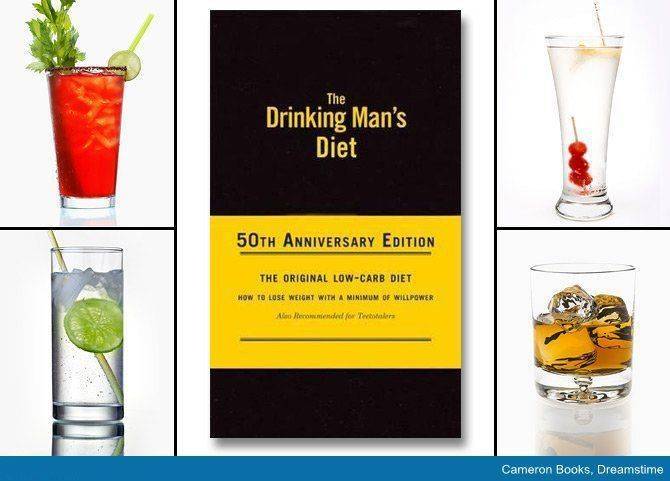
The Drinking Man’s Diet: How to Lose Weight with a Minimum of Willpower?,
This high-protein, high-fat, low-carbohydrate diet claims that men should consume only masculine foods. It also states that alcoholic drinks may be consumed freely.
Although a fabrication, as a high-protein, low-carbohydrate diet it helped pave the way for the Atkins and Dukan diets.
The Beverly Hills Diet
The diet was endorsed by actors and entertainers. Its creator, Judy Mazel, who had no scientific or nutritional training, opened a diet clinic in Beverly Hills and claimed the diet had helped her lose more than 70 kilos.
This fruit-based diet promises weight loss after 5 weeks of 10-15 kilos. Following this period, carbohydrates, fats and protein are gradually reintroduced according to strict rules. Fruit must always be eaten alone; protein may be eaten with fat but not carbohydrates; carbohydrates must not be eaten with protein; and beer counts as a carbohydrate. Wine is considered a serving of fruit, but champagne is "neutral" and may be consumed at any time.
In a JAMA article in 1981, Dr. Gabe Mirkin and Ronald Shore strongly criticized the diet for lacking a scientific and nutritional foundation, and Mazel’s theory that weight gain resulted from undigested food "trapped" in the body.

Stone Age and Paleolithic Diets
Modern interest in eating like our prehistoric ancestors arose in 1975, when gastroenterologist Dr. Walter Voegtlin proposed the Stone Age Diet, including meat, animal fats and plants but eliminating dairy and grains. In the 1980s, Stanley Boyd Eaton published a similar prehistoric East African Diet. Other researchers also investigated the health benefits of the traditional Inuit diet.
However, popular interest in Prehistoric Diets began in 2002 when Loren Cordain, a professor of health and exercise sciences, published The Paleo Diet. This high-protein diet includes lean meat, fish, fruit, vegetables, some animal fats and eggs while avoiding processed foods, wheat, dairy products, grains, legumes, sugar, salt and potatoes. According to Cordain, it is a diet claiming that we are genetically adapted to eating like hunter-gatherers as a way to lose weight while preventing diabetes, heart disease and cancer.
Despite a critical calcium deficiency, the diet has shown potential advantages in reducing type 2 diabetes and cardiovascular risk. It remains one of the high-protein, low-carbohydrate diets attracting interest, although it is not among the healthiest diets.

The Fit for Life Diet
The Fit for Life Diet was first marketed in 1985 by "nutritionists" Harvey and Marilyn Diamond. Harvey Diamond stated that on the diet he had "overcome a longstanding digestive disorder, ended migraine headaches and lost more than 25 kilograms."
The diet is based on "timing and food secrets that work with your natural body cycles." The authors argue that eating at the wrong time provokes "rotting" in the stomach, and categorically distinguish "dead" foods (which clog the stomach) from "living" foods (which cleanse it). According to this diet, dairy products should also always be avoided.
The diet says the day should begin with only fruit and fruit juices. Lunch can consist of "living" foods and dinner of "dead" foods.
The Fit for Life Diet has been heavily criticized because its theories are unsupported by scientific research or clinical trials. The diet may cause serious complications (unwanted effects) in patients with diabetes, as well as vitamin, mineral and calcium deficiencies.

The Rotation Diet
The Rotation Diet consists of exercise, diet and behavioral modification. It was introduced in 1986 by Martin Katahn, professor of psychology and director of the weight management program at Vanderbilt University. Katahn lost 32 kilos on this diet.
The diet consists of varying degrees of calorie restriction over 3 weeks (600, 900 and 1200 calories daily for women and 1200, 1500 and 1800 for men), followed by a maintenance/recovery period (from 1 week to 1 month). It claims average weight loss over 3 weeks of 13 kilos, and half a kilo a day.
According to Katahn, a rotating diet stops metabolic adaptation. Although its low calorie intakes have been severely criticized, the Rotation Diet was well received by some nutritionists. The rotation concept has also been adopted in diets for food allergies.

The Blood Type Diet
The Blood Type Diet recommends food and exercise according to a person’s blood type, arguing that "knowing your blood type is an important tool for understanding how your body responds to food, your susceptibility to disease and your natural response to stress."
The diet was published in 1996 by Dr. Peter D’Adamo, a specialist in natural medicine and glycobiology. Dr. Peter believes blood circulation is "the key that opens the door to the mystery of health, disease, longevity, physical vitality and emotional strength."
A study published in 2013 by Dr. Leila Cusack and colleagues stated that "there is still no evidence to substantiate the claimed health benefits of blood type diets" and that appropriate randomized clinical trials were needed for further research.

Intermittent Fasting and the 5: 2 Fasting Diet
The principle of intermittent fasting is to eat normally for a certain period (usually 5 days), then fast or reduce calorie intake for a shorter period (usually 2 days).
This diet has been criticized for causing weakness and low energy on fasting days. The British Dietetic Association stated that only limited evidence supports the diet, and that the Mediterranean Diet can produce similar, healthier weight loss.
Studies by Mark Mattson show potential advantages of fasting for brain function and that it "improves general health and helps prevent and manage the major diseases of aging."
A small trial published in March 2018 by Dr. Rona Antoni and colleagues compared "the effects of intermittent and continuous energy restriction on postprandial glucose and lipid metabolism following matched weight loss." Although there was no statistically significant difference between intermittent and continuous calorie restriction in achieving 5% weight loss, intermittent energy restriction appeared more advantageous in reducing blood fats after meals.
However, a study presented at the European Society of Endocrinology Congress in May 2018 reported that an alternate-day fasting diet caused imbalances in the secretion and activation of insulin, the hormone regulating blood sugar, potentially creating long-term health risks.

Conclusion
There are many other diets we have not named here. The common feature of fad diets is a promise of rapid weight loss by substantially restricting certain food groups or calories from carbohydrates. However, food intake and total energy are not the only factors affecting body weight: physical activity, genetics and even culture/nationality must also be considered. Neither life nor nutrition can resolve health problems through a diet sustainable for only a few months. Individuals should also always be considered together with their families/children. Ultimately, children are obliged to follow the choices of their parents, their role models. In summary, individual weight-loss stories, as frequently seen online or in the media, cannot be generalized to declare a particular diet the healthiest. Scientists have studied healthy diets for decades, and although there is no miracle, truly healthy diets are known:
Sources
Extreme Diets: Fads and Facts
medscape.com - May 21, 2018
Was this article helpful?
Your feedback helps us improve our content.




Reader comments
Share your comment
Your name and comment are published only after administrator approval. Your email address is never shown to visitors.
Be the first to comment.