
Pembrolizumab Immunotherapy Receives FDA Approval for Early-Stage Triple-Negative Breast Cancer

In this article
On 26 July 2021, FDA (United States Food and Drug Administration) approved neoadjuvant (preoperative tumor-shrinking) treatment with chemotherapy, followed after surgery by adjuvant treatment continued with a single agent, for high-risk, early-stage triple-negative breast cancer using pembrolizumab (Keytruda, Merck) immunotherapy.
The FDA also granted regular approval to pembrolizumab for patients whose tumors, as determined by an FDA-approved test, have PD-L1 (Combined Positive Score [CPS] ≥10) expression and who have locally recurrent, unresectable or metastatic triple-negative breast cancer. This approval is for pembrolizumab in combination with chemotherapy. In November 2020, the FDA had granted accelerated approval for this indication.
The Study That Led to FDA Approval of Pembrolizumab in Early-Stage Breast Cancer
The efficacy of pembrolizumab in combination with neoadjuvant chemotherapy, followed by surgery and continued adjuvant treatment with pembrolizumab as a single agent, was investigated in a randomized, multicenter, double-blind, placebo-controlled study of 1174 patients: KEYNOTE-522.
Patients had newly diagnosed, previously untreated, high-risk early-stage triple-negative breast cancer. High-risk breast cancer was defined as a tumor larger than 1 cm but ≤2 cm in diameter with nodal involvement, or a tumor larger than 2 cm in diameter regardless of nodal involvement; in other words, T1c N1-2 or T2-4 N0-2. Tumor PD-L1 expression was not a criterion for enrollment.
Patients were randomly assigned to 2 groups in a 2:1 ratio to receive pembrolizumab in combination with chemotherapy or placebo in combination with chemotherapy.
Results
The main efficacy outcome measures were the pathological complete response rate and event-free survival.
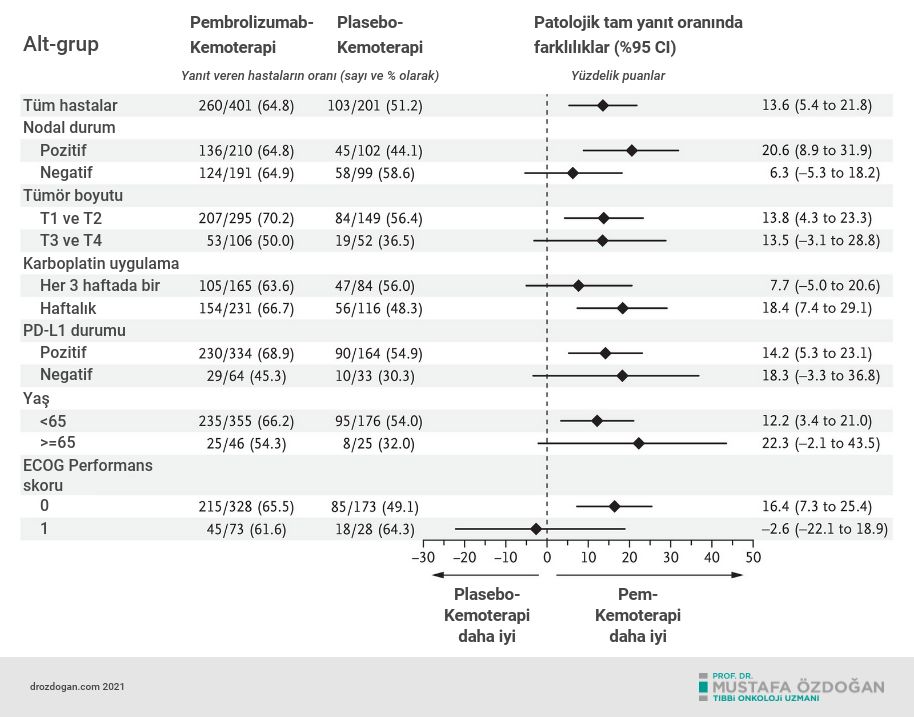
- In patients who received pembrolizumab in combination with chemotherapy, the pathological complete response rate was 64.8% (95% CI: 59.5, 66.4), compared with 51% (95% CI: 50.6, 60.6) in patients who received chemotherapy alone.
- Event-free survival rates were 91.3% and 85.3%, respectively (HR 0.63; 95% CI: 0.43, 0.93).

Side Effects
The most common side effects reported in ≥ 20% of patients in studies using pembrolizumab in combination with chemotherapy were fatigue/asthenia, nausea, constipation, diarrhea, decreased appetite, rash, vomiting, cough, dyspnea (difficulty breathing), fever, alopecia (hair loss), peripheral neuropathy, mucosal inflammation, stomatitis (mouth sores), headache, weight loss, abdominal pain, arthralgia, myalgia and insomnia.
The recommended pembrolizumab dose for triple-negative breast cancer is 200 mg every 3 weeks or 400 mg every 6 weeks, as an intravenous infusion every 30 minutes. Pembrolizumab is administered in combination with chemotherapy for 24 weeks of neoadjuvant treatment, followed by up to 27 weeks of adjuvant treatment as a single agent.
*
Below is an analysis of patients with a pathological complete response according to different subgroups:
Sources
2. Pembrolizumab for Early Triple-Negative Breast Cancer. Peter Schmid, M.D., Javier Cortes, M.D., Lajos Pusztai, M.D., Heather McArthur, M.D., Sherko Kümmel, M.D., Jonas Bergh, M.D., Carsten Denkert, M.D., Yeon Hee Park, M.D., Rina Hui, Ph.D., Nadia Harbeck, M.D., Masato Takahashi, M.D., Theodoros Foukakis, M.D., et al., for the KEYNOTE-522. NEJM 27 Feb 2020.
Was this article helpful?
Your feedback helps us improve our content.




Reader comments
Share your comment
Your name and comment are published only after administrator approval. Your email address is never shown to visitors.
Be the first to comment.