
Sorafenib in the Treatment of Advanced and Treatment-Resistant Desmoid Tumors

In this article
Desmoid tumors (also known as aggressive fibromatosis) arise from connective tissues and behave aggressively in the region where they develop. They are among rare cancers. Approximately 1000 new cases occur annually in the United States. Desmoid tumors typically affect young adults in their 20s and 30s, but can also occur in children, adolescents and older adults. More than %90 of desmoid tumors are sporadic (not hereditary) and harbor CTNBB1 mutations; a small proportion of tumors are associated with germline APC mutations and Gardner syndrome (the hereditary form). The main body regions affected include the abdominal wall, mesentery (a root-like organ holding the intestines together), and arms and legs. Desmoid tumors do not metastasize and carry a low risk of death (except in Gardner syndrome), but cause significant complications (side effects).
Patients may be asymptomatic (without symptoms), or may develop severe pain, swelling, deformity, loss of range of motion, bowel obstruction or perforation, or loss of vital organ function. Additional associated complications in young adults include long-term opioid (narcotic painkiller) use, social isolation, insomnia, anxiety, depression, and interruption of education and employment.
Although some drugs have activity against desmoid tumors, there is no accepted standard systemic treatment for these tumors. Beyond a few prospective (forward-looking) studies, the most relevant clinical data have come from case series and retrospective (backward-looking) analyses.
Desmoid tumors may follow phases of rapid growth followed by stabilization, spontaneous regression or further growth. Spontaneous regression is reported in up to % 20 of patients. A “wait and see” strategy is increasingly advocated for many patients. Surgery has been the standard primary treatment, but the risk of local (regional) recurrence (cancer returning) is unacceptably high (>% 40). Local (radiation therapy) or systemic treatments are generally necessary for patients with disease-related symptoms or progressive disease. Systemic treatment options include hormonal blockade, cytotoxic chemotherapy and tyrosine kinase inhibitors (smart cancer pills). Response rates associated with these treatments vary (% 0 to 40). For example, in small prospective studies, imatinibwas found to have limited activity (% 6 to 11), and no predictive biomarker was identified. A retrospective analysis used a starting dose of 400 mg once daily of an oral multitargeted tyrosine kinase receptor inhibitor, sorafenib(Nexavar), and showed acceptable safety, improved quality of life and, when assessed using the Response Evaluation Criteria in Solid Tumors (RECIST version 1.1), a response rate of % 25. Subsequently, to evaluate sorafenib’s safety and effectiveness in treating desmoid tumors, the randomized trial discussed here, published on 20 December 2018 in NEJM, was conducted as a double-blind, placebo -controlled phase 3 clinical trial .
Study Details
- The study enrolled 87 patients with progressive, symptomatic or recurrent desmoid tumors.
- Patients were randomized into two arms: one group received sorafenib 2 times daily at 400 mg, while the other received placebo.
- Patients in the placebo group whose disease progressed were allowed to cross over to the sorafenib group.
- The primary endpoint the study aimed to measure was investigator-assessed progression-free survival . Objective response rates to treatment and side effects were also assessed.
Study Results
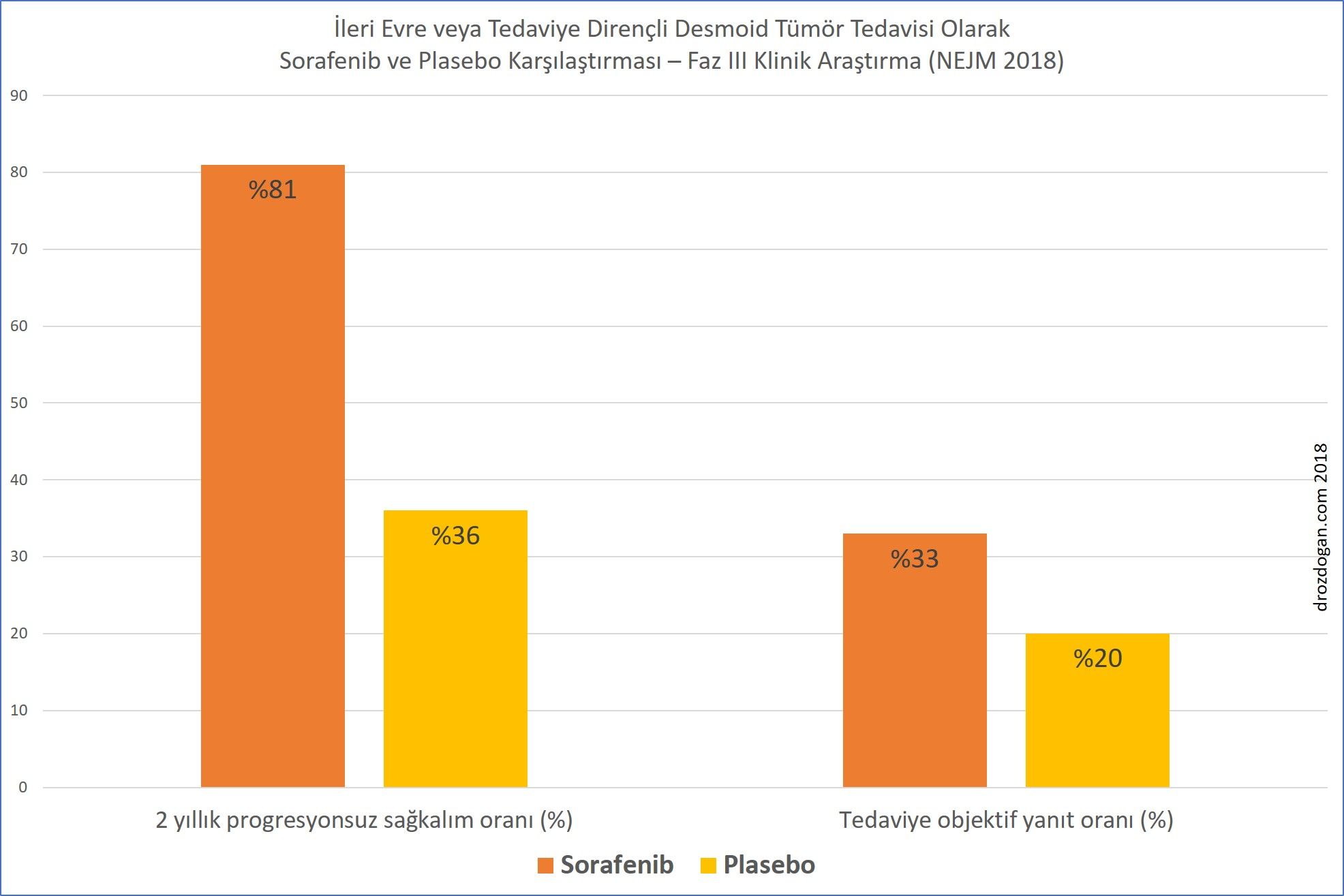
- In this study, with a median follow-up of 27.2 months, the 2-year progression-free survival rate was % 81 in the sorafenib group and % 36 in the placebo group. • Giving patients sorafenib instead of placebo reduced the risk of cancer progression or death by % 87.
- Before crossover, the objective response rate was % 33 in the sorafenib group and % 20 in the placebo group. Responses are ongoing in patients who had an objective response to treatment.
- Among patients receiving sorafenib, the most frequently reported mild (grade 1 and 2) side effectswere skin rash (% 73), fatigue (% 67), hypertension (% 55) and diarrhea (% 51).
Conclusion
Among patients with progressive, treatment-resistant and symptomatic desmoid tumors, sorafenib significantly improved progression-free survival and substantially prolonged stable responses. In this respect, sorafenib may receive FDA approval for treating desmoid tumors in the coming period.
Sources
Sorafenib for Advanced and Refractory Desmoid Tumors.
NEJM, 20 December 2018.
Was this article helpful?
Your feedback helps us improve our content.




Reader comments
Share your comment
Your name and comment are published only after administrator approval. Your email address is never shown to visitors.
Be the first to comment.