
The IMMUNED adjuvant combination immunotherapy trial made a difference in resected stage-4 malignant melanoma with no residual disease

In this article
At ESMO 2019, the IMMUNED trial attracted attention when its preliminary results were presented. In May 2020, The Lancet published comprehensive analyses of the trial, with results capable of changing routine practice.
Between 2015-2018, the trial enrolled patients with stage 4 disease who nevertheless had oligometastatic disease (a small number of metastases) and had undergone surgery, with no residual (remaining) cancer after surgery: a total of 167 patients. Patients with mucosal or uveal (ocular) melanoma were not included in the trial.
In 2015, when the trial began, there was no drug option for resected oligometastatic stage 4 melanoma that was FDA-approved.
In the phase-II randomized, three-arm, double-blind trial:
- Arm: the patient group receiving dual placebo (the observation group without treatment),
- Arm: nivolumab 3 mg/kg every 14 days, with maintenance treatment similar to arm 3,
- Arm: nivolumab 1 mg/kg concurrently with ipilimumab 3 mg/kg every 21 days for 4 cycles, followed by maintenance nivolumab 3 mg/kg until disease recurrence, or for 1 year in patients without a reason to discontinue because of adverse effects.
The IMMUNED trial found that:
- At a median follow-up of 28.4 months, cancer had not recurred in more than half of the patients receiving the nivolumab-ipilimumab combination, so median recurrence-free survival had not yet been reached, whereas it was 12.4 months with nivolumab alone and 6.4 months with placebo.
- Compared with placebo, the combination arm achieved a 77% improvement in recurrence-free survival (HR: 0∙23 (97∙5% CI 0∙12–0∙45; p<0∙0001). With nivolumab alone, this improvement remained at 46% (HR:0∙56 (0∙33–0∙94; p=0∙011).
- The 2-year recurrence-free survival rate was 70% (55∙1–81∙0) in the combination arm, 42% (28∙6–54∙5) with nivolumab alone, and 14% (5∙9–25∙7) with placebo.
Treatment-related grade 3 and 4 (serious) adverse effects occurred in 71% of the combination arm and 27% of the nivolumab-alone arm. Treatment discontinuation due to adverse effects was observed in 62% of the combination arm and 13% of the nivolumab-alone arm.
The rates of adverse effects and treatment discontinuation due to adverse effects observed in the combination arm of this trial were higher than the immunotherapy adverse-effect rates reported in previously published studies.
The history of adjuvant treatment for melanoma and where we stand


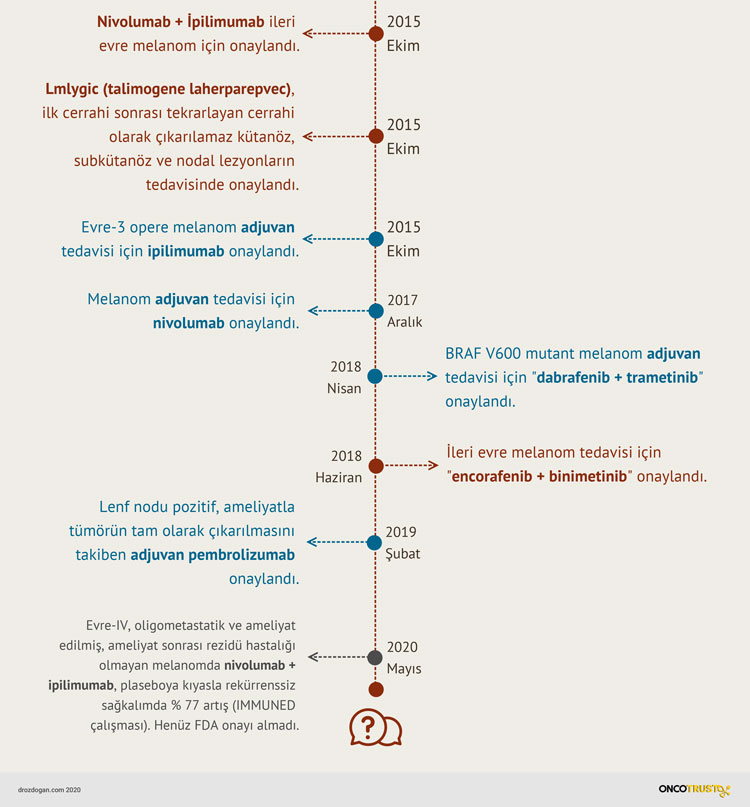
In patients with high-risk stage 3 malignant melanoma, postoperative adjuvant high-dose interferon (INF) showed efficacy in 1996 in the Journal of Clinical Oncology publication of the ECOG 1684 trial, in which the treatment arm showed a median survival advantage of 1 year over placebo. These results led to FDA approval of high-dose interferon alfa 2B for adjuvant treatment of malignant melanoma. However, high-dose IFN also brought many adverse effects and difficulties with tolerability.
Published in The Lancet in 2015, EORTC 18071 was a phase-III randomized trial enrolling patients with resected high-risk stage 3 malignant melanoma. Adjuvant ipilimumab was given as induction treatment at 10 mg/kg every 3 weeks for 4 doses, followed by maintenance at the same dose every 3 months for up to 3 years.
Recurrence-free survival was 17.1 months in the placebo arm and 26.1 months in the ipilimumab arm, a highly statistically significant advantage. This trial led to FDA approval of ipilimumab as adjuvant treatment for patients with resected high-risk stage 3 disease.
The rates of inability to continue the drug because of treatment-related adverse effects were 29% during induction and 52% over the entire treatment period. The long-term results of the trial were published in 2019 in Eur J Cancer and showed a 27% overall survival advantage. The adverse-effect profile and the high proportion of patients unable to continue treatment raised questions. The North American Intergroup Trial (E1609) administered adjuvant ipilimumab at 10 mg/kg or 3 mg/kg for 4 cycles to patients with resected stage 3-4 disease (3B-C and M1A-B), followed by 4 maintenance doses at the same doses every 12 weeks. These two arms were compared with high-dose interferon alfa. For the first time in this trial, adjuvant ipilimumab at 3 mg/kg was tested against the standard treatment of high-dose interferon alfa and showed a 22% survival advantage. No survival difference was found between ipilimumab at 10 mg/kg and high-dose interferon. A possible reason for this negative result was that 50% of patients receiving 10 mg/kg could not continue treatment because of grade 3 and 4 (serious) adverse effects. Grade 3 and 4 adverse effects occurred in 58% with ipilimumab at 10 mg/kg and 37% at 3 mg/kg.
NEJM published in 2017 the trial involving 906 patients with stage 3 and 4 malignant melanoma, CheckMate 238, which compared nivolumab with ipilimumab as postoperative adjuvant treatment; 1-year recurrence-free survival was 70.5% with nivolumab versus 60.8% with ipilimumab. As might be expected, grade 3 and 4 adverse effects were found in 14.4% with nivolumab and 45.9% with ipilimumab. Nivolumab subsequently received FDA approval in 2017 for resected stage 3-4 malignant melanoma.
KEYNOTE-054 administered pembrolizumab 200 mg every 21 days for 18 doses to patients with resected stage 3 disease, compared with a placebo arm, and found 18-month recurrence-free survival of 71.4% versus 53.2%. Grade 3 and 4 adverse effects were reported at 14.7%, similar to the level in the nivolumab trial. This trial also led to FDA approval of pembrolizumab for adjuvant treatment of resected stage 3 melanoma.
Among adjuvant targeted treatments, the dabrafenib-trametinib combination was tested in patients with BRAF V600E and V600K mutations in a phase-III trial involving 870 patients, against placebo, and showed a 43% survival advantage over placebo. At a median follow-up of 3.5 years, the expected cure rate was 54% versus 37% with placebo. This trial led to FDA approval of the dabrefenib-trametinib combination as adjuvant combination treatment in April 2018.
Conclusion
We see that BRAF mutation was not an exclusion criterion in adjuvant immunotherapy trials and that, in subgroup analyses of trial groups that included stage 4 patients, the presence of BRAF mutation was not a determining factor in treatment failure.
The IMMUNED trial differs somewhat from the adjuvant trials mentioned above by targeting oligometastatic patients. Nevertheless, BRAF-mutant disease was not an exclusion criterion in IMMUNED either.
Although the marked increase in grade 3 and 4 adverse effects alongside the success achieved with combination immunotherapy is concerning in routine practice, the OpaCIN-neo trial showed that nivolumab 3 mg/kg and ipilimumab 1 mg/kg appeared effective while the rate of significant adverse effects fell from 40% to 20%.
We believe that the efficacy and adverse-effect profile of the combination of fixed-dose nivolumab 240 mg every 14 days plus ipilimumab 1 mg/kg every 6 weeks in the ongoing CheckMate 915 phase-III randomized trial will determine our future treatment strategy for patients with resected stage 4 malignant melanoma.
In conclusion, despite the increased adverse-effect burden, the ipilimumab-nivolumab combination produced a result that cannot be ignored in adjuvant treatment of resected stage 4 malignant melanoma, where the risk of cancer recurrence is very high: a reduction in recurrence risk approaching 80% in the overall group, regardless of PD-L1 level and BRAF V600 mutation.
To date, stage 4 patients have made up a small proportion of the patients included in randomized adjuvant immunotherapy trials. The successful results obtained in the IMMUNED trial in resected oligometastatic patients with no residual disease are capable of changing practice.
Sources
Adjuvant nivolumab plus ipilimumab or nivolumab monotherapy versus placebo in patients with resected stage IV melanoma with no evidence of disease (IMMUNED): a randomised, double-blind, placebo-controlled, phase 2 trial.
Lancet, May 2020.
Was this article helpful?
Your feedback helps us improve our content.


Reader comments
Share your comment
Your name and comment are published only after administrator approval. Your email address is never shown to visitors.
Be the first to comment.