
What Is a MUTYH Mutation? Which Cancer Risks Does It Increase?

In this article
What Is the MUTYH Gene?
The MUTYH (MutY homolog) gene plays a vital role in DNA repair. It encodes adenine DNA glycosylase, an enzyme that repairs oxidative DNA damage in cells. By recognizing and correcting damage caused by oxidative stress, the MUTYH gene preserves cells’ genetic integrity.
DNA is continually damaged by internal and external factors. Molecules known as reactive oxygen species (ROS), in particular, can oxidize DNA bases. Such damage can cause mutations, leading to uncontrolled cell growth and cancer. The MUTYH gene plays a critical role in reducing cancer risk by repairing this oxidative damage.
The Function of MUTYH
The enzyme produced by MUTYH particularly handles damaged base pairs called 8-oxo-G (8-oxoG), formed by guanine oxidation. Normally, 8-oxoG can mistakenly bind to guanine rather than adenine in the DNA strand. These mismatches can cause errors during DNA replication and ultimately lead to mutations.
MUTYH recognizes and corrects these mismatched bases, allowing DNA to be copied correctly. This takes place through base excision repair (BER). MUTYH removes the incorrect adenine and allows the correct base to be inserted. This preserves DNA integrity and normal cell function.
Effects of MUTYH Mutations
Changes in the MUTYH gene, or mutations,reduce or eliminate this repair mechanism’s effectiveness. DNA damage may then accumulate over time, leading to genetic changes that can cause various cancers. MUTYH mutations are particularly associated with the inherited polyposis syndrome MUTYH-associated polyposis (MAP). MAP involves numerous colon polyps and increased risks of colon and other cancers.
MUTYH mutations may also increase risks of small bowel, thyroid, ovarian, bladder, and other cancers.
What Is an Inherited MUTYH Mutation? General Information for Carriers
People with inherited MUTYH mutations receive them from their parents. Such changes in MUTYH carry an increased risk of some cancers.
How MUTYH Mutations Are Inherited
MUTYH mutations follow an autosomal recessive inheritance pattern. This means that, for their effects to appear, a mutant gene copy must be inherited from each parent. A person can therefore have two MUTYH mutations by receiving a mutant copy from each parent. Others have only one mutant copy and are called mutation carriers.
Risks for Carriers
Carriers with One MUTYH Mutation: A person carrying only one MUTYH mutation is generally healthy and has no clear signs of disease. However, colon cancer risk may be slightly increased, particularly with a family history. A carrier’s children risk having two mutant copies if the other parent also carries a MUTYH mutation.
People with Two MUTYH Mutations: People with two MUTYH mutations develop MUTYH-associated polyposis (MAP). Numerous polyps may form in the colon and rectum and become cancerous over time. Risks of other cancers, including small bowel, thyroid, ovarian, and bladder cancers, are also increased.
Genetic Counseling for People with Inherited MUTYH Mutations
Genetic counseling helps MUTYH mutation carriers and their families understand and manage cancer risks. Counselors provide information on screening and preventive measures. For example, colon cancer screening should start earlier and be more frequent in MUTYH mutation carriers. Other screening methods, such as upper endoscopy and urinalysis, may also be recommended.
Family Planning and Inherited MUTYH Mutations
MUTYH mutation carriers should also seek genetic counseling about family planning. If both parents carry a MUTYH mutation, their children risk inheriting two mutant copies, increasing the likelihood of MAP. Information about prenatal genetic testing and other family planning options is therefore important.
Which Cancer Risks Increase with an Inherited MUTYH Mutation?
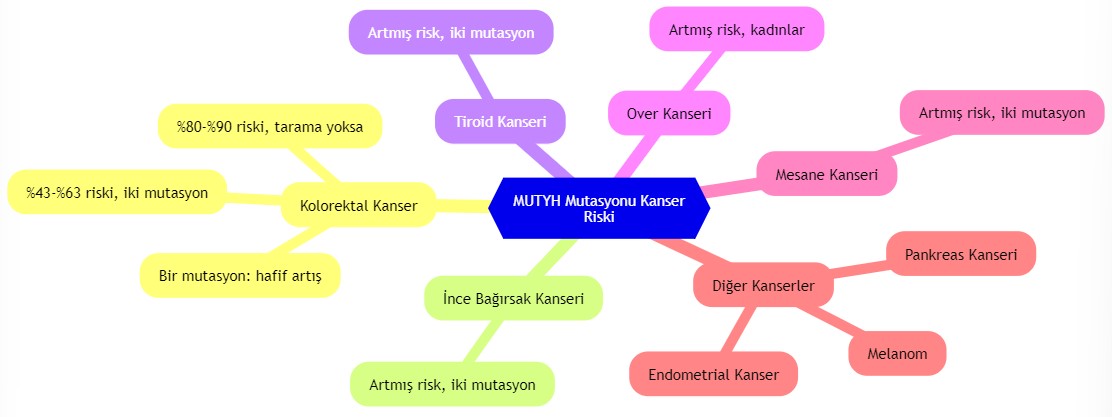
The cancer risks most increased in MUTYH mutation carriers are described below.
Colorectal Cancer
Colorectal Cancer Risk:
- People with Two MUTYH Mutations: Colorectal cancer risk is substantially increased in MUTYH mutation carriers, particularly those with two mutations (known as MUTYH-associated polyposis, or MAP). Their lifetime colorectal cancer risk ranges from 43% to 63%. Without regular screening, this may reach 80-90%.
- Carriers with a Single MUTYH Mutation: Risk may be slightly increased in people carrying one MUTYH mutation, particularly with a family history of colorectal cancer. However, the increase is not as high as in those with two mutations.
Small Bowel Cancer
Small Bowel Cancer Risk:
- Small bowel cancer risk is also increased in people with two MUTYH mutations. The risk of polyps forming in the small bowel and subsequently becoming cancerous is high in MUTYH mutation carriers.
Thyroid Cancer
Thyroid Cancer Risk:
- Thyroid cancer risk may be increased in MUTYH mutation carriers, particularly in those with two mutations.
Ovarian Cancer
Ovarian Cancer Risk:
- Ovarian cancer risk may be increased in women with MUTYH mutations, although not to the same extent as colorectal cancer risk.
Bladder Cancer
Bladder Cancer Risk:
- Bladder cancer risk is also increased in people with two MUTYH mutations. This may be particularly evident in those with MUTYH-associated polyposis (MAP).
Other Cancers
Extraintestinal Cancers:
- In addition to thyroid, ovarian, and bladder cancers, other cancer risks may rarely be increased in MUTYH mutation carriers. Some studies, for example, suggest possible increases in melanoma, pancreatic cancer, and endometrial cancer risk.
How Should People with Inherited MUTYH Mutations Manage Risk?
Regular cancer screening is recommended for MUTYH mutation carriers. This may include:
- Colonoscopy: Should start earlier and take place more frequently.
- Upper Endoscopy: May be performed to examine the stomach and small bowel.
- Urinalysis: May be performed to look for blood in the urine.
People with two MUTYH mutations may need surgery for colon cancer or polyps. Removal of a larger section of the colon may be recommended.
How Should Cancer Be Treated in MUTYH Mutation Carriers?
MUTYH mutation carriers need a specific approach to cancer treatment. MUTYH is an enzyme important in DNA base repair; ineffective repair in people with MUTYH mutations therefore increases cancer risk. People diagnosed with cancer may consequently be more likely to have dMMR, MSI-H and TMB-H status. Treatment strategies should target the specific repair defects this genetic mutation may cause.
Targeting MUTYH in Cancer Treatment
-
Response to Chemotherapy and Radiotherapy:
- Cells carrying MUTYH mutations have a reduced capacity to repair DNA damage and may therefore be more sensitive to chemotherapy and radiotherapy These treatments kill cancer cells by causing further DNA damage.
- Example: Studies in pancreatic cancer cells have shown that suppressing MUTYH reduces cell survival and increases chemotherapy sensitivity.
-
Polymerase Inhibitors and DNA Repair Enzymes:
- DNA repair defects caused by MUTYH mutations may also be treated by targeting other DNA repair enzymes. Such treatments may inhibit cancer cell growth by suppressing enzymes that perform MUTYH’s functions.
- Example: MUTYH and OGG1 are known to work together to remove 8-oxoG from DNA. Treatments targeting OGG1 may therefore increase damage caused by MUTYH mutations.
-
Immunotherapy:
- Accumulated DNA damage in cancer cells may make them easier for the immune system to recognize. This may increase immunotherapy effectiveness. In MUTYH mutation carriers, immunotherapies may improve the immune system’s ability to recognize and destroy cancer cells.
-
Genetic Counseling and Screening:
- MUTYH mutation carriers should regularly participate in genetic counseling and screening programs to enable early cancer diagnosis and treatment.
- Example: Colonoscopy is often recommended for MUTYH mutation carriers to reduce colorectal cancer risk.
-
New Therapeutic Targets:
- Given MUTYH’s role in handling cellular oxidative stress, modulating this protein may be an important target for new therapeutic approaches. Future studies targeting its specific functions may increase cancer cells’ chemotherapy sensitivity and improve patient prognosis.
Conclusion
Cancer treatment in MUTYH mutation carriers requires personalized approaches targeting the specific DNA repair defects caused by genetic mutations. These may increase chemotherapy and radiotherapy sensitivity, improve immunotherapy effectiveness, and enable new therapeutic targets. Regular screening and genetic counseling are vital for managing cancer risk and increasing treatment opportunities through early diagnosis.
Was this article helpful?
Your feedback helps us improve our content.




Reader comments
Share your comment
Your name and comment are published only after administrator approval. Your email address is never shown to visitors.
Be the first to comment.