
What Is Mediastinal Lymphadenopathy? Does It Cause Cancer? What Is Mediastinoscopy?

In this article
Mediastinal lymphadenopathy is swelling of the lymph nodes in the chest cavity. It can be a sign of various benign (noncancerous) or malignant (cancerous) diseases.
A lymph node is part of the body's immune system and plays an important role in preventing infections and diseases from spreading. These small glands along the flow pathways of lymph fluid act as outposts of the body's defenses. Cellular waste products, viruses, bacteria, and cancer cells are filtered at these tiny outposts. The human body contains approximately 600-700 lymph nodes.
A simplified illustration of the lymphatic system is shown below.

What Does Mediastinal Lymph Node Mean?
A mediastinal lymph node is a lymph node in the mediastinum, the central part of the chest cavity between the lungs. Abnormal enlargement of one or more nodes here is called mediastinal lymphadenopathy .
The anatomy of lymph nodes in the lung and chest region is shown below.

Note: Particularly in lung cancer, it is very important to determine whether suspicious-looking lymph nodes detected on computed tomography (CT) or PET-CT scans are hilar or mediastinal . This is discussed later under mediastinoscopy .
The mediastinum contains structures including the trachea (windpipe), esophagus, heart, and major blood vessels. Mediastinal lymph nodes are located here and can enlarge for various reasons, including:
- Lower respiratory tract infection
- An inflammatory or autoimmune condition
- Cancer
What Are the Symptoms of Enlarged Mediastinal Lymph Nodes?
People with mediastinal lymphadenopathy generally experience the following symptoms:
- Fever
- Weight loss
- Night sweats
- Chest discomfort
What Causes Mediastinal Lymphadenopathy—Does It Cause Cancer?
Mediastinal lymphadenopathy can occur for several reasons.
Although this is a frequently asked question, mediastinal lymphadenopathy itself does not cause cancer. It appears as a sign of various diseases: it is an effect, not a cause.
Malignant Conditions
Lymphoma, lung cancer, and esophageal cancer are among the malignant causes responsible for most cases of mediastinal lymphadenopathy. Lymphoma is cancer that begins in lymphocytes, a type of white blood cell. Swelling of lymph nodes around the lungs or in the chest cavity generally indicates lung cancer or cancer that has spread there from elsewhere in the body.
Benign Conditions
Benign conditions are noncancerous. Most conditions causing inflammation in the chest/lung region can enlarge lymph nodes there. Swollen lymph nodes may indicate a problem involving the immune system.
Lymph nodes are small, bean-shaped structures in the lymphatic system. They help fight infection by filtering bacteria and viruses in the bloodstream and transporting them through the body.
Lymph nodes can swell or enlarge as they work to filter out "bad" cells. Lymphadenopathy, meaning swollen lymph nodes, can occur when the immune system fights infection.
Noncancerous causes of mediastinal lymphadenopathy include:
- Sarcoidosis
- Amyloidosis
- Tuberculosis
- Chronic obstructive pulmonary disease (COPD)
- Cystic fibrosis (CF)
- Coccidioidomycosis
- Certain autoimmune diseases, such as lupus

How Is Mediastinal Lymphadenopathy Treated?
There is no direct treatment for mediastinal lymphadenopathy. Specialists focus on treating the underlying condition causing it:
- Cancer: Cancer treatment varies by type, where it began, and how far it has spread. Common treatments include surgery, radiation therapy, chemotherapy, immunotherapy, or combinations of these.
- Infection: Depending on the infection, specialists may use antibiotics, antifungals, or supportive treatment.
- Medications: Some medications can cause swollen lymph nodes. Anyone experiencing swelling related to a medication should consult their doctor and consider changing it.
How Is Mediastinal Lymphadenopathy Diagnosed?
In most cases, people cannot feel or see mediastinal lymphadenopathy because the nodes in the mediastinum (chest cavity) lie deep inside the body. Tests are used to diagnose it.
What Imaging Methods Are Used?
- Today, the method most commonly used is computed tomography (CT) to identify mediastinal lymph nodes. It is more sensitive than plain chest X-rays and can detect abnormalities not visible on X-rays. In some cases, contrast-enhanced CT may be needed.
- Another method is magnetic resonance imaging (MRI), but it takes longer and costs more.
What Is Mediastinoscopy, and How Is It Performed?
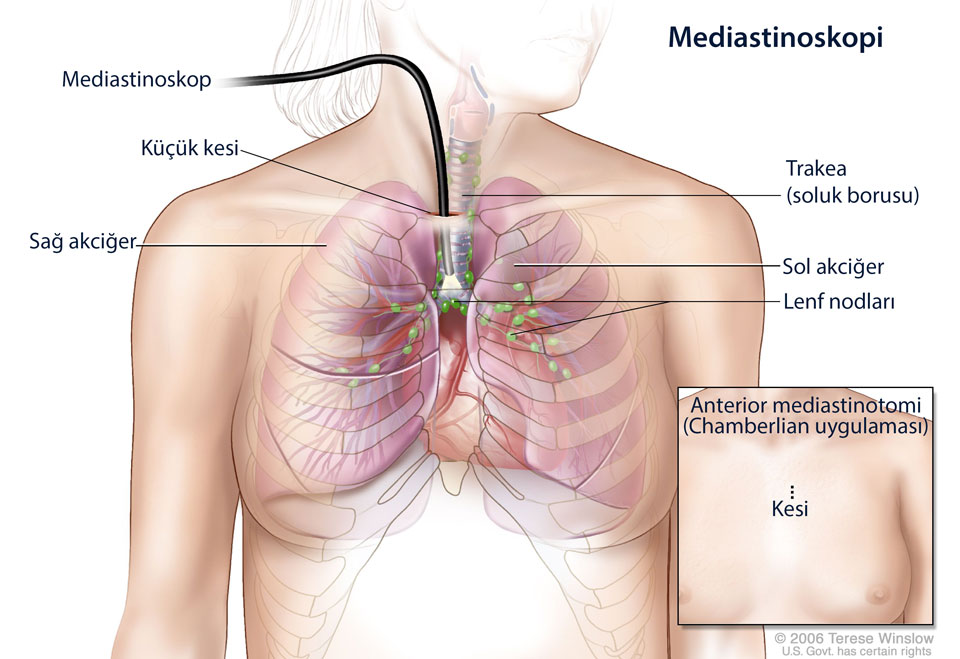
Mediastinoscopy is a surgical procedure examining the mediastinum, the space between the lungs in the chest. It provides an opportunity to examine many vital structures, including part of the heart and the major blood vessels, as well as lymph nodes and other tissues.
Particularly in non-small cell lung cancer (NSCLC), we often use mediastinoscopy to distinguish stages 3A and 3B . If mediastinoscopy identifies stage 3A lung cancer, this means the cancer is operable.
The procedure allows lymph node or other tumor tissue samples to be removed for biopsy, providing information needed to better determine the stage and spread of cancer.
During mediastinoscopy, the surgeon makes a small incision near the sternum (breastbone) and examines the chest lymph nodes using a scope. If abnormalities are found, the surgeon removes them and requests a biopsy.
What Does Seeing Millimeter-Sized Lymph Nodes in the Mediastinum Mean?
Seeing millimeter-sized lymph nodes in the mediastinum indicates abnormal growth or change in nodes there. This means they may contain cancer cells, and a biopsy may be needed for further investigation. Mediastinoscopy allows closer examination of lymph nodes in the middle of the neck and more detailed inspection of images on a screen.
Can Mediastinal Lymphadenopathy Itself Cause Problems or Complications?
Mediastinal lymphadenopathy can arise for many reasons and cause various complications.
These include:
- Respiratory problems: Enlarged mediastinal lymph nodes may obstruct the airways and cause breathing difficulties.
- Cardiovascular problems: Enlarged mediastinal lymph nodes may affect the heart or vascular structures.
- Fluid accumulation: Enlarged mediastinal lymph nodes may cause fluid to accumulate in the pleural space (between the membranes around the lungs), leading to breathing difficulties.
Summary
Mediastinal lymphadenopathy is enlargement of lymph nodes in the chest cavity. It can occur in many noncancerous diseases as well as in people with lung cancer, Hodgkin disease, or other cancers. However, it does not itself cause cancer; it is a sign of various diseases. There are underlying causes for this condition, one of which is cancer. Infections, such as upper respiratory tract infections, can also cause this type of lymph node swelling.
Assessment includes reviewing the patient's medical history, performing a physical examination, and using diagnostic imaging, most commonly CT.
Correctly diagnosing the underlying condition leads to positive outcomes for patients, which is very important. Overall health generally varies with the underlying cause. For example, the 5-year relative overall survival rate for people with non-Hodgkin lymphoma (NHL) is 73%.
Was this article helpful?
Your feedback helps us improve our content.



Reader comments
Share your comment
Your name and comment are published only after administrator approval. Your email address is never shown to visitors.
Be the first to comment.