
What Types of Ovarian Cysts Exist? Can Cysts Become Cancer?

In this article
Ovarian cysts in women are usually small and harmless. They are most common during reproductive years but can occur at any age.
This article on ovarian cysts covers:
What Is an Ovarian Cyst?
In medical terminology, ovaries are part of the female reproductive system. They lie in the lower abdomen on either side of the uterus. As part of the menstrual cycle, they release an egg every 28 days, a process called ovulation. The ovaries also produce the female hormones estrogen and progesterone.
Cysts are generally benign, meaning noncancerous, and usually need no treatment. Sometimes a fluid-filled sac called a cyst develops in an ovary. Many women develop at least one in their lifetime.
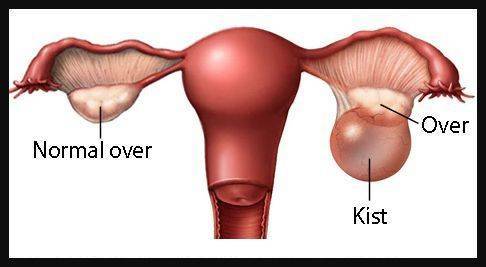
Ovarian cysts are relatively common in people with regular periods because small cysts can develop naturally as part of the menstrual cycle.
Ovarian cysts generally cause no signs or symptoms (complaints), but sometimes cause pain and bleeding.
Cysts may be as small as a pea or larger than an orange. A cyst is a closed sac-like structure, separated from surrounding tissue by a membrane. It contains fluid, gas or semisolid material. Its outer part is called the cyst wall.
A cyst larger than 5 cm in diameter may need surgical removal.
What Types of Ovarian Cysts Exist?
Cysts can develop anywhere in the body.
There are two main ovarian cyst types:
- Functional ovarian cysts
- pathological cysts
Functional Ovarian Cysts
The most common type. These harmless cysts form part of a woman's normal menstrual cycle and are short-lived.
There are two types of functional ovarian cyst:
- Follicular cysts
- Luteal ovarian cysts
Follicular Cysts
Follicular cysts are the most common type. A woman has two ovaries. An egg moves from an ovary into the uterus, where it can be fertilized by sperm. The egg forms in a follicle containing fluid that protects the growing egg. When the egg is released, the follicle ruptures.
Sometimes the follicle does not shed its fluid and shrink after releasing the egg, or does not release an egg. It swells with fluid, becoming a follicular ovarian cyst.
A cyst normally appears at any time and usually disappears within a few weeks.
Luteal Ovarian Cysts
These are less common. After an egg is released, tissue called the corpus luteum remains. Luteal cysts may develop when it fills with blood. They generally disappear within a few months but may occasionally split or rupture, causing sudden pain and internal bleeding.
Pathological Cysts
These ovarian cysts may be harmless or malignant (cancerous).
There are two types of pathological cyst:
- Dermoid cysts (cystic teratomas)
- Cystadenomas (ovarian cystadenomas)
Dermoid Cysts (Cystic Teratomas)
A dermoid cyst is generally benign. These arise from egg-producing cells and require surgical removal. They are the most common pathological cyst type in women younger than 30.
Cystadenomas (Ovarian Cystadenomas)
Cystadenomas are ovarian cysts developing from cells covering the ovary's outer surface. They contain a mucus-like substance or watery fluid.
Rather than growing inside the ovary, cystadenomas generally attach by a stalk. They can grow outside it. They are rarely cancerous but require surgical removal.
Cystadenomas are more common in women older than 40.
Ovarian Cyst Symptoms and Possible Complaints
Although most cysts cause no symptoms, ovarian cyst symptoms may include:
- Irregular and possibly painful menstrual bleeding.
- Pelvic (groin-region) pain: this may be lower back pain, persistent pain radiating to the thighs, or intermittent and constant pain. It may occur just before menstruation begins or ends.
- Dyspareunia: pelvic pain during intercourse. Some women may have abdominal pain and discomfort afterward.
- Bowel problems: such as bowel pressure during defecation or frequently needing the toilet.
- Abdominal problems: bloating or heaviness may occur.
- Urinary complaints: difficulty emptying the bladder completely or feeling a frequent need to urinate.
- Hormonal abnormalities: rarely, the body produces abnormal hormone amounts, which may increase body hair.
Some cyst symptoms (complaints) may resemble pregnancy, such as breast tenderness and nausea.
Ovarian Cysts and Cancer
Most ovarian cysts are not cancer. This possibility should be considered when a cyst develops after menopause, the time when a woman stops menstruating. Cysts forming after menopause have a higher chance of being cancerous.
Certain underlying conditions, such as endometriosis, may also cause ovarian cysts. Endometriosis is a condition in which cells lining the uterus, ovaries and fallopian tubes begin appearing outside the uterus.
Ovarian Cancer
Ovarian cancer occurs when ovarian cells proliferate uncontrollably to form a tumor. Untreated, these cells can spread to surrounding tissues and elsewhere in the body.
Different ovarian cancer types can develop depending on the cell of origin. Epithelial ovarian canceris the most common type. Of ovarian cancers, % 90 are epithelial.
An epithelial ovarian tumor means cancer began in cells of the surface layer covering the ovary.
Epithelial ovarian cancers also have different types:
- serous (the most common subtype)
- endometrioid
- clear cell
- mucinous
- undifferentiated or unclassifiable
Ovarian cyst and ovarian cancer symptoms can sometimes be confused.
Related topic: Ovarian Cancer Treatment by Stage
How Is an Ovarian Cyst Diagnosed?
The most frequently used diagnostic method uses sound waves: ultrasound (USG). The figure below shows the most common ovarian cyst situations a physician encounters:
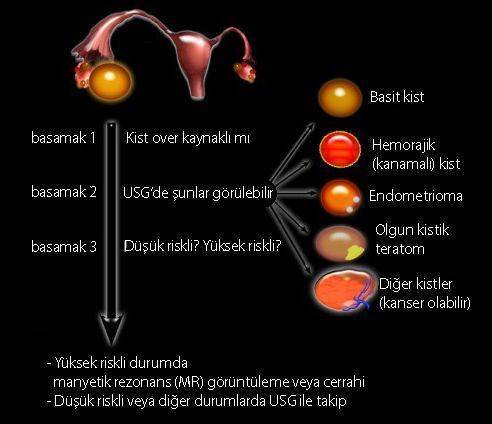
If a doctor suspects a cancerous cyst, they request other tests such as magnetic resonance (MRI).
Ovarian Cyst Treatment
The doctor evaluates the cyst to decide whether treatment is needed.
Most ovarian cysts disappear spontaneously without medical treatment. However;
a person may need treatment depending on:
- The cyst's size and appearance
- Symptoms
- Whether menopause has occurred
The doctor may recommend monitoring the cyst with regular pelvic ultrasound examinations to see whether its size or appearance changes.
A doctor may sometimes recommend birth control pills for someone with ovarian cysts. They may not shrink the cyst but can prevent it from worsening.
Ovarian Cyst Surgery
The doctor may recommend removal if a cyst:
- is very large or growing,
- persists after medication,
- is thought to prevent a woman from having children,
- looks unusual (malignant, cancerous), and
- causes complaints such as pain
Depending on cyst type, surgery may include:
- Cystectomy: This involves removing the cyst.
- Oophorectomy: This involves removing the cyst together with the ovary.
- Total hysterectomy and oophorectomy: This involves removing malignant cysts by removing the uterus, ovaries and fallopian tubes. Chemotherapy or radiation therapy may be needed afterward.
Follow us on Instagram, Twitter and Facebookfor updates.
Related topic: The Latest in Ovarian Cancer Treatment
Was this article helpful?
Your feedback helps us improve our content.




Reader comments
Share your comment
Your name and comment are published only after administrator approval. Your email address is never shown to visitors.
Be the first to comment.