
For the First Time, Lung Cancer Incidence in Women Exceeds Men’s

Historically, lung cancer has been more common in men. However, a new analysis of the last 20 years of United States data found lung cancer incidence among women aged 30-49 exceeded men’s for the first time. Differences in smoking habits alone could not explain this, and more research is needed.
Lung cancer is the 3rd most common cancer in women worldwide (breast first, colorectal second). It remains the leading cause of cancer death in both sexes.
Women’s incidence historically paralleled increased smoking. Smoking among men spread in the early 1900s and peaked with World War 1; among American women it spread in the 1930-1960 period. Tobacco companies successfully used large, cunning advertising campaigns, such as linking cigarettes to women’s freedom.
Today, lung cancer incidence in both sexes is notincreasing; it is even declining slightly in the United States and some European countries. However, as noted, incidence differs between sexes in certain age groups.
One reason for higher incidence among young adult women may be that nonsmoker lung cancer affects women more. Women may therefore be genetically more susceptible to nonsmoking causes.
Smoking alone causes approximately %85 of lung cancers. However, lung cancer causes differ between sexes by approximately %10. This means:
In the United States, among every 100 male lung cancer cases, 9 are due to nonsmoking lung cancer risk factors , while among every 100 female cases, 19 have nonsmoking causes.
The commonest nonsmoking causes:
- radon exposure (the most important cause after smoking),
- air pollution,
- arsenic
- asbestos
- diesel exhaust and similar carcinogens
Secondhand and thirdhand smoke may also affect women more.
Although evidence is unclear, smoking may have a greater carcinogenic effect on women than men. For example, a study of 600 thousand participants found 6500 lung cancers. The incidence ratio of current-smoking women versus nonsmoking women was significantly higher than the corresponding ratio in men (smoking increased risk 1.64-fold in women and 1.43-fold in men).
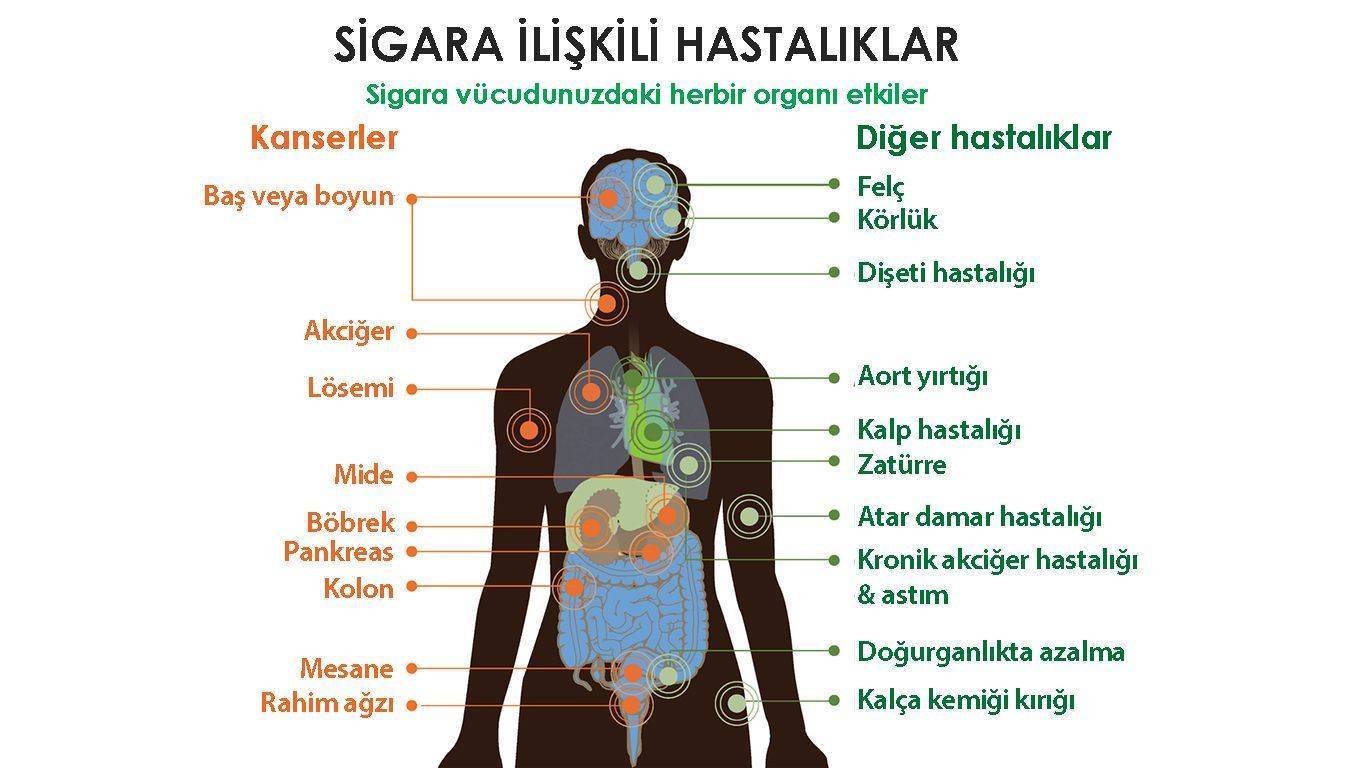
Smoking also causes diseases beyond lung cancer. According to WHO, at least %25 of female smokers die from a smoking-related disease. The commonest noncancer conditions are cardiovascular disease and chronic obstructive pulmonary disease (COPD). Smoking also causes esophageal, head and neck, breast, stomach and colon cancers.
Hormonal factorshave also been linked to greater female susceptibility. Some studies examining relief of menopausal symptoms show that estrogen-progestin hormonal supplements moderately but significantly increase lung cancer risk. Because other studies show the opposite, supplementation’s effect is considered neutral.
Dietary and vitamin supplements are another issue. Large earlier studies showed high-dose vitamins B6 and B12 and beta-carotene supplements increase lung cancer risk, without discussing sex differences.
Finally, women with lung adenocarcinoma appear to have a better prognosis than men. Female non-small-cell lung cancers are also more likely to have EGFR, ALK, and ROS1 genetic alterations, so testing for these should be considered when planning treatment.
Conclusion
Lung cancer remains the leading cancer-related cause of death in both women and men. Most cases arise from smoking, and smoking prevalence among women remains unacceptably high.
Smoking and nonsmoking risk factors appear to affect sexes differently. Reasons are unclear, but hormones, DNA repair capacity and cancer–immune interactions may contribute.
Sources
Higher Lung Cancer Incidence in Young Women Than Young Men in the United States.
N Engl J Med. 2018.
Was this article helpful?
Your feedback helps us improve our content.




Reader comments
Share your comment
Your name and comment are published only after administrator approval. Your email address is never shown to visitors.
Be the first to comment.