
From World War 2 to the Nobel Prize: Dr. Harald zur Hausen and the Discovery That HPV Causes Cervical Cancer

Through pioneering work offering the chance to almost eliminate cervical cancer, Dr. Harald, born in 1936, spent his childhood in Gelsenkirchen, heavily affected by World War 2. Although his family suffered no deaths, war prevented him from completing primary education. Undeterred, he entered Gymnasium, the German secondary school for high-achieving pupils, at age 10. Missing primary education made the first year difficult, but hard work closed the gap. He successfully completed secondary school in northern Germany, where his family moved, in 1955.
Interested in biology, animals and flowers from childhood, he always wanted to be a scientist. Choosing between biology and medicine after school, Dr. Harald selected medicine at Bonn University. Maintaining his love of biology, he also attended biology classes despite difficulties in the first two years. A good result in his second-year examination gave him confidence, he says. He graduated in 1960, completed two years as an intern and became a general practitioner.
He then began microbiology and immunology work at Düsseldorf University. He recalls: “Initially, for the first and only time, I doubted choosing an academic career and considered returning to hospital work. Soon experimental research fascinated me, and I knew I had made the right decision.” In his early academic years, he trained in bacterial and viral development and early diagnosis while beginning research on virus-induced chromosomal changes.
During his 3rd year in Düsseldorf, feeling his training insufficient, he sought postdoctoral opportunities, particularly in America. An offer came from Children's Hospital of Philadelphia, where he began in 1965. His laboratory intensely studied the newly discovered Epstein–Barr virus (EBV), developing diagnostic tests and investigating epidemiology. At that time, Burkitt lymphoma patients were shown to develop antibodies against viral antigens, prompting him to work on the agent, although he felt deficient in rapidly developing molecular diagnostic methods. He obtained permission to study adenovirus instead. While examining chromosomal changes in infected human cells, he also demonstrated Epstein–Barr virus from antigen-positive Burkitt lymphoma cells through electron microscopy . Around the same time, EBV's immortalizing effect on B lymphocytes and its causation of infectious mononucleosis were established.
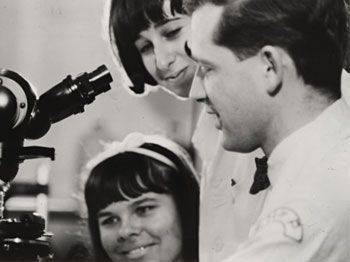
Figure 1. Harald zur Hausen with two technicians in the Children's Hospital of Philadelphia laboratory in 1967.
In 1968, Würzburg University offered him the chance to establish his own group. He returned to Germany and focused entirely on EBV, aiming to demonstrate EBV DNAin all Burkitt lymphoma cells and its relationship with recurrent infection. With Dr. Werner Henle and Dr. George Klein, he collected and examined Burkitt lymphoma and nasopharyngeal carcinoma biopsies and serological samples. EBV DNA was subsequently demonstrated in biopsies, becoming the first viral DNA demonstrated in tumorsin these investigations.
In 1972, Dr. Harald became director of the newly established Institute of Virology in Nuremberg, focusing on cervical cancer , long suspected of viral origins. By the late 1960s, herpes simplex type 2 (HSV-2) was the main suspect. He asked his friend Dr. Heinrich Schulte-Holthausen to investigate. Using the same techniques previously applied to EBV, Dr. Heinrich found no association despite repeated attempts.
Dr. Harald reviewed earlier studies showing genital warts progressing to squamous cell carcinomas and containing typical papillomavirus particles. He hypothesized a cervical cancer–papillomavirus link and continued research. Although many collected biopsies matched plantar wart specimens, genital wart and cervical cancer biopsies tested negative. He continued, considering that different papillomavirus types might exist. Over subsequent years, his group and Dr. Orth's Paris group identified many papillomaviruses (today, over 100 types are known, approximately 30 causing various human warts and fewer causing cancers).
Appointed director of Freiburg's new Institute of Virology in 1977, he continued working there with Nuremberg colleagues. In 1979, Dr. Gissmann and Dr. Ethel-Michele successfully demonstrated DNA of human papillomavirus-6 (HPV-6) from a genital wart. Later, HPV-11 was isolated from a laryngeal papilloma, a vocal cord nodule. Using HPV-11 as a basis, one of 24 cervical cancer biopsies tested positive for HPV-11.
In 1983, HPV-16was demonstrated, followed one year later by HPV-18 . Their association with cervical cancer was investigated, and viral DNA was found integrated into tumor-cell DNA . Although portions of viral DNA were absent, HPV's E6 and E7 genes were consistently present and shown to synthesize proteins.

Figure 2. Summary of the discovery earning Dr. Harald the Nobel Prize: how some HPV infections (approximately %0.8) develop into cervical cancer over time.
During his Freiburg period, Dr. Harald discovered certain phorbol esters activated latent EBV DNA. He also discovered a new lymphotropic polyomavirus in African green monkey lymphoblasts. With Dr. Jörg Sclehofer, he demonstrated increased DNA copy production by HSV, polyoma, papilloma, adeno and vaccinia viruses.
His hypothesis that human papillomaviruses cause cervical cancer, followed by isolation of the two commonest types and elucidation of their mechanism, earned him the 2008 Nobel Prize in Physiology or Medicinefor this work.
Appointed scientific adviser to the German Cancer Research Center in 1983, he reorganized the center while continuing research on intracellular and extracellular mechanisms inhibiting viral oncogene activity. After working there for 20 years, he retired in 2003, continuing research in his own rented laboratory and serving as editor-in-chief of the International Journal of Cancer.
His pioneering work enabled HPV vaccines providing over % 90 protection against infection with HPV types. The preventive HPV vaccine received FDA approval in 2006 and has already substantially reduced cervical cancer incidence in countries using it routinely; indeed, Australia, which offers free vaccination in schools, is approaching complete elimination of cervical cancer.
Note: Approximately %5 of all cancers are thought HPV-related.

Sources
nobelprize.org
Was this article helpful?
Your feedback helps us improve our content.




Reader comments
Share your comment
Your name and comment are published only after administrator approval. Your email address is never shown to visitors.
Be the first to comment.