
How Cancer Cells Communicate with Each Other – The Complexity of Cancer

To communicate and connect with each other, cells establish signaling networks . These signaling networks carry important information for cells concerning protein synthesis, cellular architecture, differentiation and apoptosis (programmed cell death). Signaling networks within cells can also integrate and distribute information and respond to stimuli. The discovery of signaling networks has had major implications for understanding and treating cancer cells.
Cancer cells are formed by mutations occurring in signaling networks. They can therefore evade many defense mechanisms established by the body and produce certain factors such as growth factor on their own. Signals transmitted in signaling networks are generated by proteins and enzymes. Therefore, when the characteristics of cancer cells are investigated, protein interactions are examined. The first human proto-oncogene (the name given to genes that cause cancer as a result of mutation) discovered was Src.
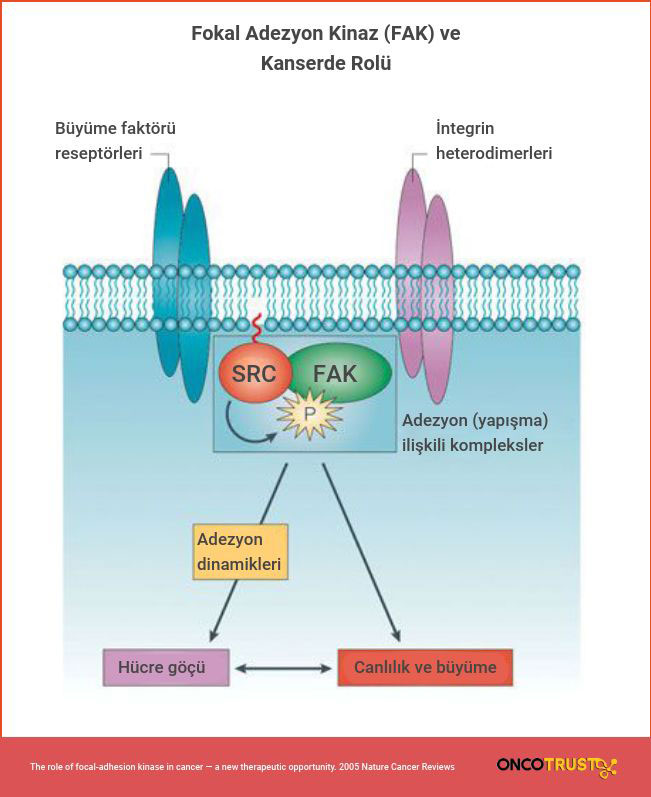
The interaction of Src with FAK (focal adhesion kinase) has been found to play an important role in tumor cell invasion. Src and FAK are kinases involved in cell movement (enzymes that change the function of a target protein by adding phosphate to it). In some circumstances, Src phosphorylates FAK (attaches a phosphate group to an organic molecule), creating docking sites for certain signaling proteins. Genetically inactivating Src kinases and FAK therefore disrupts cell motility. Src and FAK also exhibit high expression (the process of producing products such as proteins) in some invasive (metastasized) cancers. This observation has provided evidence for the roles of Src and FAK in cell motility and invasion.
Margaret Frame conducted research to understand the role of FAK in carcinogenesis (cancer formation), and her results showed that FAK was decisive in the initiation and progression of protein levels in cancer cells. In the same study, it was also observed that adding active Src to noninvasive (nonmetastatic) cancer made it invasive. The common conclusion drawn together with other research is that Src supports cell motility and tumor cell growth through multiple mechanisms. However, most of these mechanisms depend on FAK (local activation of RAC and phosphorylation of FISH are independent of FAK).

Another interaction is the Ras-MAP interaction. This interaction plays a role in identifying targets in cancer cells. Ras is activated by mutations and interacts with more than 20 effectors. Serine / threonine Raf activates the MAP pathway and the RAF-MEK-ERK pathway, which are necessary for a series of oncogenic Ras transformations (fragmentation of a gene as a result of a cell entering a foreign gene). These pathways have their own substrates (substances processed in enzyme reactions) and are regulated by scaffold proteins. The Map kinase pathway activates transcription (transfer of a DNA sequence to RNA) in the Ets family and regulates the expression of multiple genes. Together with certain enzymes, EphA2 kinase reduces wild-type RAS and regulates RAS that has not been mutationally activated. Activation of MAP kinase has an important effect on tumor cell survival. MAP kinase signals describe new targets to caspase 9 gene. Caspase 9 inhibits some anticancer factors. Therefore, caspase 9 supports the view that the Ras MAP interaction promotes tumor cell survival. In addition, the p14 gene serves to localize MAP kinase activation so that MAP can evade certain tumor suppressors.

PI3 kinase is involved in regulating cell growth, motility and survival. PI3 kinase produces phosphoinositides that convert proteins containing lipid-recognition domains to the membrane. PI3 kinase controls cell growth through a chain of events. First, PI3 kinase produces PDK1 and AKT. AKT then activates mTOR kinase. mTOR activates translation in 2 ways. First, in increased translation of 5-terminal oligopyrimidine tract (TOP) mRNAs encoding proteins and other components of the translation machinery, it activates the involved ribosomal S6 protein kinase and inactivates an inhibitor of initiation factor eIF4E, namely 4EBP-1. PI3 regulates cell growth in this way. Akt and PI3 rearrange YB-1, a DNA- and RNA-binding protein. The mutant form of YB-1 localizes to the nucleus rather than the cytoplasm and does not block transformation. This allows cancer cells to multiply. Recent research shows that mTOR is regulated by the hormones TSC-1 and TSC-2. Because these hormones are growth inhibitors and tumor suppressors, mutations in them can lead to sclerotic (hardened) tumors in other organs. In addition to its effect on cell growth, PI3 kinase can support cancer cell survival and metastasis through Akt. PI3 kinase, together with Akt, Mad3, Myc and s6 kinase, mediates Ras-induced cellular senescence. Thus, in addition to its contributions to cancer cells, it develops a protective control mechanism.

In the Rho family, GTPases can cause cancer through their activators and effectors. In normal cells, GTPases are involved in cell motility and proliferation. Besides GTPases, other genes belonging to the Rho family occur in various cancers, and Rho is necessary for transformation involving the Rac, Ras and Cdc42 genes. Channing Der's research examined the relationship of the Rac and Ras genes with the Tiam1 gene. The Rac GEF Tiam1 gene contains a Ras-binding domain. Mice lacking Tiam1 are resistant to Ras- and Rac-induced cancers. This study established that members of the Rho family are oncogenes. Independent growth of pancreatic cancer cells carrying activated K-Ras depends on both activated Ras and continuous expression of the Tiaml gene. Another example is the oncogenicity of the PAR1 gene, which is involved in Rho-dependent transformations. When Par1 is overproduced, it becomes an oncogene, and this depends on RhoA function. The Rho family also affects microtubules. Thus, together with various kinases such as RhoA, RhoB, Erk, Map, Cdc42, mDia2, MTOC and ROCK, it participates in cell movement and cell targeting during cancer. WAVE and Scar proteins are a group of scaffold proteins mediating the effects of GTPases on the actin cytoskeleton. These proteins connect GTPases to the Arp2 /3 complex, which adjusts the actin filament arrangement and nucleates branching. WAVE proteins thereby aid cell motility.
Many other protein interactions like these take part in communication between cancer cells and confer certain characteristics on them. Possible targets for anticancer therapeutics (related to treatment) are already being intensively investigated for some mutated genes. As this complex signaling mechanism and these protein interactions become better understood, new cancer treatments will be developed. Since these mechanisms will also increase our understanding of cancer, the resulting treatments will become more effective. Cancer survival rates will thereby increase.
Was this article helpful?
Your feedback helps us improve our content.




Reader comments
Share your comment
Your name and comment are published only after administrator approval. Your email address is never shown to visitors.
Be the first to comment.