
Nonsurgical Treatment Is an Effective Alternative for Muscle-Invasive Bladder Cancer

In this article
The usual approach to muscle-invasive bladder cancer (MIBC) is surgical removal of the bladder. More conservative, organ-preserving options have generally been offered to patients unwilling to undergo surgery, but bladder preservation has gained wider acceptance in recent years.
These patients have stage 2 bladder cancer . Cancer has penetrated the inner bladder wall and reached its muscle layer but has not yet spread to lymph nodes or distant sites.
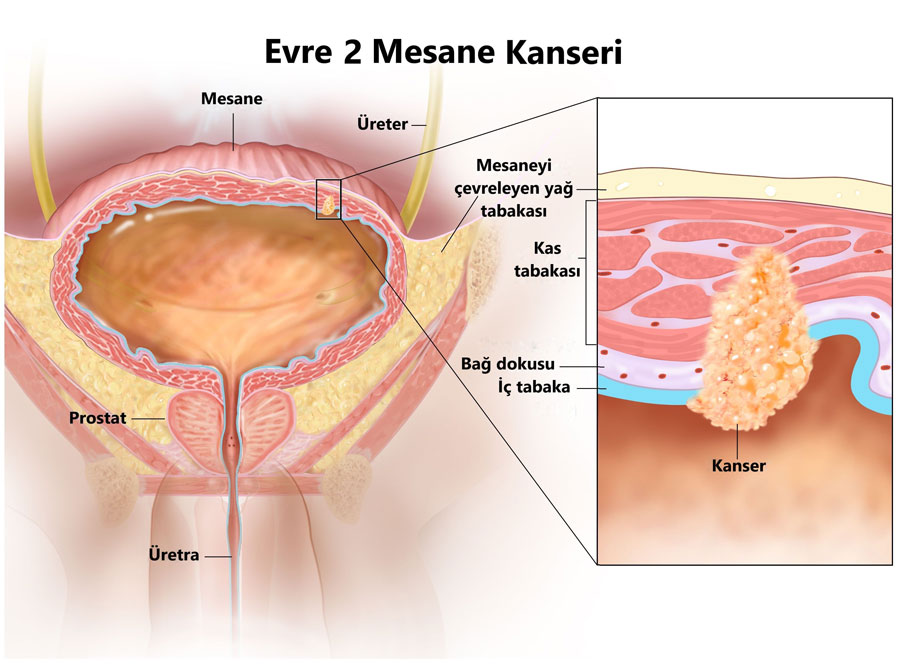
Nonsurgical options for muscle-invasive disease are now being thoroughly tested.
A University of Toronto team led by urologic oncologist Dr. Alexandre Zlotta argues that bladder-preserving treatment should be offered to all such patients, whether or not they are fit for surgery.
This striking conclusion comes from a study published online on May 12, 2023 in The Lancet Oncology . Researchers say it provides the best evidence comparing bladder removal with preservation.
The study analyzed patients undergoing radical cystectomy and those receiving maximal transurethral bladder tumor resection followed by concurrent chemoradiotherapy.
The team found no difference in cancer outcomes over 5 years. Overall survival was better with trimodal (three-stage) treatment because cystectomy carried a 2.5% postoperative mortality risk.
Trimodal treatment generally means combining three different treatment methods. Turkish commonly uses "trimodal" unchanged. More explicitly Turkish alternatives can be translated as "three-way treatment," "three-mode treatment" or "three-stage treatment."
This is the most comprehensive multicenter comparison of cancer outcomes with these approaches to date. Where randomized trials are unlikely to be feasible, Zlotta and colleagues say it provides the best evidence to guide management.
The paper has attracted considerable attention in bladder cancer circles, rightly so in my view. Its distinctive feature is how closely matched the groups are: what researchers call comparing apples with apples.
Several previous randomized trials attempted to compare these options but ended early because they could not recruit enough participants.
Part of the problem was insufficient evidence for bladder preservation, making patients reluctant to enroll. Yet strong evidence could not be generated without trials: a deadlock.
Radical cystectomy therefore remains the most common curative treatment for MIBC, despite frequent, sometimes life-changing complications and perioperative mortality.
To address this dilemma, researchers chose the next best approach to a randomized trial: a propensity-score study matching 282 trimodal patients to 437 radical cystectomy patients at a 1:3 ratio.
Treatment Guidelines Should Be Reconsidered
Careful patient selection remains essential.
The participants were ideal candidates for trimodal treatment. They had solitary tumors smaller than 7 cm and T2-T4 N0M0 muscle-invasive bladder cancer, without bilateral hydronephrosis (cancer-related enlargement of both kidneys) or extensive carcinoma in situ.
Patients choosing organ preservation must commit to ongoing follow-up, including surveillance cystoscopy, biopsies and possible intravesical treatments, and understand the recurrence risk they would not have had after bladder removal.
Recurrence with trimodal treatment was 31%, and 13% underwent salvage cystectomy over approximately 5 years. Delaying surgery did not adversely affect cancer outcomes.
Patients with a high disease and symptom burden may also obtain less relief from trimodal treatment than from cystectomy.
Study Details
Zlotta and colleagues matched 282 trimodal patients with 837 radical cystectomy patients using 1:3 matching.
After matching, median age among men in both groups was 71. In each group, 90% had cT2 disease, around 11% had unilateral hydronephrosis and almost 60% had received neoadjuvant (preoperative tumor-shrinking) or adjuvant (postoperative protective) chemotherapy.
Patients were treated at different US cancer centers during 2005-2017.

Results
- With either approach, 74% remained metastasis-free for 5 years, and disease-free survival was 76%.
- The 5-year cancer-specific survival rate was 83% with cystectomy and 85% with trimodal treatment.
- Overall, 5-year overall survival was 77% with trimodal treatment versus 72% with cystectomy (P = 0.0078).
- Perioperative mortality after cystectomy was 2.5%. No trimodal patients died within the first 90 days after treatment.
In this matched analysis, cancer outcomes with radical cystectomy and trimodal treatment were similar, particularly disease-free survival and cancer-related mortality.
Limitations include the observational design and unaccounted factors that might influence outcomes, such as tumor biology or preoperative health.
In summary,
- Trimodal therapy combines maximal transurethral resection (TURBT), radiotherapy and chemotherapy to treat bladder cancer.
- It preserves the bladder, offering an alternative to radical cystectomy, which requires bladder removal.
- It can improve quality of life and is generally appropriate for muscle-invasive disease without lymph node spread.
Another New Approach: Adding Immunotherapy to Trimodal Treatment
In recent years, immune checkpoint inhibitor immunotherapies have become important in many cancers. They "awaken" the immune system and prevent cancer cells from escaping it. They may be particularly effective in cancers where immunity matters, such as bladder cancer.
nivolumab was shown in CheckMate 274 to be highly effective as adjuvant therapy after surgery for muscle-invasive urinary tract cancers. It attracted attention as one of oncology's most important developments in the past 5 years.

Following these results, on August 19, 2021, the FDA approved nivolumab (Opdivo) as adjuvant treatment for urinary tract cancer at high recurrence risk after radical surgery, regardless of prior neoadjuvant chemotherapy, lymph node involvement or PD-L1 status.
The approval demonstrated immunotherapy's effectiveness in muscle-invasive bladder cancer. Adding it to trimodal treatment might therefore improve efficacy and overall survival, including for patients with lymph node involvement. However, clinical trial results demonstrating the effectiveness of adding immunotherapy to trimodal treatment are not yet available.
Sources
2023.
Was this article helpful?
Your feedback helps us improve our content.




Reader comments
Share your comment
Your name and comment are published only after administrator approval. Your email address is never shown to visitors.
Be the first to comment.