
Pembrolizumab Receives FDA Approval for First-Line Treatment of Cervical Cancer

In this article
For patients whose tumors are PD-L1 positive (CPS ≥1), with treatment-resistant, recurrent or metastatic cervical (cervix) cancer, first-line treatment combining chemotherapy with or without bevacizumab and the immunotherapy pembrolizumab (Keytruda, Merck) received FDA (US Food and Drug Administration) approval on October 13, 2021.
The IHC 22C3 pharmDx (Dako test) was used to measure PD-L1 for this approval.
At the same time, an accelerated approval granted in 2018 was converted to regular approval: pembrolizumab as a single agent for patients with recurrent or metastatic cervical cancer expressing PD-L1 (CPS ≥1) whose disease progressed during or after chemotherapy.
Approval Based on the KEYNOTE-826 Study
The multicenter, randomized, double-blind, placebo-controlled trial known as KEYNOTE-826 evaluated pembrolizumab with paclitaxel and cisplatin or paclitaxel and carboplatin, with or without bevacizumab in this study.
Eligible patients had treatment-resistant, recurrent or metastatic cervical cancer and had not received prior treatment for this disease; a total of 617 patients were enrolled. Both PD-L1-positive and negative patients were included and randomly assigned in a 1:1 ratio to one of two groups.
Patients in the experimental group received pembrolizumab plus chemotherapy (with or without bevacizumab)
The control group received placebo plus chemotherapy (with or without bevacizumab)
Pembrolizumab, until unacceptable toxicity, disease progression or up to 24 months, was continued.
The main efficacy outcome measures were overall survival and progression-free survival. Additional outcome measures were overall response rate and duration of response.
Results
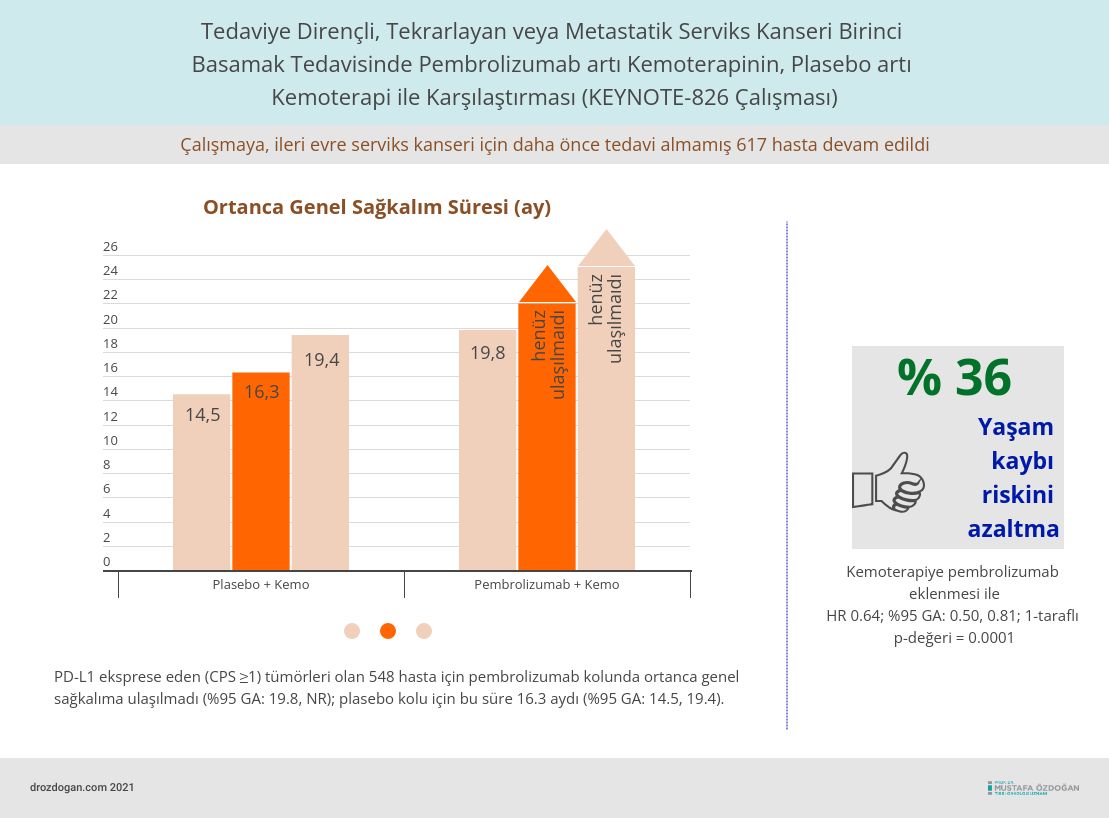
- Among 548 patients with tumors expressing PD-L1 (CPS ≥1), median overall survival was not reached in the pembrolizumab group (95% CI: 19.8, NR); it was 16.3 months in the placebo group (95% CI: 14.5, 19.4).
- Pembrolizumab reduced the risk of death by 36% (HR 0.64; 95% CI: 0.50, 0.81; 1-sided p-value = 0.0001).
- Median progression-free survival was 10.4 months in the pembrolizumab group (95% CI: 9.7, 12.3) and 8.2 months in the placebo group (95% CI: 6.3, 8.5).
- Pembrolizumab reduced the risk of cancer progression by 38% (HR 0.62; 95% CI: 0.50, 0.77; one-sided p-value< 0.0001).
- The objective response rate was 68% (95% CI: 62, 74) in the pembrolizumab group and 50% (95% CI: 44, 56) in the placebo group.
- Median duration of response was 18 months in the pembrolizumab group versus 10 months in the placebo group.
In patients treated with pembrolizumab, chemotherapy and bevacizumab, the most common (≥ 20%) adverse effects were peripheral neuropathy, alopecia, anemia, fatigue/asthenia, nausea, neutropenia, diarrhea, hypertension, thrombocytopenia, constipation, arthralgia, vomiting, urinary tract infection, rash, leukopenia, hypothyroidism and decreased appetite.
The recommended pembrolizumab dose is 200 mg every 3 weeks or 400 mg every 6 weeks until disease progression, unacceptable toxicity or up to 24 months.
Was this article helpful?
Your feedback helps us improve our content.




Reader comments
Share your comment
Your name and comment are published only after administrator approval. Your email address is never shown to visitors.
Be the first to comment.