
The Best Results to Date in Metastatic HER2-Positive Breast Cancer

In this article
Metastatic HER2+ breast cancer may have a new treatment standard in the second-line setting: new results with trastuzumab deruxtecan (Enhertu), described as “extraordinary” and “astonishing,” make this drug a candidate to become the new standard of care.
The current standard treatment for these patients is trastuzumab emtansine (T-DM1, Kadcyla). Kadcyla, a combination of chemotherapy and a targeted antibody, has held this position since 2013. Over the last 8 years, we have not seen another treatment attempt to beat this drug in a head-to-head clinical trial.
Until now…
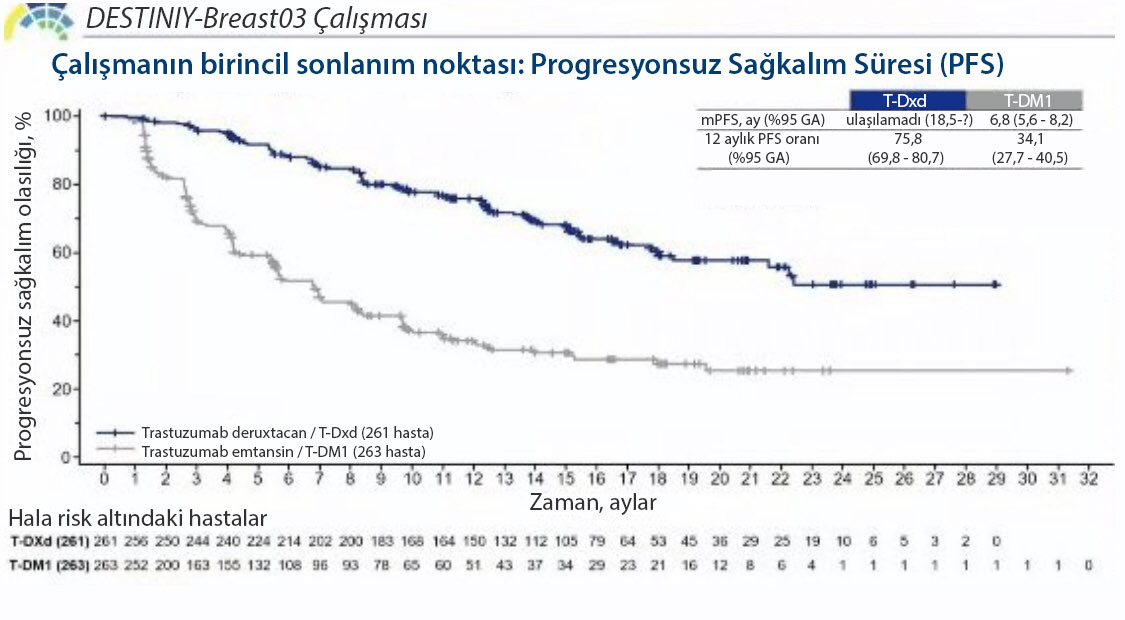
On September 18, ESMO 2021(the European Cancer Congress) featured what was, in terms of its results, the most noteworthy and exciting study , the DESTINY-Breast03 clinical trial comparing trastuzumab deruxtecan and T-DM1.
With trastuzumab deruxtecan, median progression-free survival (PFS) was 25.1 months, compared with 7.2 months with T-DM1. Trastuzumab deruxtecan reduced the risk of cancer progression by 74% (hazard ratio [HR], 0.26).
This difference is clearly “highly statistically and clinically significant.”
In addition, Dr. Sara Hurvitz, who presented the study, said that although immature at this stage, the overall survival data were “encouraging.” These data appear to support trastuzumab deruxtecan becoming the new second-line standard of care for HER2+ metastatic breast cancer.
The side effect profiles of these drugs appear “manageable” and “similar” between the two treatment arms. However, grade ≥3 drug-related adverse events occurred in 45.1% of patients receiving trastuzumab deksruxtecan and 39.8% of those receiving T-DM1.
Rationale
For HER2-positive advanced breast cancer, standard first-line treatment, established by the CLEOPATRA study in which median progression-free survival was 18.7 months, is trastuzumab plus pertuzumab plus a taxane chemotherapy.
Until now, the standard second-line treatment had been T-DM1, established by the EMILIA trial, in which patients achieved a median progression-free survival of 9.6 months.
Previous phase 2 trial data for trastuzumab deruxtecan in patients with metastatic breast cancer who had received at least 2 prior lines of treatment showed strong activity, with median progression-free survival doubling or even tripling. These findings led to FDA approval of Enhertu (trastuzumab deruxtecan) in December 2019 (see the related approval).
Details of the DESTINY-Breast03 Study
Patients enrolled in this study had unresectable or metastatic HER2+ breast cancer and had previously received trastuzumab and a taxane for advanced/metastatic breast cancer.
Approximately 90% of patients had received prior treatment. Nearly all had been given trastuzumab, and slightly more than 60% had received pertuzumab.
The two treatment arms were well balanced for baseline characteristics. The average patient age was 54. Approximately 50% had hormone receptor-positive disease, 20% to 24% had brain metastases, and 70% had visceral (internal organ) metastases.
524 patients were randomly assigned in a 1:1 ratio to one of two arms to receive trastuzumab deruxtecan or T-DM1 three times a week.
Results
- As measured by the investigator, median progression-free survival (PFS) was 25.1 months with trastuzumab deruxtecan, compared with 7.2 months with T-DM1. Trastuzumab deruxtecan reduced the risk of cancer progression by 74% (hazard ratio [HR], 0.26). Median PFS with trastuzumab deruxtecan, as measured by the independent monitoring committee, had not yet been reached.
- With trastuzumab deruxtecan, the 12-month PFS rate was 75.8%, compared with 34.1% with T-DM1.
- The improved effectiveness with trastuzumab deruxtecan was seen in “all predefined subgroups, including hormone receptor status, previous pertuzumab treatment, presence of visceral disease, number of prior treatment lines, and presence or absence of brain metastases.”
- The estimated overall survival rate at month 12 was 94% with trastuzumab deruxtecan, compared with 85.9% with T-DM1 (HR, 0.56; P = 0.007172). Median overall survival had not been reached in either treatment arm.
- The confirmed overall response rate was 79.7% with trastuzumab deruxtecan, compared with 34.2% with T-DM1 (P < 0.0001).
- The results also showed that 16.1% of trastuzumab deruxtecan patients and 8.7% of T-DM1 patients achieved a complete response. In addition, disease progression occurred in only 1.1% of patients treated with trastuzumab deruxtecan, compared with 17.5% in the T-DM1 arm.
- The median treatment duration was 14.3 months with trastuzumab deruxtecan and 6.9 months with T-DM1.
Grade ≥3 drug-related adverse events occurred in 45.1% of patients receiving trastuzumab and 39.8% of those receiving T-DM1. The most frequent events were neutropenia, anemia, leukopenia, thrombocytopenia, nausea and fatigue.
Serious drug-related adverse events occurred in 10.9% of patients receiving trastuzumab deruxtecan and 6.1% of those given T-DM1. Drug-related events associated with discontinuation occurred in 12.8% and 5% of patients, respectively.
The most common event associated with discontinuing trastuzumab deruxtecan was interstitial lung disease / pneumonitis, occurring in 8.2% of patients. Thrombocytopenia was the most common cause in the T-DM1 arm, occurring in 2.7% of patients.
Overall, she said that pneumonitis events considered drug-related occurred in 10.5% of patients receiving trastuzumab deruxtecan, but the vast majority were grade 1/2, and only two patients had a grade 3 event.
No treatment-related side effects were associated with death.
Trastuzumab Deruxtecan Delivers More Chemotherapy
Both products are antibody-chemotherapy conjugates, and in both, trastuzumab binds to the HER2 receptor, but each delivers a different chemotherapy to cancer cells.
Trastuzumab deruxtecan carries a chemotherapy payload not normally used in breast cancer and has twice as many chemotherapy molecules attached to each antibody as T-DM1, thereby delivering more chemotherapy to cancer cells.
In addition, trastuzumab deruxtecan “has a cleavable linker,” and when this linker breaks, it releases chemotherapy that can produce a “bystander effect” and kill neighboring cells, including HER2-negative cells.
This is particularly important for treating HER2+ breast cancer because we know that HER2+ expression is heterogeneous within tumors.
One concern in earlier studies of trastuzumab deruxtecan was lung toxicity of all grades in approximately 16% of patients.
Today, I think we can put many of these concerns aside. The reason the current trial had fewer events involving lung toxicity, without high-grade events, may relate to “a patient group exposed to fewer previous cancer treatments.”
In conclusion, data from DESTINY-Breast03, the most noteworthy study of ESMO 2021, support trastuzumab deruxtecan becoming the new second-line standard of care for HER2+ metastatic breast cancer. However, HER2 positivity applies to subtypes of many other cancers as well as breast cancer, especially stomach, lung and colon cancers. We may see new study results showing effectiveness of trastuzumab deruxtecan in other HER2-positive cancers in the coming period.
In the near future, we will also see study results on the effectiveness of trastuzumab deruxtecan in breast cancer in the adjuvant, neoadjuvant settings and in patients with postoperative residual disease.
Sources
2. DS-8201a Versus T-DM1 for Human Epidermal Growth Factor Receptor 2 (HER2)-Positive, Unresectable and/or Metastatic Breast Cancer Previously Treated With Trastuzumab and Taxane [DESTINY-Breast03]
Was this article helpful?
Your feedback helps us improve our content.




Reader comments
Share your comment
Your name and comment are published only after administrator approval. Your email address is never shown to visitors.
Be the first to comment.