
The Cervical Cancer Vaccine Could Save 62 Million People

In this article
The Cervical Cancer Vaccine
Cervical cancershave more than % 95 of their cases caused by viral HPV infection . The simplest, most effective way to combat cervical cancer should therefore be preventing HPV infection. Our strongest weapon is the HPV vaccine, used effectively since 2006 (see its discovery). Women aged 9 to 26 receive it over 6 months in 3 doses. Early vaccination is important for strong immunity, so the target age is 11-12. The same vaccine is recommended to men to prevent head and neck, anal and penile cancer. The male age range is 9 to 21, again targeting 11-12.
A Study Revealing HPV Vaccination's Potential
If 78 of the poorest countries rapidly implement HPV vaccination, cervical screening, and cancer treatment, over the next 100 years more than 74 million cases and 62 million deaths could be prevented. Despite successful treatment figures in wealthy countries such as Australia, cervical cancer remains women's a fourth most common cancer and a leading cause of death in some low-income countries. In 2018, most of the world's 570.000 new cases occurred among women in low- and lower-middle-income countries. - Related topic: Australia is about to eliminate this cancer. Vaccinating girls, twice conducting cervical cancer screening and providing invasive cervical cancer treatment could reduce incidence by % 97 and deaths by % 99, preventing more than 74 million cases and saving 62 million lives. Three teams independently studied this, obtaining similar results, also evaluated within the World Health Organization (WHO). Australia has pioneered prevention and treatment and aims to eliminate cervical cancer by 2035. HPV gene fragments occur in % 99,9 of cervical tumor tissues, and HPV is considered responsible for more than % 95 of the disease. Australia's free school HPV vaccination program aims to greatly lower future rates. A UK study found that by late 2018, the vaccination program's tenth year, no HPV infection was detected in vaccinated women aged 16 to 18.
Comparing Cervical Cancer in Low-Income Countries and the USA:
Malawihas the highest cervical cancer rate worldwide. A Queen Elizabeth Central Hospital (QECH) study in southern Malawi observed newly diagnosed patients' presentation, management, and short-term outcomes. Among Malawian women, the most common canceris cervical cancer, comprising over %40 of female cancers and a major cause of illness and death. Incomplete cancer registration and no national death certificate system make the affected population uncertain. Malawi Cancer Registry (MCR) and the International Agency for Research on Cancer (IARC) GLOBOCAN program produced markedly different estimates. Per 100.000 annually, 75,9 new cases represent the world’s highest incidence. Mortality also leads globally: per 100.000, 49,8 deaths. Survival at 5 years is only %2.9. For a striking comparison, US 5-year survival is % 68. In May 2018, WHO called for global action to eliminate cervical cancer. Modeling suggested Australia could eliminate it as a public health problem within the next decade through high HPV vaccination and screening coverage. Meanwhile, Chinahas offered population-based screening since 2009 and approved HPV vaccination in 2016. However, screening coverage is % 21.4, and vaccination is limited because it is not yet in the national program. Elimination in China will therefore require more effort and time than in Australia. THE LANCET Public Healthpublished a modeling study aiming to predict China's cervical cancer incidence through 2100 and evaluate budget strategies for elimination.
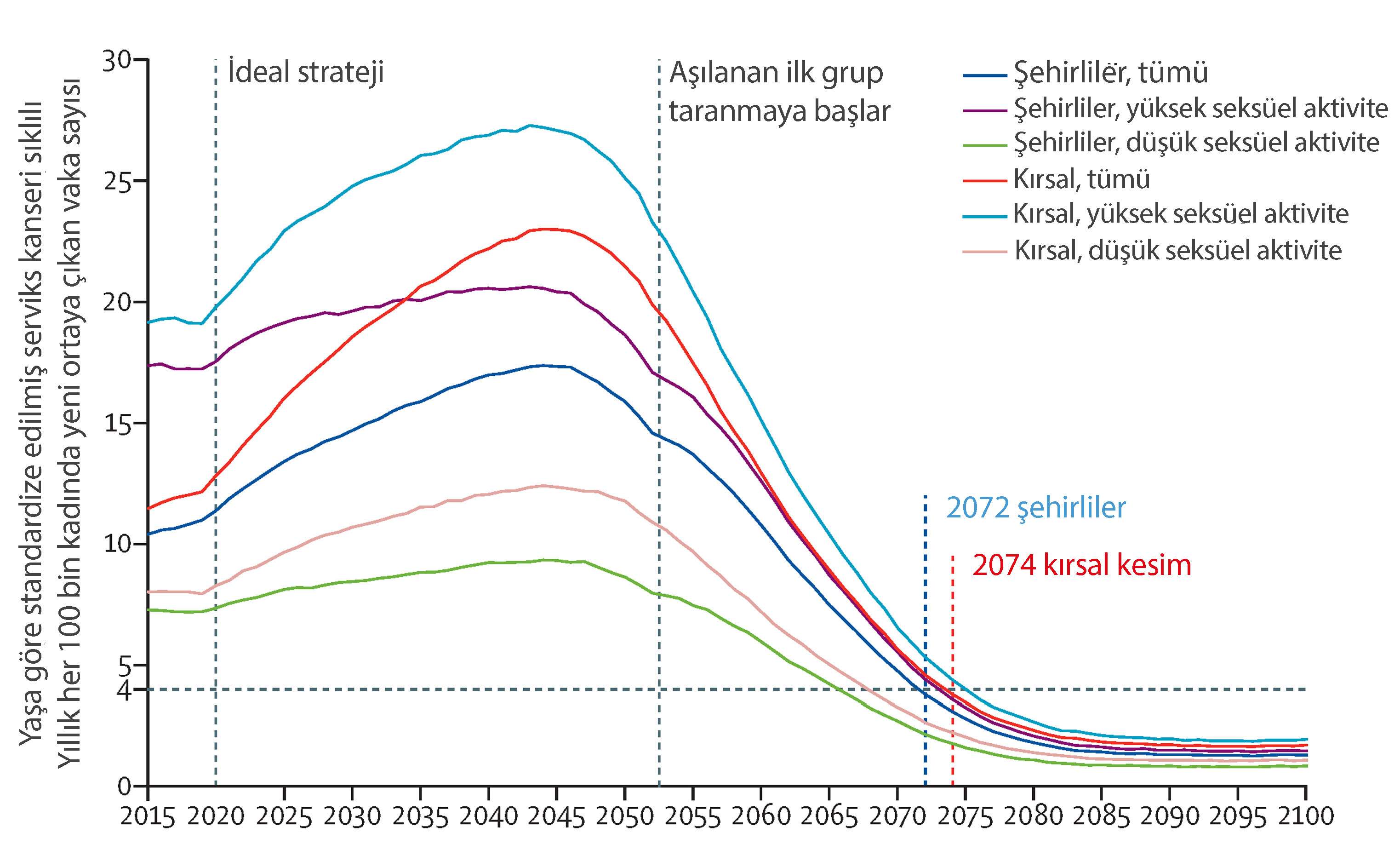
The Graph Above: Modeled age-specific cervical cancer incidence in China between 2015 – 2100 under new strategies. Considering aging, urbanization, and sexual activity trends, unchanged strategies are projected to make China's incidence between 2015 – 2100 triple . Modeling suggests China can eliminate cervical cancer if, from 2020, it vaccinates girls aged 12 and expands population screening with a broad screening interval. Without increasing its budget, it could achieve this by the early 2070s. Current incidence is slightly per 100.000 women, with slightly fewer than 4 cases annually. To prevent increases, modeling included all ages, urban and rural residents, and high and low sexual activity. Cervical precursors and 14 high-risk HPV strains (types 16, 18, 31, 33, 35, 39, 45, 51, 52, 56, 58, 59, 66, and 68) were included. If current strategies persist, by 2100 incidence is projected to triple compared with 2015. The revised strategy targets girls aged 12 with at least % 95 vaccination and women aged 45 with at least % 90 screened once (currently % 90 urban and % 33 rural). With a fixed budget and new strategy, modeling predicts likely elimination in urban China in 2072 (2070-2074) and rural China in 2073 (2071-2075). Limitations remain: modeling where cancer registration is poor is very difficult and cannot represent the full population. China's screening coverage is lower than other countries', but adopting the new strategy in 2020 aims for elimination over 50 years. In conclusion, these indicators and projections provide important data shaping countries' current and future health investments. Each country clearly faces distinct vaccination, screening, and treatment challenges. The HPV–cervical cancer relationship importantly demonstrates that some cancers are substantially preventable.
Sources
Projections up to 2100 and a budget optimisation strategy towards cervical cancer elimination in China: a modelling study.
THE LANCET Public Health, 01 Sep 2019.
Was this article helpful?
Your feedback helps us improve our content.




Reader comments
Share your comment
Your name and comment are published only after administrator approval. Your email address is never shown to visitors.
Be the first to comment.