
Trastuzumab Deruxtecan Is Also Effective After Trastuzumab Emtansine in Breast Cancer

In this article
Enhertu, a next-generation cancer drug containing trastuzumab deruxtecan, showed superior results in patients with HER2-positive metastatic breast cancer previously treated with trastuzumab emtansine (Kadcyla).
The Lancet reported the phase III DESTINY-Breast02 trial by André and colleagues, showing that fam-trastuzumab deruxtecan-nxki improved progression-free survival compared with physician's choice of treatment in HER2-positive metastatic breast cancer previously treated with ado-trastuzumab emtansine.
The results indicate a significant survival advantage with trastuzumab deruxtecan in HER2-positive metastatic breast cancer. This is also the first randomized trial showing that an antibody-drug conjugate (ADC) can overcome resistance to a previous ADC. This is an important development for patients with HER2-positive metastatic breast cancer who have received multiple treatment lines.
Antibody-drug conjugates (ADCs) use an antibody designed to bind a molecular target on a tumor, linked to a chemotherapy agent that can then be delivered to a particular tumor cell. This is known as a "Trojan horse" approach. (For further details, see A Frontier in Drug Discovery: Targeted Antibody-Chemotherapy Conjugates)
Details of DESTINY-Breast02
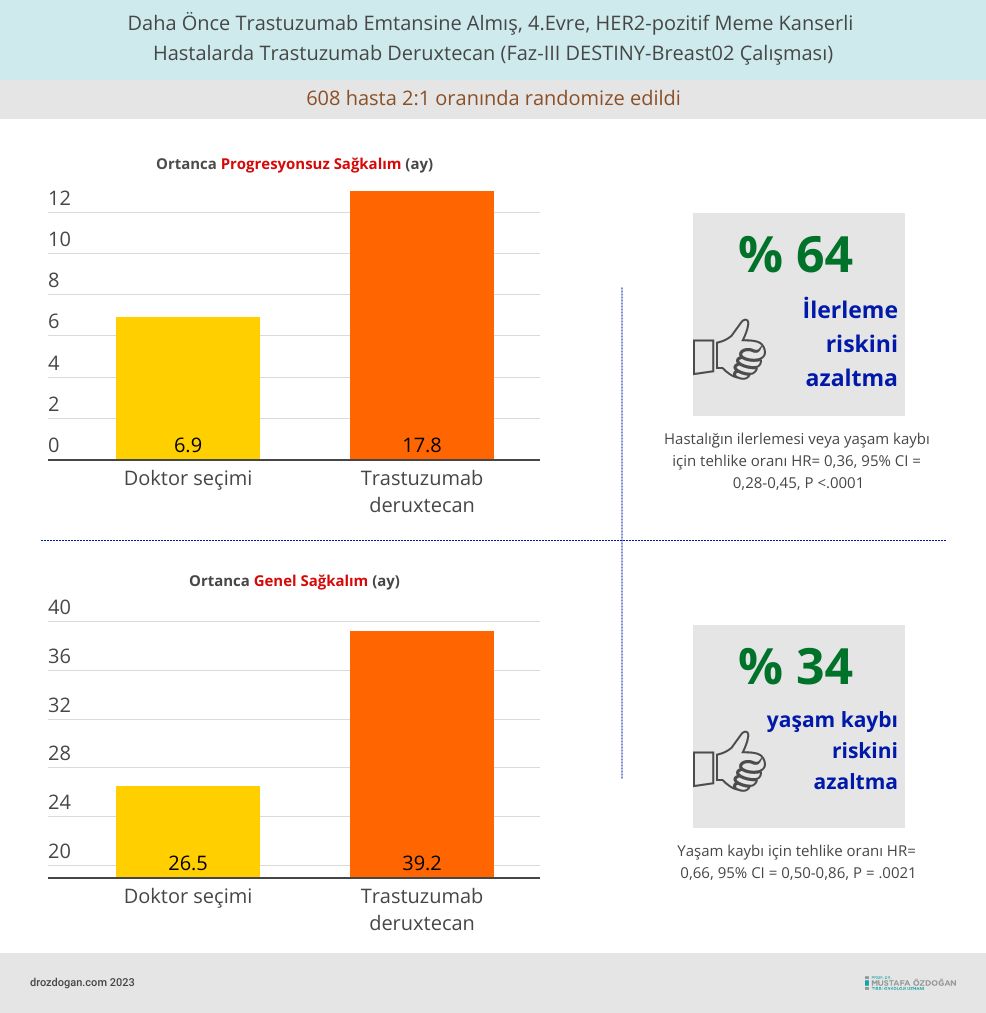
In this open-label study, 608 patients from centers in North America, Europe, Asia, Australia, Brazil, Israel and Turkey were randomized 2:1 between September 2018 and December 2020 to trastuzumab deruxtecan (406 patients) or physician's choice (202 patients).
Physician's choice options were oral capecitabine with intravenous trastuzumab, or oral capecitabine with lapatinib.
More than 99% had previously received trastuzumab and trastuzumab emtansine, and 77-78% had received pertuzumab. The primary endpoint was progression-free survival.
Progression-Free Survival
Median follow-up was 21.5 months (IQR=15.2-28.4 months) with trastuzumab deruxtecan and 18.6 months (IQR=8.8-26.0 months) with physician's choice.
Median progression-free survival with trastuzumab deruxtecan was 17.8 months (95% CI=14.3-20.8 months), compared with 6.9 months with physician's choice (95% CI=5.5-8.4 months) (HR=0.36, 95% CI=0.28-0.45, P<0.0001).
Progression-free survival rates at 12 and 24 months were 62.3% versus 27.2% and 42.2% versus 13.9%, respectively.
Median overall survival with trastuzumab deruxtecan was 39.2 months (95% CI=32.7 months to not estimable), compared with 26.5 months with physician's choice (95% CI=21.0 months to not estimable) (HR=0.66, 95% CI=0.50-0.86, P=0.0021, crossing this analysis's significance threshold of P=0.0040).
Overall survival rates at 12 and 24 months were 89.4% versus 74.7% and 65.9% versus 54.3%, respectively.
Adverse Effects
Serious (grade≥3) adverse effects occurred in 53% with trastuzumab deruxtecan versus 44% with physician's choice. Common events with trastuzumab deruxtecan included neutropenia (11% versus 2%), anemia (8% versus 3%), nausea (7% versus 3%), diarrhea (3% versus 7%) and palmar-plantar erythrodysesthesia (1% versus 10%).
Drug-related interstitial lung disease (ILD) occurred in 42 patients (10%, including 2 grade 5 cases) with trastuzumab deruxtecan, versus 1 patient (<1%) with physician's choice. Drug-related adverse events caused four deaths (<1%) with trastuzumab deruxtecan: two from ILD and one each from acute myeloid leukemia and pneumonia. No treatment-related deaths occurred with physician's choice.
Summary
DESTINY-Breast02 shows that trastuzumab deruxtecan is effective and safe in HER2-positive metastatic breast cancer previously treated with trastuzumab emtansine. The study demonstrates significantly longer survival and superiority over other treatments chosen by physicians.
Serious treatment-related adverse effects were somewhat more frequent with trastuzumab deruxtecan than with physician's choice, although drug-related deaths remained relatively uncommon. These findings support its role as an important option in HER2-positive metastatic breast cancer. Trastuzumab deruxtecan is, however, a preferred earlier option for patients with HER2-positive metastatic disease who have not yet received trastuzumab emtansine.
These findings will help expand treatment options and highlight the potential value of antibody-drug conjugates in future cancer care.
Sources
Was this article helpful?
Your feedback helps us improve our content.




Reader comments
Share your comment
Your name and comment are published only after administrator approval. Your email address is never shown to visitors.
Be the first to comment.