
What is a PMS2 mutation? Which cancers does it increase the risk of?

In this article
What is an inherited PMS2 mutation? General information for carriers
- The name PMS2 comes from "PMS1 (Protein Mismatch repair System component) homolog 2". The PMS2 gene is located on chromosome 7. The PMS2 protein, the product of the PMS2 gene, plays an important role in repairing DNA damage as an endonuclease enzyme.
- Both men and women may have a PMS2 gene mutation.
- In the PMS2 gene, inherited mutations are associated with Lynch Syndrome. Lynch Syndrome is also known as Hereditary Non-polyposis Colorectal Cancer (HNPCC).
- People who carry an inherited PMS2 mutation have a higher risk of most cancers, but in particular large bowel (colon and rectum) and uterine (endometrial) cancer are the leading types of cancer at risk.
- For people who carry a PMS2 mutation, there are guidelines for certain cancer screening and prevention measures.
- People who carry an inherited PMS2 mutation and have been diagnosed with cancer may receive certain treatments or participate in clinical trials.
- Children who inherit a PMS2 mutation from both their mother and father may have a rare syndrome known as Constitutional Mismatch Repair Deficiency (CMMRD), which causes a high risk of various cancers during childhood and adolescence.
Which cancers does an inherited PMS2 mutation increase the risk of?
If you have a positive result for an inherited PMS2 mutation on your genetic test, you are advised to contact a team that can review your and your family’s cancer history and help you choose the best plan to manage your cancer risk: a multidisciplinary oncology team.
People who carry an inherited PMS2 mutation have a higher lifetime risk of many cancers. In addition, cancers tend to occur at an earlier age than in people in the general population.
The most common cancers associated with a PMS2 mutation are:
- Colorectal cancer
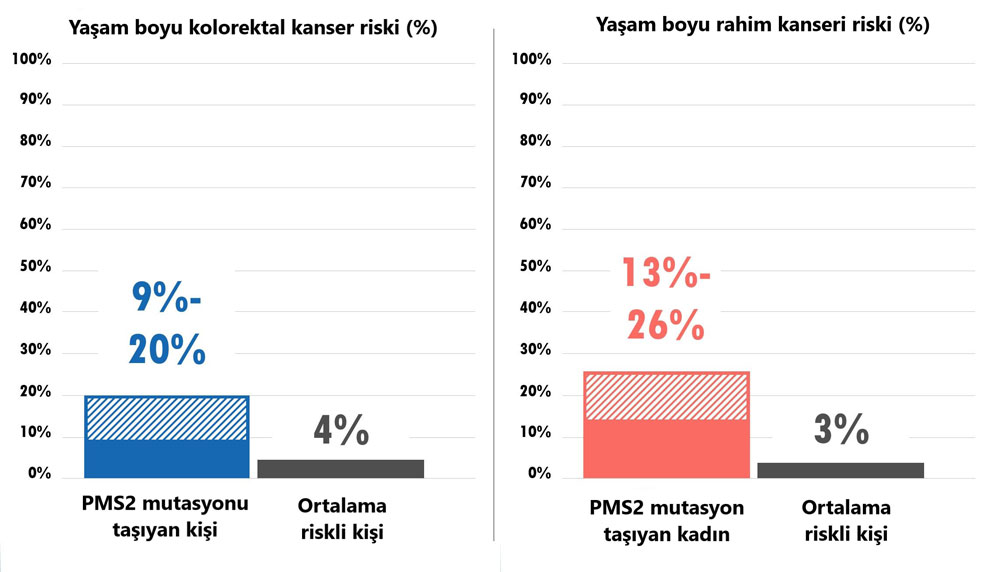
- Lifetime risk is 4% in the general population, compared with between 8.7% and 20 in these individuals.
- Average age at diagnosis is between 68 – 72 in the general population, compared with between 61 – 66 in these individuals.
- Uterine cancer
- Lifetime risk is 3% in the general population, compared with between 13% and 26 in these individuals.
- Average age at diagnosis is 60 in the general population, compared with 49 – 50 in these individuals.
Other cancer risks
The exact risk of skin growths called cutaneous sebaceous neoplasia has not been clearly defined, but experts believe that a PSM2 mutation increases the risk.
The risks of the following cancers in people who carry a PMS2 mutation are debated. The following cancers are linked to other genes associated with Lynch Syndrome. However, some studies do not show an increased risk of these cancers in people who carry a PMS2 mutation.
- Ovarian cancer
- Stomach cancer
- Bladder and other urinary tract cancers
- Small bowel cancer
- Central nervous system cancer
- Pancreatic cancer
- Breast cancer in women
- Prostate cancer
Studies on how mutations in the PMS2 gene affect cancer risks are ongoing.
What should risk management involve for people who carry an inherited PMS2 mutation?
The National Comprehensive Cancer Network (NCCN) provides risk management guidelines for men and women with a PMS2 mutation. You are advised to consult a genetics specialist who can review your and your family’s cancer history and help you decide on the best risk management plan.
The NCCN risk management guidelines for people who carry a PMS2 mutation include information on the following cancers:
- Colorectal cancer
- Uterine cancer
- Other cancers
Colorectal cancer
- Have a colonoscopy between the ages of 30 -35 (or 2 – 5 years before the earliest age of colon cancer in the family, if it was diagnosed before age 25).
- Repeat colonoscopy every 1 – 2 years. Talk to your doctor about whether your screening should be annual or every two years. Men, people over 40, and people with a history of colon cancer or colon polyps may benefit most from annual screening.
- Daily aspirin may reduce the risk of colorectal cancer. The best dose and timing for aspirin are not known. Current research found that taking 600 mg of aspirin daily reduced the risk of colorectal cancer in people with Lynch Syndrome. Talk to your doctor about the benefits and risks, and the best timing and dose.
Uterine cancer
- Symptom awareness and biopsy: Uterine cancer can often be detected early based on symptoms followed by a biopsy. For this reason, experts recommend that all women be aware of uterine cancer symptoms and promptly report anything persistent to their doctor.
- Abnormal vaginal discharge
- Pelvic or abdominal pain
- Abdominal bloating
- Difficulty eating
- Frequent feeling of bladder fullness
- Screening: In the absence of symptoms, regular uterine cancer screening using transvaginal ultrasound and / or endometrial biopsies does not appear to achieve better outcomes than symptom awareness followed by biopsy for any woman with symptoms. Nevertheless, some women undergo regular screening using transvaginal ultrasound and endometrial biopsies. Transvaginal ultrasound is not recommended for premenopausal women. Women should talk to their doctor about the benefits, risks, costs and timing of transvaginal ultrasound and endometrial biopsies to make a decision about screening.
- Surgery: Removing the uterus (hysterectomy) reduces the risk of uterine cancer in women with Lynch Syndrome. However, hysterectomy has not been shown to reduce the risk of death from uterine cancer. Women should talk to their doctor about the benefits and risks of hysterectomy after completing child-rearing. The best time for surgery may vary depending on the gene mutation and the family’s cancer history.
- Drug treatment: Oral contraceptive medications (birth control medications) may reduce the risk of uterine cancer in women with Lynch Syndrome. Women should talk to their doctor about the benefits, risks and timing of contraceptive medications.
Other cancers
The following cancers are also included in guidelines providing risk management for people who carry a PMS2 mutation. However, it is noted that there is very little evidence of increased risk or benefit from management (unless there is a family history).
Ovarian cancer
- Surgery: According to experts, there are not enough records to recommend that all women who carry a PMS2 mutation have their ovaries and fallopian tubes removed (salpingo – oophorectomy). Women should talk to their doctor about the benefits and risks of salpingo – oophorectomy after completing child-rearing. The best time for surgery varies depending on the gene mutation and the family’s cancer history.
- Symptom awareness: Experts recommend that all women know the symptoms of ovarian cancer. Women should report to their doctor any of the following symptoms that last several weeks and anything different from normal:
- Pelvic or abdominal pain
- Abdominal bloating
- Difficulty eating
- Feeling full early
- Frequent feeling of bladder fullness
- Screening: In the absence of symptoms, regular screening is performed using transvaginal ultrasound and CA125 blood tests. However, ovarian cancer screening does not help detect ovarian cancer early. Women who are not planning surgery should talk to their doctor about the benefits, risks, costs and timing of transvaginal ultrasound and CA125.
- Drug treatment: Oral contraceptive medications (birth control medications) may reduce the risk of uterine cancer in women with Lynch Syndrome. Women should talk to their doctor about the benefits, risks and timing of contraceptive medications.
Pancreatic cancer screening in people with a family history
- People who carry a PMS2 mutation and have a first- or second-degree relative with pancreatic cancer should consider screening in their early 50s or 10 years earlier than their relative’s age at diagnosis.
- For people considering pancreatic cancer screening, NCCN recommends screening at an experienced facility and ideally under research conditions. Before undergoing screening, people should talk to their doctor about its benefits, risks, costs and limitations.
- Consider annual screening with contrast-enhanced MRI-MRCP (magnetic resonance cholangiopancreatography) and / or EUS (endoscopic ultrasound).
Bladder, kidney and ureter cancer
- People with a family history of urinary tract cancer should consider starting annual urinalysis between the ages of 30 – 35.
Brain cancer
- Consider starting physical and neurological examinations between the ages of 25 – 30.
Stomach cancer
- For people with a family history of stomach cancer and / or people of Asian ancestry:
- Consider stomach cancer screening at age 40, every 3 – 5 years, using a procedure known as EGD (esophagogastroduodenocopy – esophagogastroduodenoscopy (ÖGD)).
- If stomach screening is performed, consider H. Pylori testing and treatment.
Breast cancer
- Manage your breast cancer risk based on family history. Risk-reducing mastectomy (surgical removal of the breasts) is generally not recommended.
Cancer treatment for people who carry PMS2
Experts are conducting research studies to learn about the best treatments for people who carry an inherited PMS2 mutation.
Most cancers in people who carry an inherited PMS2 mutation will have a tumor biomarker known as “MSI – high” or “MSI – H” (microsatellite instability). This biomarker is also known as “MMR – D” (mismatch repair deficiency). Tumor testing for MMR – D or MSI – high may be important because these tumors are more likely to respond to immunotherapy agents known as immune checkpoint inhibitors.
MSI – H colorectal cancer
- For people with colorectal cancer, this concerns stage 2. MSI – high cancers have a good prognosis (disease course) and may not benefit from 5 – Fluorourasil adjuvant therapy (immunotherapy used in colorectal cancer).
- Keytrude (pembrolizumab) is an immune checkpoint inhibitor used to treat metastatic or advanced colorectal cancer that has progressed after treatment with a fluoropyrimidine, oxaliplatin and irinotecan.
- Opdivo (nivolumab) is approved as an immune checkpoint inhibitor used alone or in combination with Yervoy (ipilimumab) for metastatic cancer that has progressed after treatment with a fluoropyrimidine, oxaliplatin and irinotecan.
Immune checkpoint inhibitors to treat any MSI – H cancer
- Keytrude (pembrolizumab) was approved to treat any solid tumor testing MSI – H that has progressed after treatment and has no other treatment options.
Other medical concerns for people who carry an inherited PMS2 mutation
Children who inherit a PMS2 mutation from both their mother and father may have a very rare syndrome known as “constitutional mismatch repair deficiency (CMMRD)”. CMMRD may pose a high risk of various cancers during childhood and adolescence. Children with CMMRD syndrome may have blood (hematological) and brain / central nervous system tumors, and colorectal and other types of cancer are generally seen at an older age in patients with Lynch syndrome. Most, though not all, CMMRD patients resemble neurofibromatosis, a genetic disorder that causes tumors to form on nerve tissue, particularly showing harmless, light-brown “café au lait” spots on the skin. For a child to have CMMRD syndrome, both their mother and father must have a PMS2 mutation. If one partner has a known mutation, couples may want to talk to a genetic counselor about testing the other partner before having children.
To select embryos without inherited PMS2 mutations, parents have the option of using assisted reproductive technology and preimplantation genetic diagnosis.
Sources
Was this article helpful?
Your feedback helps us improve our content.




Reader comments
Share your comment
Your name and comment are published only after administrator approval. Your email address is never shown to visitors.
Be the first to comment.