
What is chronic myeloid leukemia CML? What are its symptoms? How is it treated?

In this article
Chronic Myeloid Leukemia - CML is a cancer of white blood cells. It is a stem cell disease accompanied by genetic changes related to blood cell production.
Blood is our transport organ and consists primarily of different cells called blood cells. These are platelets, red blood cells and white blood cells, each with a different function. Platelets control bleeding. Red blood cells (erythrocytes) carry oxygen. White blood cells belong to the immune system and fight infection. These cells are produced in bone marrow by blood stem cells (hematopoietic stem cells). Just as each of us developed through proliferation and differentiation of a single cell called a zygote, formed by sperm and egg, all different blood cells arise through proliferation and differentiation of a blood stem cell. A blood stem cell can become a myeloid or lymphoid stem cell. Lymphoid stem cells become lymphocytes, while myeloid stem cells can become red blood cells, platelets or white blood cells.

Chronic myeloid leukemia, a white blood cell cancer, is a stem cell disease accompanied by genetic changes related to blood cell production. What are these genetic changes?
A chromosome fragment breaking off and attaching to another chromosome is an example of the genetic changes leading to CML. The newly formed chromosome in CML is called the Philadelphia chromosome , with the bcr and abl genes, normally on separate chromosomes, joined together. As a result of this genetic change, or mutation , bone marrow begins producing nonfunctional, uncontrolled white blood cells. Disease-related complaints develop because of these problems.
The figure below shows how the Philadelphia chromosome forms.
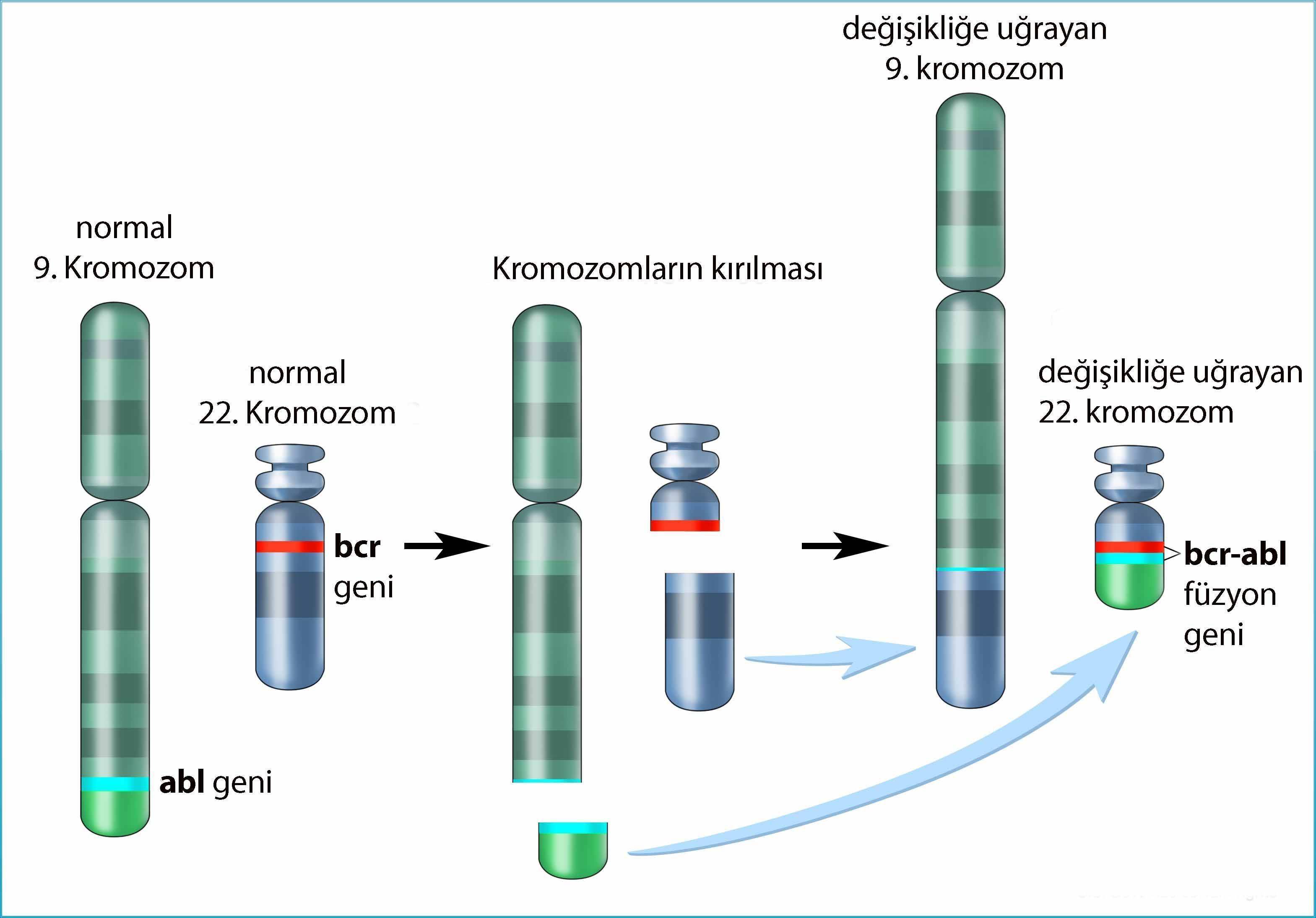
Our cells contain 23 pairs of chromosomes. Exchange of segments between chromosome 9 and chromosome 22 makes chromosome 22 shorter than normal. At the same time, bcr-abl is formed as a new gene. It is an oncogene promoting cancer development and produces the BCR-ABL oncoprotein, which causes uncontrolled cell multiplication. However, not all CML patients have the Philadelphia chromosome. Other oncogenes are thought to contribute to CML.
Philadelphia chromosome-positive CML is usually sporadic, meaning not genetic but an event occurring during life. It occurs in somatic cells (those making up most of the body) and therefore generally does not pass from parents to children. Thus, the Philadelphia chromosome is usually not inherited.
However, saying this condition is entirely nonhereditary could be misleading. Some evidence suggests certain genetic factors may increase a person’s likelihood of forming the Philadelphia chromosome. Genetic predispositions may therefore contribute to disease development. It is still generally considered sporadic, but a genetic component is thought to play a role.
Related topic: The Philadelphia Chromosome: A 50-year road to targeted cancer drugs
Signs and symptoms of Chronic Myeloid Leukemia
In early stages, CML often causes no symptoms, or its symptoms are frequently confused with other conditions. These include:
- Fatigue and muscle weakness
- Night sweats
- Weight loss
- Fever
- Bone pain
- Enlarged spleen (splenomegaly)
- Pain or fullness in the stomach area
- Feeling full after eating even a small amount
However, these are not symptoms unique to CML. They can occur with other cancers and with many noncancerous conditions.
Some patients have bone or joint pain from leukemia cells that have spread from bone marrow to the bone surface or into a joint.
Problems caused by insufficient blood cells
Many signs and complaints caused by CML arise because leukemia cells replace normal blood-forming cells in bone marrow. Consequently, people with CML do not produce enough red blood cells, properly functioning white blood cells or platelets.
- Anemia is a shortage of red blood cells. It may cause weakness, fatigue and shortness of breath.
- Leukopenia is a deficiency of normal white blood cells, increasing infection risk. Although leukemia patients may have very high white blood cell counts, leukemia cells do not protect against infection as normal white blood cells do.
- Neutropenia means low normal neutrophil levels. Neutrophils, a white blood cell type, are very important in fighting bacterial infections. Neutropenic people are at high risk of very serious bacterial infections.
- Thrombocytopenia is a deficiency of platelets. It can cause frequent or severe nosebleeds, unexplained bruising or other bleeding. Some CML patients actually have too many platelets (thrombocytosis). These often do not work properly, however, and these people commonly have bleeding and unexplained bruising.
Treatment TARGETING the Genetic Change in CML: Imatinib - Glivec
The most commonly used method in developing a drug is rational drug design . If the disease-causing change (genetic mutation) is known, developing a targeted drug to suppress the problem caused by faulty coding is rational drug design. Since the 1980s, CML has been known to be associated with Philadelphia chromosome mutation and genetic abnormalities of the bcr-abl protein in blood cells. Drug development against this target dates to those years. Effective against it, the discovery of Imatinib took until 1990. After laboratory studies assessing efficacy and side effects, clinical trials in 1998 demonstrated efficacy, and in 2001 it received FDA approval. In the same month, it appeared on Time magazine’s cover, famous for the phrase “a bullet against cancer”. Imatinib’s use in CML increased 5-year survival from %31 to %60 (the active ingredient is available in our country under the names Glivec, Glivon, Imagliv, Imatenil, Imatis and Imavec).

Imatinib
is a “tyrosine kinase inhibitor” targeting triggers of intracellular growth and proliferation signals. It is the first drug that introduced the concept of targeted treatments. Studies after its use in CML showed it also inhibits C-kit and platelet-derived growth factor receptors. These oncogenes (cancer proteins) are elevated in gastrointestinal stromal tumors, dermatofibrosarcoma protuberans, desmoid tumors and certain rare blood diseases. Imatinib is now also used to treat these diseases.
Was this article helpful?
Your feedback helps us improve our content.




Reader comments
Share your comment
Your name and comment are published only after administrator approval. Your email address is never shown to visitors.
Be the first to comment.