
When and to Whom Should Immunotherapy Be Given in Early-Stage Breast Cancer?

In this article
The question of which patients should receive immunotherapy for early-stage breast cancer, and when, is a major topic of debate in neoadjuvant (before surgery) and adjuvant (after surgery) treatment approaches.
Recently, immunotherapy has shown promising results, particularly in subgroups such as triple-negative breast cancer (TNBC) . However, there is no clear answer regarding its efficacy and timing in other breast cancer types. On August 29, 2024, JAMA Oncology published a comprehensive meta-analysis that sheds light on important questions and presents findings that could reshape treatment approaches.
Neoadjuvant Immunotherapy: Promising Results in TNBC and HR-Positive, HER2-Negative Patients
The meta-analysis examined nine randomized clinical trials evaluating neoadjuvant immunotherapy combined with chemotherapy in 5114 patients. The participants were divided into the following subgroups:
- 2097 patients with triple-negative breast cancer (TNBC),
- 1924 patients with hormone receptor (HR)-positive, HER2-negative disease,
- 1115 patients with HER2-positive breast cancer.
The studies included agents from four classes of immune checkpoint inhibitors, such as pembrolizumab, atezolizumab, durvalumab and nivolumab, as immunotherapy . The results showed:
High Response Rates in TNBC
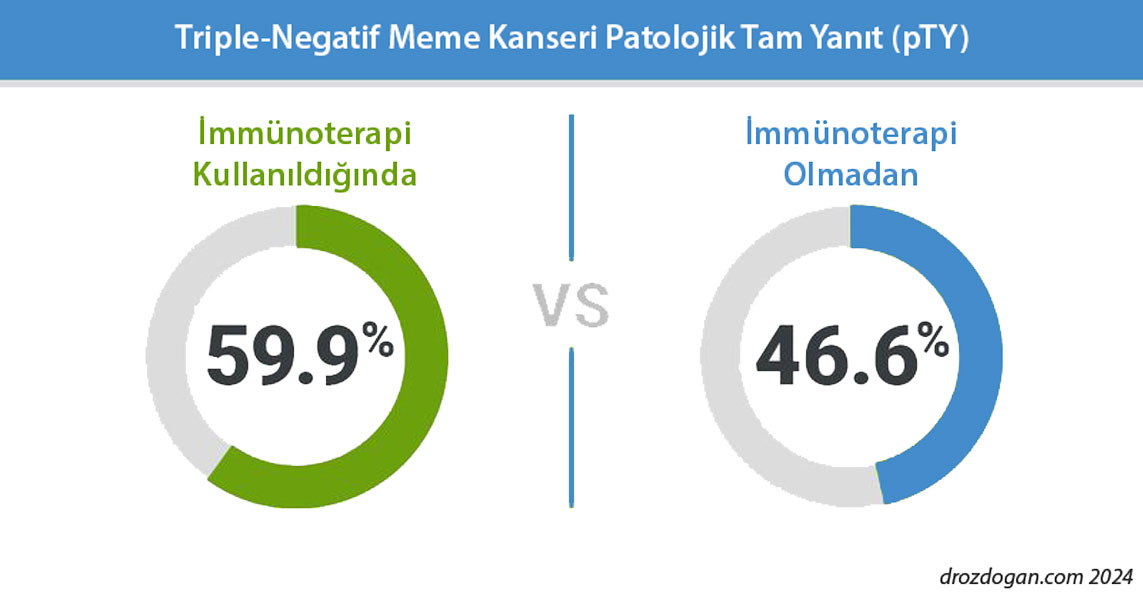
- Pathologic complete response (pCR): With the addition of immunotherapy, the rate rose from 46.6% to 59.9% (odds ratio [OR], 1.64).
- Event-free survival: The 5-year event-free survival rate was 80% in patients treated with immunotherapy, compared with 71.8% in those who did not receive it (hazard ratio [HR], 0.69).
- In patients who achieved pCR: The 5-year event-free survival rate was 92% with immunotherapy and 88% without immunotherapy.
- In patients with residual disease: Event-free survival rose to 63.3% with immunotherapy, compared with 56.1% without immunotherapy.
Selective Response in HR-Positive, HER2-Negative Patients
- pCR rates: Reached 24.6% with immunotherapy (14.8% in the control group).
- This improvement was more pronounced in PD-L1-positive tumors (rising to 31%), whereas in PD-L1-negative tumors only a marginal increase (to 10%) was observed.
Insufficient Response in HER2-Positive Patients
Neoadjuvant immunotherapy did not appear to provide a significant benefit in HER2-positive tumors.
Managing Side Effects
Although neoadjuvant immunotherapy did not significantly increase the gastrointestinal and hematologic side effects specific to chemotherapy, immunotherapy-specific adverse effects were notable. Grade 3 or higher immune-related adverse events were reported at a rate of 10.3%.
Adjuvant Immunotherapy: A Debated Benefit
Data on adjuvant treatment (immunotherapy after surgery) showed that continuing immunotherapy after surgery did not significantly improve overall survival. The following findings are particularly notable:
- In adjuvant immunotherapy trials such as KEYNOTE-522 and IMpassion031, survival rates among TNBC patients who achieved pCR (92.1%) were similar to rates in studies where immunotherapy was not continued (92.8%).
- In patients with residual disease: Continuing immunotherapy did not significantly improve survival (HR, 1.23; 95% CI, 0.60-2.53).
These findings suggest that the efficacy of immunotherapy in TNBC may be limited to the neoadjuvant setting. Continuing immunotherapy may also increase both treatment-related toxicity and financial burdens.
Implications for the Future
These results strongly indicate that the use of immunotherapy in early-stage breast cancer should be reassessed. The following points warrant particular attention:
-
The possibility of omitting adjuvant immunotherapy: The ability to omit adjuvant treatment safely could redefine treatment paradigms. By reducing unnecessary treatment burden, this could improve patients' quality of life.
-
The need for more clinical trials: Additional clinical research is needed to support the accuracy and generalizability of these findings. Larger studies involving specific patient groups could strengthen the existing evidence.
-
Personalized treatment approaches: New studies informed by molecular and genetic data are needed to better understand the benefits of immunotherapy in different patient subgroups. This could enable more precisely targeted treatment strategies.
These points provide an important roadmap for optimizing the role of immunotherapy in early-stage breast cancer.
Conclusion: Time to Reshape Treatment Strategies
Although neoadjuvant immunotherapy shows promise for TNBC and certain HR-positive, HER2-negative tumors in early-stage breast cancer, its lack of efficacy as adjuvant treatment remains a major subject of debate. These findings offer an important opportunity to spare patients unnecessary treatment burden and improve clinical outcomes. However, considering the limitations of these analyses based on cross-trial comparisons, more definitive answers await future clinical trials.
Sources
Was this article helpful?
Your feedback helps us improve our content.




Reader comments
Share your comment
Your name and comment are published only after administrator approval. Your email address is never shown to visitors.
Be the first to comment.