
A New Step in Lung Cancer Treatment: Tumor Resection Without Mediastinoscopy

In this article
Recent research points to an important development for patients with lung cancer . A European study showed that patients with negative systematic endosonography findings could proceed directly to lung cancer surgery, including tumor resection and lymph node dissection, without confirmatory mediastinoscopy. This offers a less invasive and potentially faster treatment process.
Operable lung cancer means that the tumor can be removed surgically. General health, tumor stage and size help determine operability. Patients with operable disease have the opportunity for complete tumor removal and prevention of further spread through surgery.
Systematic endosonography is described as a noninvasive imaging technique using endoscopic ultrasound (EUS) and endobronchial ultrasound (EBUS) to assess lymph nodes and mediastinal structures. It is important in lung cancer staging. A negative result means no signs of tumor spread to lymph nodes were found during the examination.

Endoscopic ultrasound-guided fine-needle aspiration biopsy. An endoscope containing an ultrasound probe and biopsy needle is inserted through the mouth into the esophagus. Sound waves reflected from body tissues create a sonogram, a computer-generated image of nearby lymph nodes. This guides needle placement to obtain tissue, which is examined under a microscope for cancer.
*
Mediastinoscopy is a surgical examination of the mediastinum, the central area of the chest. It can confirm whether cancer has spread to lymph nodes.
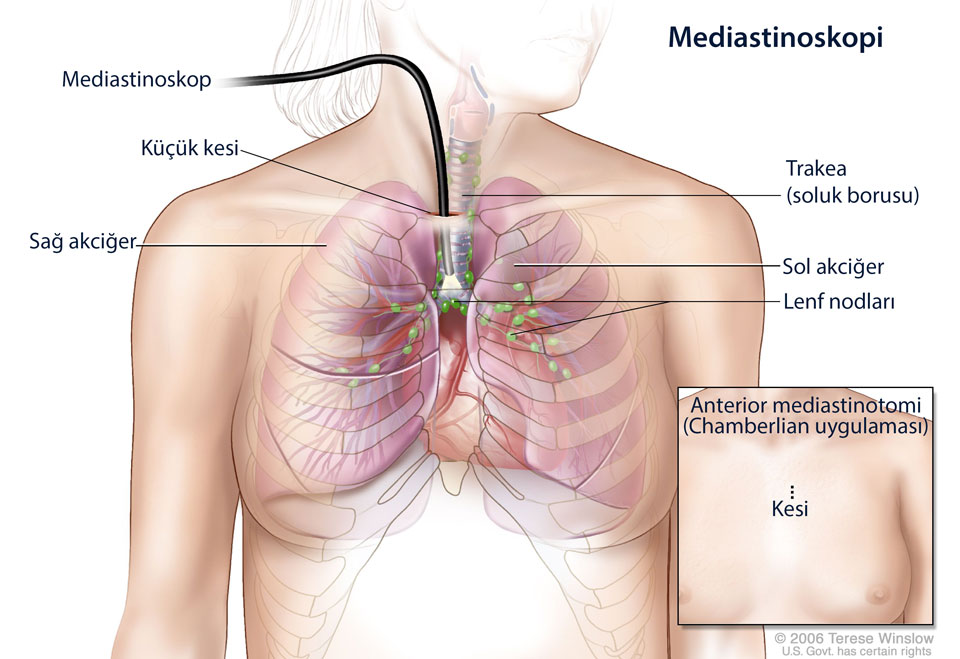
Mediastinoscopy. A mediastinoscope is inserted into the chest through an incision above the breastbone to look for abnormal areas between the lungs. This thin, tube-like instrument has a light and lens for viewing. Tissue can be sampled from lymph nodes on the right side of the chest and examined microscopically for cancer. In anterior mediastinotomy, or the Chamberlain procedure, an incision beside the breastbone provides access to lymph nodes on the left side.
Study Details
Researchers in the Netherlands and Belgium conducted MEDIASTrial , proposing a new approach: patients with negative systematic endosonography can proceed immediately to tumor resection and lymph node dissection without confirmatory mediastinoscopy.
Understanding N2 Disease
N2 disease is a term used in lung cancer staging. The TNM classification describes tumor size and spread (T), lymph node involvement (N), and distant metastases (M).
N2 disease indicates spread to mediastinal lymph nodes in the middle of the chest. Detecting N2 involvement is important for treatment planning, and immediate surgery is generally not preferred in these patients.

For a right-sided lung tumor, N stages are:
N1
Peribronchial and/or hilar nodes on the same side as the tumor
N2
Mediastinal and/or subcarinal nodes on the same side as the tumor
N3
Mediastinal and/or hilar nodes on the opposite side, and any supraclavicular lymph nodes
Results
-
The study included 346 patients recruited from centers in the Netherlands and Belgium.
-
After negative systematic endosonography, patients were divided into two groups:
- The first included 171 patients undergoing immediate tumor resection and lymph node dissection.
- The second included 175 patients undergoing tumor resection and lymph node dissection after confirmatory mediastinoscopy.
-
The primary aim was to compare unforeseen N2 disease rates after immediate resection with those after confirmatory mediastinoscopy. An 8% noninferiority margin was set.
-
Mediastinoscopy detected metastases in 14 of 175 patients (8.0%; 95% confidence interval, 4.8%–13.0%).
-
Unforeseen N2 disease was found in 15 of 171 patients undergoing immediate resection (8.8%; 95% confidence interval, 5.4%–14.0%) and 12 of 155 patients in the mediastinoscopy group (7.7%; 95% confidence interval, 4.5%–13.0%). The difference was 1.03%, with an upper difference bound of 7.2% (P for noninferiority=0.0144).
-
Serious morbidity or 30-day mortality occurred in 12.9% after immediate resection and 15.4% in the mediastinoscopy group (P=0.4940).
Confirmatory mediastinoscopy after negative systematic endosonography aims to detect previously unrecognized N2 disease. This study, however, shows that patients with negative endosonography can proceed directly to resection and lymph node dissection without this confirmation.
The approach is expected to offer a less invasive, faster treatment process, potentially improving quality of life and comfort for patients with lung cancer.
Was this article helpful?
Your feedback helps us improve our content.




Reader comments
Share your comment
Your name and comment are published only after administrator approval. Your email address is never shown to visitors.
Be the first to comment.