A Pause on the Threshold of 1965: The Balance Sheet of Cancer Medicine
In this article
A Pause on the Threshold of 1965: The Balance Sheet of Cancer Medicine
Yesterday we looked at the founding of IARC (Day 143), and today we stop and open the ledger. We drew the last balance sheet on Day 100: two local columns (surgery and radiotherapy) and a sprouting systemic treatment. Since then 44 days have passed, along with a chain running from 1896 to 1965. A balance sheet needs numbers, so I state one limit at the start: for 1965 I could not verify the overall cancer survival of any single country. The earliest verified overall figure I have is for 1974-1976, about 50 percent in adults (USA, NIH fact sheet). So I build the balance sheet not on a single number but on individual diseases and on when the evidence arrived in each.
What was in hand in 1965?
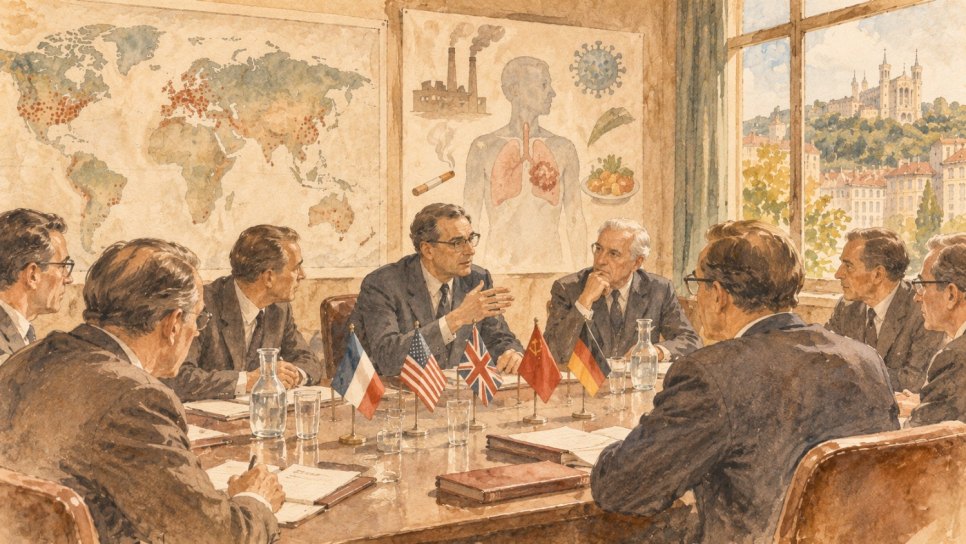
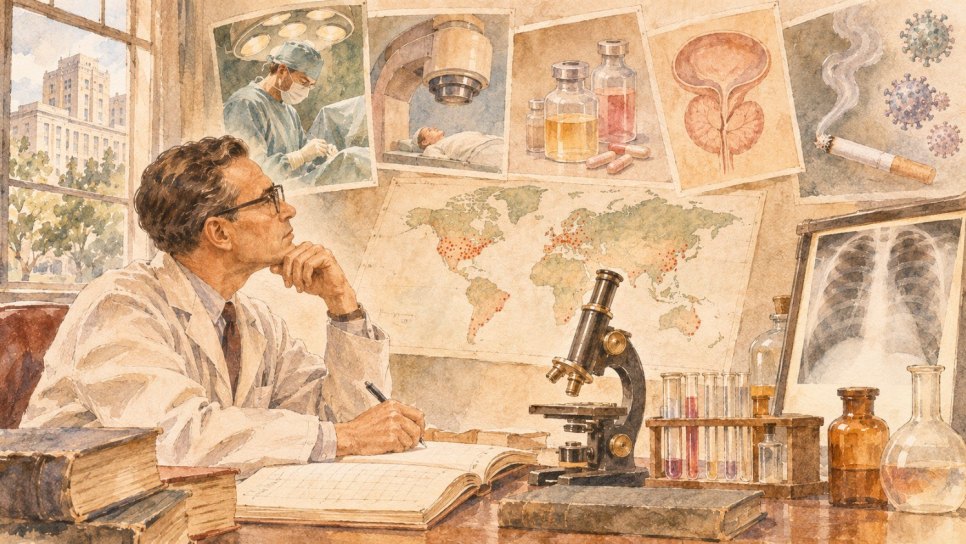
Those who follow the series know the columns. Surgery: Wertheim's radical hysterectomy (Day 93) and Patey's modified mastectomy, aimed at "cutting less" (Day 104). Radiotherapy: the entry of X-rays and radium into use (Days 92 and 94) and the cost becoming visible (Day 95). Hormones: Beatson's oophorectomy (Day 91), Lacassagne's experiments (Day 105) and Huggins's prostate work (Day 112). Drugs: from Ehrlich's "magic bullet" idea (Day 96) to the first nitrogen mustard patient (Day 115), Farber's children's ward (Day 122), Min Chiu Li's choriocarcinoma work (Day 132) and the combination-therapy stories of recent weeks (Days 141 and 142). The fifth column is causes: Doll and Hill's finding on cigarettes (Day 125), the 1964 Surgeon General's report (Day 139), viruses (Days 97 and 140) and, as told yesterday, the institution that would count causes across countries (Day 143).
This list is a list of capabilities, not a list of successes. Two separate questions must not be confused: a treatment producing a response in a disease is one thing; most patients surviving that disease is another. In 1965 the second was, with a few exceptions, more the exception than the rule. To show this disease by disease I look at two subjects: Hodgkin disease and Wilms tumour in children.
The record of 335 children
The analysis by Ledlie, Mynors, Draper and Gorbach, published in the British Medical Journal on 24 October 1970, examines 335 cases of Wilms tumour seen in England and Wales in 1962-1966. According to the abstract, the outcome depended on the stage at the first operation and on whether metastasis had occurred. Three-year survival was 35 percent in children whose kidney was removed; no child whose kidney was not removed survived. Recurrence occurred in about two-thirds of cases, almost always within two years of the first treatment, and three-year survival in the recurrence group was 11 percent. The authors saw very little survival improvement attributable to actinomycin D and asked for controlled trials.
This is a national record, not the best results of a centre. That is often what is missing from a balance sheet: the brilliant series of a few centres and the experience of a whole country are not the same figure.
What does "treatable" mean? Remission, survival, cure
Let us separate three concepts. Remission is the disappearance of the signs and findings of disease; it can return. Survival rate is the proportion alive at a given time (for example three or five years); it depends on who is counted (a national register or one centre's selected patients). Cure is the disease never returning, and it can be said only years later, with long follow-up. For the same disease these three words have different figures. In the childhood leukaemia we described on Day 142, what we saw in the 1960s was remission; cure came as combination treatment and supportive care accumulated over the years.
A trial on the threshold: Hodgkin disease
According to a review article, before combination chemotherapy Hodgkin lymphoma was mostly a disease that could not be treated and that led to loss of life; some patients with early-stage disease were cured by radiotherapy (no figures or dates are given). At the NCI in 1964, Vincent DeVita and colleagues began testing a four-drug regimen for advanced Hodgkin disease: mechlorethamine, Oncovin (vincristine), procarbazine and prednisone. According to OncLive, its name was suggested by his NCI superior Emil Frei III: MOPP. Of the first 43 patients, 36 reached complete remission within six months (36/43, about 84 percent), and results were first reported in 1967. The full publication came in 1970 (DeVita, Serpick, Carbone; Annals of Internal Medicine). As one review relays, in the 20-year follow-up of a 188-patient series that included the first 43 (Longo and colleagues, 1986), the complete response rate was 84 percent and the proportion disease-free for more than ten years was 66 percent.
Note the timing. The regimen was already being tried in 1965; but what was known in 1965 was the remissions in the first patients. The ten-year disease-free figure was published in 1986. So the balance sheet of 1965 is one in which the later evidence had not yet been written.
Two children's series from the same period
In Wilms tumour, two studies from the same period draw a different picture. In Ledlie and colleagues' national series (1962-1966) the contribution of actinomycin D was very small. In the study by Jenkin, Jeffs, Stephens and Sonley published in the Canadian Medical Association Journal on 17 July 1976, five-year relapse-free survival in children treated in 1963-1968 was 49 percent and overall survival 70 percent; in 49 unselected children treated in 1969-1974 these were 78 and 81 percent. The authors attribute the improvement to adjuvant actinomycin D and vincristine. The absolute difference: 29 points in relapse-free survival and 11 points in overall survival; the relative difference about 59 percent and 16 percent (the calculations are mine).
These two studies cannot be compared directly: one is a national register with three-year survival, the other a treatment series with five-year survival; and the periods and treatments also differ. My reading is this: in the "treatable" picture of 1965 there was a gap between the promising results of centre series and what happened across a country, and only later controlled trials narrowed it. I mark this inference as interpretation, not evidence.
The other column of the balance sheet: cost and limits
The same Wilms study also records a cost: actinomycin D and vincristine maintained with whole-lung irradiation were found excessively toxic in lung metastases; acute diffuse pneumonitis developed in 5 of 11 patients, and 3 of them lost their lives. For MOPP, a review mentions significant blood toxicity, infertility and the risk of secondary leukaemia (rates are not given). So every gain came with a cost for the patients of that day.
The second limit is data. For 1965 I have no verified survival figure for all cancers across a country. The earliest verified overall figure belongs to 1974-1976: about 50 percent in adults; under 50 percent in childhood cancers (NIH fact sheet, September 2006 update). These figures cannot be projected back to 1965. The third limit is that "which disease became treatable when?" has no single answer; we took choriocarcinoma on Day 132 and childhood leukaemia on Day 142, and in each the word "treatment" meant something different.
What remained after 1965
- The principle of combination treatment: giving drugs with different side-effect profiles together (Day 142)
- Counting causes by comparing across countries (Day 143)
- The demand for controlled comparison: the call by Ledlie and colleagues
What fell or weakened
- The expectation that "one method is enough": surgery, radiation or a drug alone
- Counting remission as cure: long follow-up was needed later
- Mistaking a selected centre's series for a country's experience
Both sides of 1965: when did the evidence arrive? The axis runs from 1962 to 1977. Green marks are dates whose bibliographic record is verified or that are confirmed in several sources; blue marks rest on a single secondary source (the start of chemotherapy in Turkey in 1965, MOPP's first report in 1967). Wide green bars show treatment periods. Dates known only by year are drawn mid-year.
Radium, chemotherapy and the first council in Istanbul
According to Kösebay and Göker's article on the history of gynaecologic oncology in Turkey, the first radium purchase was made in 1926 with the contribution of the Istanbul Municipality, and the results were presented at the 1929 National Turkish Medical Congress. The same article reports that in 1965 Dr. İmer Adalı joined the Oncology Institute in Istanbul and, together with Dr. Metin Aran, brought chemotherapy to Turkey. In 1968 an oncology council of gynaecologists, pathologists, medical oncologists and radiation oncologists was formed at Hacettepe; in 1972 a medical oncology branch within internal medicine was opened at Hacettepe under Prof. Dr. Dinçer Fırat and two cobalt-60 units were acquired. So Turkey's balance sheet in 1965 was not a reflection of the world balance sheet of the same year but a story just beginning: radium was already there, chemotherapy was just entering, and the multidisciplinary council came three years later. All of this comes from a single secondary source, and I used the part I read through a summarizing tool, not the whole article.
From 1896 to today
What was verified and what remains uncertain
- Overall survival figure: no national all-cancer survival for 1965 could be verified. The NIH fact sheet (archived copy, September 2006 update) gives 50 percent for adults in 1974-1976; there is no 1960s figure on the page. I did not write a figure I remembered but could not verify.
- Wilms, national series: Ledlie et al., BMJ 1970 (4:195-), 335 cases, 1962-66; only the abstract was read. The end page and radiotherapy details are not in the abstract.
- Wilms, treatment series: Jenkin et al., CMAJ 1976;115(2):136-140; only the abstract was read. The 1969-74 group is 49 children; the size of the 1963-68 group is not in the abstract.
- Comparison warning: the two studies differ in type of record, survival interval and period; the relative percentage differences (about 59 and 16 percent) are my calculation.
- Start of MOPP: 1964 (OncLive and the "Historical Bibliography" entry); first report 1967 (OncLive only; the journal is not named); full publication 1970, Ann Intern Med 73(6):881-895 (bibliographic record read; abstract not read).
- "36 of 43" and "80 percent": OncLive's summary says "80 percent" and also gives 36 of 43 (about 84 percent) without reconciling them. I took 36 of 43 as the basis.
- 188 patients, 20 years: "84 percent complete response, 66 percent disease-free for more than ten years" is relayed from a review; Longo et al., J Clin Oncol 1986;4(9):1295-1306 was seen only as a citation in that review and was not itself read. I could not extract the review's title and authors.
- Early-stage Hodgkin by radiotherapy: appears in the same review without figures or dates; the contribution of Peters and Kaplan is not in this source.
- Frei's naming of MOPP: OncLive; not confirmed by another source.
- Choriocarcinoma and childhood leukaemia: covered on Days 132 and 142; not re-verified in this article.
- Turkey: Kösebay D, Göker B. Türk Jinekolojik Onkoloji Dergisi 2012-2:31-49; a single secondary source, read through a summarizing tool. The statement that İmer Adalı and Metin Aran "brought" chemotherapy in 1965 is the article's; I found no other source for the first chemotherapy in Turkey. A student project's abstract says the Turkish Cancer Society was founded in 1964; I did not include it because it was not confirmed elsewhere.
- Yesterday's box: in the "tomorrow" box of Day 143 I said the "two columns" picture of Day 100 would be updated; this article does that at the level of diseases, and I did not re-read the text of Day 100.
Two Prizes, Fifty-Five Years: The 1966 Nobel, Rous and Huggins
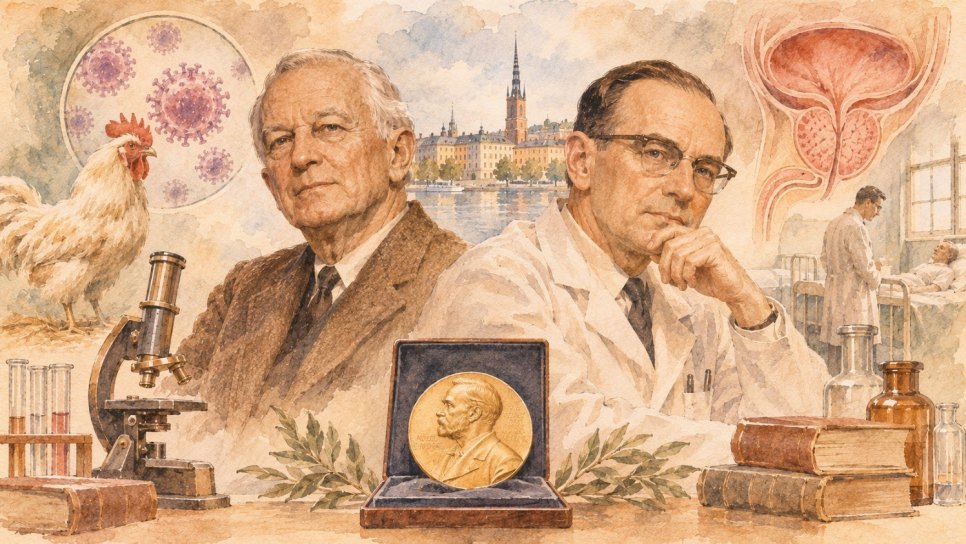
Today we stood on the threshold of 1965. Tomorrow we move one year ahead: the 1966 Nobel Prize in Physiology or Medicine was shared between Peyton Rous, who put forward the idea of a virus in 1911 with a chicken sarcoma (Day 97), and Charles Huggins, who found hormone treatment in prostate cancer (Day 112). I will verify tomorrow the announcement date, the citation text and each man's road to the prize; I will also look at how the "rejected pioneer" motif works once more for Rous.
Author's note: The easy route for this balance sheet was to write a figure such as "in 1965 survival was this many percent." I could not verify that figure and did not invent it. Instead I proceed from two diseases that show when the evidence arrived, and I state openly that I read most of them from abstracts. So this article is not a statistic but a reading made with records; and the strongest finding of that reading is that part of the balance sheet of 1965 was written in 1970 and in 1976.
Sources and Further Reading
- Ledlie EM, Mynors LS, Draper GJ, Gorbach PD. Natural history and treatment of Wilms's tumour: an analysis of 335 cases occurring in England and Wales 1962-6. Br Med J 1970;4(5729):195-. doi:10.1136/bmj.4.5729.195 (abstract read).
- Jenkin RD, Jeffs RD, Stephens CA, Sonley MJ. Wilms' tumour: adjuvant treatment with actinomycin D and vincristine. Can Med Assoc J 1976;115(2):136-140. PMC1878570 (abstract read).
- DeVita VT Jr, Serpick AA, Carbone PP. Combination chemotherapy in the treatment of advanced Hodgkin's disease. Ann Intern Med 1970;73(6):881-895. doi:10.7326/0003-4819-73-6-881 (bibliographic record read; abstract not read).
- Longo DL et al. Twenty years of MOPP therapy for Hodgkin's disease. J Clin Oncol 1986;4(9):1295-1306 (seen only as a citation in a review; not itself read).
- OncLive. How a bold thinker helped introduce chemotherapy combinations to cancer therapy. onclive.com (read).
- Haematologica. Review on the history of Hodgkin lymphoma treatment, haematologica.org/article/view/11705 (read; title and authors could not be extracted).
- NIH. Cancer fact sheet (September 2006 update), archived copy: webarchive.library.unt.edu (read).
- Kösebay D, Göker B. Dünyada ve Türkiye'de jinekolojik onkolojinin tarihçesi. Türk Jinekolojik Onkoloji Dergisi 2012;(2):31-49 (read through a summarizing tool). dergipark.org.tr/download/article-file/439462.
- Mukherjee S. The Emperor of All Maladies: A Biography of Cancer. New York: Scribner; 2010 (general context; the relevant part was not read in this session).
This article is Day 144 of the "365 Days of Cancer History" series and presents the state of cancer medicine on the threshold of 1965 as a historical reading. It is historical-popular content, not a diagnosis or treatment recommendation. For treatment decisions consult your physician. Sources are verified; details that rest on a single secondary source, only an abstract or a text that could not be read are marked in the fact-check notes.
Was this article helpful?
Your feedback helps us improve our content.