Two Prizes, Fifty-Five Years: The 1966 Nobel, Rous and Huggins
In this article
Two Prizes, Fifty-Five Years: The 1966 Nobel, Rous and Huggins
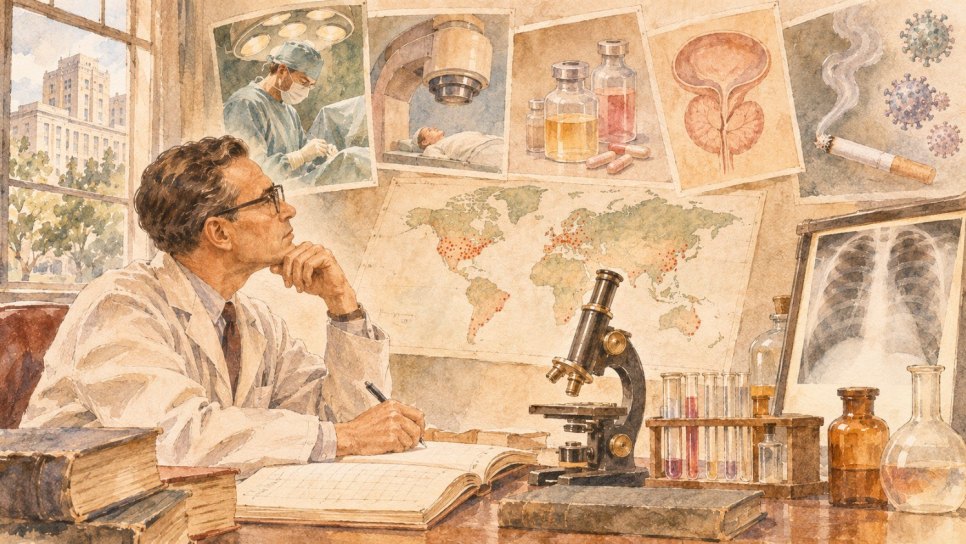
Yesterday we drew up the balance sheet of 1965 (Day 144): on one side powerful capabilities whose evidence had not yet been written, on the other the columns of causes and treatment. Today we move one year ahead. In the autumn of 1966 the committee in Stockholm chose one name from each of those two columns. One was a man who asked about cause with a chicken sarcoma (Day 97); the other a surgeon who asked about treatment with a prostate patient's blood test (Day 112). We told the two stories on separate days. Today we look at them side by side as the two halves of one prize, and we ask a question: is a prize the end of a scientific proof, or a belated record of it?
What does the official text say?
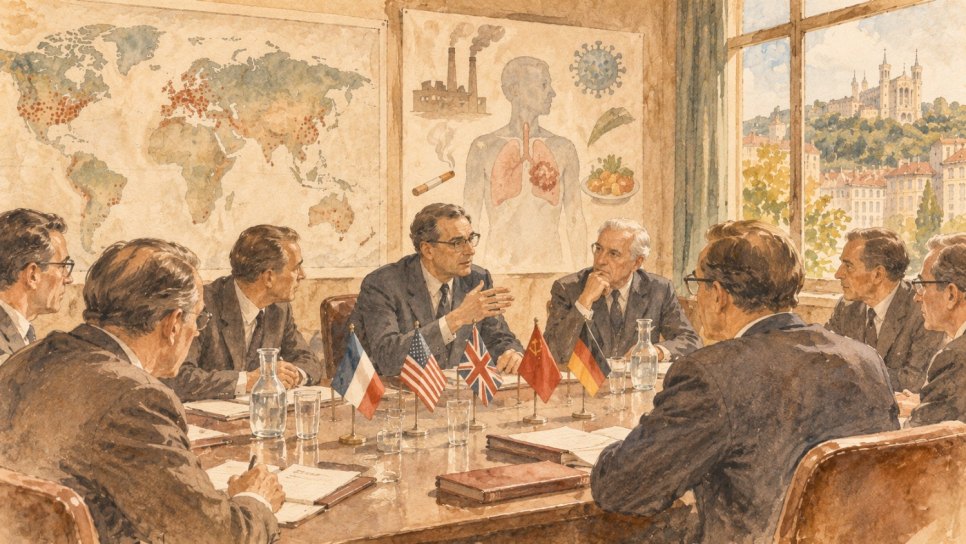
According to the Nobel Foundation's page, the 1966 Nobel Prize in Physiology or Medicine was awarded to two people, half to each. To Peyton Rous for his discovery of tumour-inducing viruses; to Charles Brenton Huggins for his discoveries concerning the hormonal treatment of prostatic cancer. These two motivations are my rendering of the official wording on the Nobel Foundation's page.
The announcement was made in October 1966. Time magazine's issue of 21 October 1966 says the prize was announced "last week"; I could not verify the exact day. According to the same magazine Rous was 87 and Huggins 65. Rous was born on 5 October 1879 and Huggins on 22 September 1901 (Nobel biographies); the ages fit these dates. The fifty-five years in the title is the gap between Rous's chicken sarcoma report (1911) and the prize. For Huggins the same calculation is shorter: Time says his contributions came "more than twenty-five years" earlier, a rough count back to 1941.
The two laureates speak
According to the lecture pages on the Nobel site, both lectures are dated 13 December 1966. Rous's lecture is titled "The Challenge to Man of the Neoplastic Cell". From the site's summary, this is what Rous says (conceptual summary): tumours arise when cells stop obeying the body's coordination, and the nature of this change is still poorly understood; outside agents such as chemicals, radiation and some viruses can start a tumour long before it becomes visible, while tissue injury or inflammation can promote growth. Tumour viruses in chickens, rabbits and mice mostly act as "initiators"; the cancer can continue after the virus is gone. Rous does not accept a simple somatic-mutation explanation. He ends by saying that no virus has been proven to cause cancer in humans, that some viruses may be initiators, that he thinks most human cancers rest on environmental and lifestyle exposures, and that prevention and treatment remain limited.
There is an irony here, but a quiet one: the prize went to the discovery of tumour viruses, and the man who received it says in his lecture that this discovery does not explain most human cancers. Huggins's lecture is titled "Endocrine-Induced Regression of Cancers"; it covers prostate and breast cancer, rat tumours, adrenalectomy and hypophysectomy, and it states plainly that only a small share of cancers respond strongly to hormones. We covered the first series of 21 patients and the later loss of response on Day 112; I do not repeat that here.
What does a belated prize show?
A Nobel Prize is a committee's recognition of a discovery; it is not a measure of how many patients benefited. The delay is not a measure either, but it says something: the field's view has changed. According to the presentation speech by Nobel Committee member G. Klein (I read the text on the site with a summarising tool), Rous's work was done "around 1910"; many researchers who tried to transmit mouse and rat tumours with cell-free filtrates failed and treated the chicken results as an exception; the link between viruses and cancer met scepticism for decades, and the picture changed in the 1950s. So the 1966 prize records not an experiment done in 1966 but a change of view spread over half a century.
Rous's road: from the chicken to the prize
According to his Nobel biography, Rous came to the Rockefeller Institute in 1909 at Simon Flexner's request to take over the cancer research laboratory; he became a Member in 1920, a Member Emeritus in 1945 at the age of 65, and kept working in the laboratory until the end of his life on 16 February 1970. Time writes that when the prize was announced he had been retired for twenty-one years but still went to the laboratory almost every day. We told the 1911 report on Day 97: the filtrate of a chicken breast sarcoma produced the same tumour in healthy chickens. Whether this discovery was the "first" is disputed; Ellermann and Bang's leukaemia work of 1908 came earlier. Rous can therefore be described not as "the first to prove tumour viruses" but as "the first known name to show a filterable agent in a solid tumour"; that sentence is my own summary.
The Nobel archive's nominee page counts 17 nominations for Rous. The entries I could read begin in 1926 (nominated by Karl Landsteiner) and run to 1951; among them are 1931, 1934, 1935, 1936, 1937, 1939, 1946 and 1947. 1926 is an interesting year: that year's cancer-related prize went to Fibiger's worm theory (Day 102). Rous's name was on the nominee list that year. I claim no causal link between the two events; that they sit in the same calendar line is meaningful enough. The page does not say which work the nominations were based on.
Huggins's road: from a blood test to the prize
Huggins, born in Halifax, graduated in medicine at Harvard in 1924, joined the University of Chicago as an instructor in surgery in 1927, became professor in 1936, and in 1951 director of the Ben May Laboratory for Cancer Research (Nobel biography). His 1941 papers and the effect of castration and oestrogen on serum phosphatases were told on Day 112. Time writes that he applied castration to prostate cancer and showed that the benefit came not from the operation itself but from the hormonal change.
Huggins's page in the Nobel archive lists three nominations: two in 1950 (Otto Warburg and Kellogg Speed) and one in 1951 (R. Geissendörfer). I assume the Warburg named there is the Warburg of Day 101; the page does not identify him further. According to the presentation speech (G. Klein, read with a summarising tool), in more than half of the patients with advanced prostate cancer the tumour had shrunk or disappeared, and many remained free of symptoms for years; the value of the same approach in breast cancer was more limited. That figure is the speaker's summary and is not a measure of survival.
The limits the prize hides
Three limits have to be read together. The first is Rous's own assessment: in his lecture he notes that no virus-cancer link has been proven in humans. The second is Huggins's own line: cancers that truly respond to hormones are a small share; the response is lost over time in most patients; according to the summary, in the first series of 21 patients only 4 people, that is about one fifth in absolute terms, lived beyond 12 years (as I noted on Day 112, it is not fully clear from the summary which group this statement refers to). The third is the Nobel itself: this prize does not measure how many years a patient gained. I have no relative survival figure for 1966 and I am not inventing one.
In his lecture Huggins also says that stilboestrol (1938) was the first synthetic substance to control cancer and that this work counts as "the beginning of chemotherapy in cancer" (I read this through a summarising tool). That is a "first" claim and it depends on the definition: suppressing hormones and a drug that directly damages cells (a cytotoxic drug) are not the same thing. The first nitrogen mustard patient is the subject of Day 115, the story of DES of Day 110.
What remained
- The columns of cause and treatment standing side by side in one prize: cancer is not one question
- A laureate setting limits in his own lecture
- The question "is this tumour hormone-dependent?"
What fell or weakened
- The expectation that "every cancer is explained by a virus": Rous himself limited it
- The expectation that hormone therapy would spread to every cancer
- Treating the prize as the end of the evidence
Two roads crossing in 1966. The axis runs from 1905 to 1975. Green marks are dates verified in a bibliographic or primary source; blue marks are approximate in year or week (Huggins's 1941 work, the week of the announcement); the amber mark shows 1911, where sources differ slightly (the presentation speech says about 1910). Wide green bars show spans. Dates known only by year are drawn mid-year.
Side by side in the calendar, apart in cause
I could not find a documented direct link between this prize and Turkish medicine, and I am not forcing one. All I have is the calendar: according to the secondary source I used on Day 144 (Kösebay and Göker, 2012; a single source) chemotherapy came to Turkey in 1965 and a multidisciplinary oncology council was formed at Hacettepe in 1968. The 1966 Nobel falls between these two dates. I do not claim this has causal meaning; I only note that the beginning in Turkey fell in the same decade in which, elsewhere in the world, cause and hormonal treatment were being recognised.
From 1909 to today
What was verified and what remains uncertain
- Announcement day: The exact day was not found. Time's piece of 21 October 1966 says the prize was announced "last week" (read with a summarising tool). The piece says "Royal Caroline Institute"; the presentation speech uses the same name; the institution is the Karolinska Institute.
- Motivation and sharing: From the Nobel Foundation summary page (read with a summarising tool). The English phrasing is my rendering.
- Ages: Rous 87, Huggins 65: according to Time; birth dates (5 October 1879, 22 September 1901) from the Nobel biographies. Because the announcement date is unknown I cannot settle whether Rous was 86 or 87 at the award; Time says 87.
- 1911 and "around 1910": The presentation speech summary says "around 1910" and does not name the chicken sarcoma; Time and the sources of Day 97 say 1911. I rely for 1911 on the citation I verified on Day 97 and did not re-read it for this piece.
- Presentation speech: The speaker appears on the page as "Professor G. Klein"; the page gives no date for the speech. "Almost half a century", "more than half" and the hormone-treatment results are from a summarising tool; they are treated as figures and interpretations of the speaker, not as measurements.
- Lectures: The 13 December 1966 date of both lectures is from the lecture pages on the Nobel site. Rous's lecture content is from the site summary; Huggins's is from a PDF read with a summarising tool; neither was compared with the full text. I did not give the date of the award ceremony in this piece and did not verify it.
- Stilboestrol as "first synthetic substance": Huggins's own wording (via a summarising tool); it depends on definition and is not a verified "first".
- Nominations: For Rous the page counts 17 nominations; I could see only ten entries between 1926 and 1951 and did not see the remaining seven. For Huggins three nominations (two in 1950, one in 1951). The grounds for the nominations are not on the page. That the nominator "Otto Warburg" is the Warburg of Day 101 is an assumption.
- Ellermann-Bang 1908: Carried over from Day 97; not re-verified here. The phrase "first known name to show a filterable agent in a solid tumour" is my own summary.
- Rous biography: The Nobel biography gives 1909, 1920, 1945 and 16 February 1970 and that the work continued; it does not explain why the prize came late. Huggins's biography gives birth, education and appointment dates; it does not cover the prostate work.
- Turkey: No direct link was found. The 1965 and 1968 dates come from the single secondary source I used on Day 144.
- Yesterday's box: What the "tomorrow" box of Day 144 promised, the prize date, motivation and the two men's roads, was covered; the exact day of the announcement is the exception.
Care at the End of Life: Cicely Saunders and the Birth of Palliative Care, 1967
Until now we have followed the cause and the treatment of cancer. Tomorrow we ask what happens when treatment reaches its limit. Cicely Saunders had come by three separate roads, as a nurse, a social worker and a physician, and in 1967 she opened the door of a hospice in London. I will verify the opening date of St Christopher's, the source of the concept of "total pain" and Saunders's own road tomorrow.
Author's note: We usually tell Nobel Prizes as if they were a moment of arrival. In this piece I saw the opposite: both men who received the prize had stated the limit in their own lecture. Rous thought that most human cancers do not come from viruses; Huggins said that cancers that respond to hormones are a small share. The delay of the prize is therefore a sign worth reading: the field accepted the evidence slowly, together with its limits. I also say openly that I read an important part of this piece from summaries on the official site; comparing them with the full texts would be a next step.
Sources and Further Reading
- Nobel Foundation. The Nobel Prize in Physiology or Medicine 1966 (summary page; motivations and sharing). nobelprize.org/prizes/medicine/1966/summary/ (read with a summarising tool).
- Klein G. Presentation Speech, Nobel Prize in Physiology or Medicine 1966. nobelprize.org/prizes/medicine/1966/ceremony-speech/ (read with a summarising tool).
- Rous P. The Challenge to Man of the Neoplastic Cell. Nobel lecture, 13 December 1966. nobelprize.org (site summary read).
- Huggins CB. Endocrine-Induced Regression of Cancers. Nobel lecture, 13 December 1966. nobelprize.org (PDF read with a summarising tool).
- Nobel Foundation. Biographies of Peyton Rous and Charles B. Huggins; nomination archive pages. nobelprize.org (read with a summarising tool; only part of Rous's nominations seen).
- Time. Piece on the 1966 Nobel Prize in Physiology or Medicine, 21 October 1966. time.com/archive/6630371/ (read with a summarising tool).
- Rous P. A sarcoma of the fowl transmissible by an agent separable from the tumor cells. J Exp Med 1911;13(4):397-411 (citation verified on Day 97; not re-read for this piece).
- Huggins C, Hodges CV. Studies on prostatic cancer. I. Cancer Res 1941;1:293-297 (verified on Day 112; not re-read for this piece).
- Mukherjee S. The Emperor of All Maladies: A Biography of Cancer. New York: Scribner; 2010 (general context; the relevant part was not re-read for this piece).
This article is Day 145 of the "365 Days of Cancer History" series and presents the 1966 Nobel Prize in Physiology or Medicine as a historical reading. It is historical-popular content, not a diagnosis or a treatment recommendation. Please consult your physician about treatment decisions. Sources have been verified; details that rest on a single secondary source, on a summary only, or on a text that could not be read are marked in the fact-check notes.
Was this article helpful?
Your feedback helps us improve our content.