Counting the Causes Beyond a Single Country: The Founding of IARC, from Nice to Lyon (1963-1965)
In this article
Counting the Causes Beyond a Single Country: The Founding of IARC, from Nice to Lyon (1963-1965)
Yesterday we looked at one question from this year: if one drug is not enough, can several be given together (Day 142)? Today we turn from the same year, 1965, to the other question: what causes cancer? In recent days we have seen four clues: cigarettes (Doll and Hill, Day 125), the Surgeon General's report (Day 139), a virus (Epstein-Barr, Day 140) and a metal (platinum, Day 141). Each had been found inside one country or one laboratory. There was no place that could compare these clues across countries, and that no single government owned. Today's subject is the founding of that place.
One letter, thirteen signatures
The Agency's official founding date is 1965, but the idea can be traced two years back. According to Saracci and Wild's book on IARC's first fifty years, the idea was raised in early 1963 by Yves Poggioli, a journalist from Nice, who wrote to Emmanuel d'Astier de La Vigerie, the editor of Libération. D'Astier took the matter to French President de Gaulle. On 7 November 1963, d'Astier and twelve co-signatories sent de Gaulle an open letter: let one half of one percent of the military budgets of France, the Soviet Union, the United Kingdom and the USA fund an international cancer institution. De Gaulle replied favourably two days later, on 9 November. On 11 November the French minister Raymond Marcellin contacted the World Health Organization (WHO) Director-General, Marcolino Gomes Candau; Eugène Aujaleu took over the follow-up. IARC's own history page tells it more briefly: "a group of leading French public figures" persuaded de Gaulle to adopt the project; it names no one.
What stands out in this chain is the scale of the funding proposal. The letter suggested setting aside a small share of four countries' military spending for cancer. I did not verify for this article how the Agency was actually financed; I know only that this was the proposal. A second note: I read this story from a single source, the book.
From meetings to a resolution
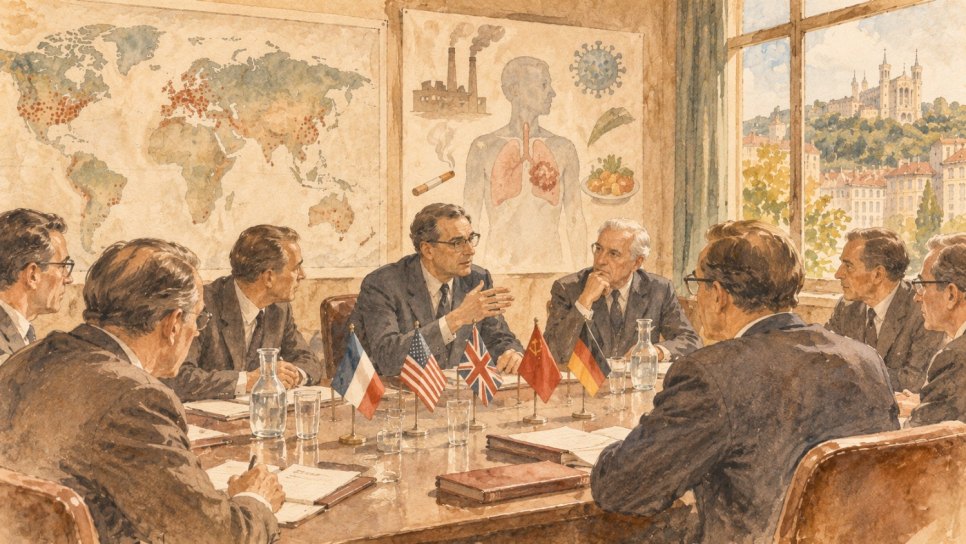
According to the book, the next steps were these: technical meetings in Paris (17-18 December 1963 and 27-28 February 1964), the Stockholm conference of the Union for International Cancer Control (UICC) on 7-9 September 1964, a WHO resolution of 19 June 1964 (authorizing the Director-General to begin discussions) and intergovernmental meetings in Lyon on 16-18 February 1965. The Scientific Committee met from 30 March to 2 April 1965 and identified epidemiology as the Agency's principal activity, with pathology and training also emphasized.
On 20 May 1965 the World Health Assembly established the Agency by resolution WHA18.44, under Article 18(k) of the WHO Constitution. IARC's current history page also gives this day as its birthday. But the date on which the Agency actually began to function is another: after the five founding states confirmed the Statute, WHO announced on 20 September 1965 that IARC had begun functioning on 15 September. So the question "what is the founding date?" has two answers, and both are correct; I open this in the fact-check box.
The first Governing Council and the first Scientific Council
According to the book, IARC's first Governing Council met in Lyon on 23-24 September 1965. Eugène Aujaleu chaired it, and the Italian Giovanni Canaperia was vice-chair. At the meeting Lyon was formally confirmed as headquarters. There were five founding states (the Federal Republic of Germany, France, Italy, the United Kingdom and the USA); Australia and the Soviet Union joined at the same September meeting, bringing the number to seven. Israel joined in 1966 and the Netherlands in April 1967. The next day, 25 September, the first Scientific Council met. The book lists twelve members, among them Richard Doll (United Kingdom), Nikolai Blokhin (USSR), Abraham Lilienfeld (USA), George Klein and Isaac Berenblum (Israel). We already know two of these names from earlier days: Doll was among those who showed the link between cigarettes and lung cancer in 1950 (Day 125). According to the book, Doll was also offered the directorship and declined.
Limit: who chaired the Council is not stated in the part I read.
Why epidemiology? Applying the same method in many places
Searching for the causes of cancer in a single hospital or a single country often does not reach sufficient numbers. When the same method is used to count in many countries, differences become visible. This is why two things stand out in the early years: comparing cancer incidence across countries (the UICC report Cancer Incidence in Five Continents appeared in 1966, and a second volume prepared with IARC's involvement in 1970) and training (a fellowship programme began in 1966; the first international course on cancer epidemiology, with thirty participants, was held in Lyon on 24 June-5 July 1968). The Director, John Higginson, wanted the laboratory to be an integral part of the Agency, so that laboratory tests could be added to epidemiological studies. Higginson took office on 1 July 1966; IARC's page gives his years of service as 1966-1981.
According to the book's account, Higginson defined "environment" broadly: everything that surrounds people and acts on them, including air, culture, diet and chemical exposures (conceptual summary; I did not verify the exact sentence). The hypothesis based on this definition was that about 90 percent of cancers might be attributable to external conditions. This figure is often misread: "environment" here is not only pollution, and it is a hypothesis, not a measured result. Later calculations of the figure (Doll and Peto, 1981) will be the subject of a separate day.
Limits and balances: budget, representation and what was not done
The early plans also included a cancer research information centre; according to the book, budget limits meant it received less emphasis. So not everything envisaged at the founding was done with equal weight. A second balance: the Agency does not treat patients; the work entrusted to it is investigating causes, training and comparing. A treatment advance of the kind we described yesterday (Day 142) does not come by this road.
The third balance is representation. At the founding there were five states (the Federal Republic of Germany, France, Italy, the United Kingdom, the USA); the Soviet Union and Australia joined in the same September. Today's membership page lists thirty members, and among them only Egypt and Morocco appear from Africa. Membership runs on fees: according to IARC documents, in a suspended membership the annual fees continue to accumulate. Regional centres were also set up (from 1967 Nairobi, Singapore and Kingston; from 1970-71 Tehran); I did not assess here to what extent they offset the lack of representation in governance.
From idea to Agency: 1963-1971. The axis runs from 1963 to 1973. Green marks are dates confirmed in several sources or on the institution's own history page (20 May 1965; 1 July 1966). Blue marks rest on a single secondary source (Saracci and Wild's book or the Monographs document). Dates known only by year are drawn mid-year, those known only by month mid-month.
Joining in 2011, leaving in 2019
This story's direct link to Turkey begins in 2011, not 1965. According to IARC's press release of 13 May 2011, Turkey became the Agency's 22nd Participating State at that day's annual Governing Council meeting. Turkey's first IARC Governing Council representative was Prof. Dr. Murat Tuncer. According to the release, Turkey had about 170,000 new cancer cases a year and cancer was its most important public health problem; IARC Director Christopher Wild described Turkey as a natural bridge between Asia and Europe (press release and ecancer report).
Then there is a different picture. According to IARC's 62nd Governing Council document (GC/62/17), Turkey had decided to withdraw from the Agency with effect from 3 June 2019. In a letter dated 28 May 2019 it asked the WHO Director-General to convert the withdrawal into a three-year suspension, and the withdrawal was put on hold on that request. The minutes of the 63rd session in May 2021, however, state that Turkey left the Agency in June 2019 and continued to pay its contributions until the end of that year. Today's membership page lists thirty members, and Turkey is not on the list. I could not find in the documents I read how the suspension request ended or why the withdrawal was decided; I offer no comment on the reason.
From 1963 to today
What was verified and what remains uncertain
- Reading limit: Of the PDF of IARC's fifty-year book, about 531,000 characters long, I read only roughly the first 200,000. Parts I did not read may hold other dates or corrections. The book's authors are Saracci and Wild; the publication page's metadata lists only Wild.
- Founding date: 20 May 1965 (WHA18.44; IARC history page and the book). The Agency actually beginning to function: 15 September 1965 (WHO's announcement of 20 September; the book only). The two dates refer to different events; I took the WHA resolution as the basis for "founding".
- Owners of the idea: Poggioli, d'Astier, the twelve co-signatories, the 9 November reply, Marcellin and Aujaleu come from the book alone. IARC's history page names no one. I could not find the co-signatories' names in the part I read.
- Half of one percent of military budgets: reported as the proposal in the letter; I do not say the Agency was in fact financed that way.
- First Director: IARC's history page gives Higginson (1966-1981) as first Director; the part of the book I read does not explicitly say "first", but gives 1 July 1966. That Doll was offered the directorship and declined is in the book alone.
- "90 percent": I read that the book mentions the hypothesis alongside Higginson's definition of environment; the source and details of the figure were not verified. Higginson's definition of "environment" is given as a conceptual summary.
- Monographs: the programme was initiated in 1969, the first meeting was in December 1971 (Geneva), the first volume in 1972; Lorenzo Tomatis is named as the person who created the programme. All from Volume 100E alone, read through a summarizing tool. The meeting place and details need verifying.
- Regional centres: Nairobi, Singapore, Kingston (from 1967), Tehran (from 1970-71), from a single secondary source.
- Turkey 2011: 13 May 2011, 22nd Participating State (IARC press release and ecancer; the two derive from the same source). The figure of 170,000 new cases a year is from the 2011 release; it is not current data.
- Turkey 2019: the withdrawal decision (effective 3 June 2019) is in GC/62/17; the suspension request on 28 May 2019; the GC63 minutes (17-18 May 2021) say it left; it is not on today's membership page list. I could not close the gap in outcome between these three documents. The reason for the withdrawal is not in the documents.
- Number of members: 30 on today's IARC membership page. The page says "members" rather than "Participating States"; I reported it as read.
A Pause: The Balance of Cancer Medicine on the Threshold of 1965
So far we have followed a chain from 1896 to 1965 step by step. Tomorrow we stop and ask: where did cancer medicine stand in 1965? For which diseases could treatment be spoken of seriously, and for which could it not? How did the "two columns" picture of Day 100 (surgery and radiotherapy, then the sprouting systemic treatment) change in this period? Tomorrow I will rebuild this comparison from sources; I first have to verify which disease was counted as "treatable" and when.
Author's note: The easy route for this subject would have been to describe IARC as "the agency de Gaulle founded" or as "a branch of WHO". The sources show a more scattered chain: a journalist, a letter, a series of meetings, a World Health Assembly resolution and the approval of the Statute by five states. Moreover, most of the account I have rests on a single book, and I read only the first part of it. I could not find the document that has the last word on Turkey's membership. I have noted these separately in the fact-check box.
Sources and Further Reading
- Saracci R, Wild CP. International Agency for Research on Cancer: The First 50 Years, 1965-2015. Lyon: IARC; 2015. publications.iarc.who.int (publication page read; roughly the first 200,000 characters of the PDF read).
- IARC. IARC history. iarc.who.int/iarc-history (read; accessed 7 November 2026).
- IARC. About IARC membership. iarc.who.int/about-iarc-membership (read; accessed 7 November 2026).
- IARC. Press release No. 207: Turkey joins IARC, 13 May 2011. iarc.who.int (read).
- ecancer. Turkey joins International Agency for Research on Cancer. ecancer.org, news item 1752 (read).
- IARC Governing Council. GC/62/17: Suspension of the participation of Turkey (document read). events.iarc.who.int.
- IARC Governing Council. Sixty-third session, Second Meeting minutes (GC63/Min2 Rev1), 17-18 May 2021 (read). events.iarc.who.int.
- IARC Working Group on the Evaluation of Carcinogenic Risks to Humans. Personal Habits and Indoor Combustions. IARC Monographs Vol. 100E. Lyon: IARC; 2012 (history of the Monographs, read through a summarizing tool). ncbi.nlm.nih.gov/books/NBK304391.
- Mukherjee S. The Emperor of All Maladies: A Biography of Cancer. New York: Scribner; 2010 (general context; the relevant part was not read in this session).
This article is Day 143 of the "365 Days of Cancer History" series and narrates the founding of the International Agency for Research on Cancer as a historical event. It is historical-popular content, not a diagnosis or treatment recommendation. For treatment decisions consult your physician. Sources are verified; details that rest only on a single secondary source or on a text that could not be read are marked in the fact-check notes.
Was this article helpful?
Your feedback helps us improve our content.