Bittner’s Milk Factor (1936): How Mouse Mammary Tumors Passed Through Milk and How MMTV Was Found
In this article
The Factor in the Milk: John Bittner and Mouse Mammary Tumors
At the end of Day 107 we left a question hanging: could the hormone of Day 105 and the virus of Day 106 meet in the milk of a mouse? The answer began in a laboratory on the coast of Maine, with baby mice being switched between mothers. In 1936, in a single-page paper, John Bittner proposed that susceptibility to mammary tumors might be carried not only by the genes an animal is born with but also through nursing. Below we first trace this "milk factor", then see how it works together with hormones and genes. At the end we will say what this finding does not mean for humans.
Mother or heredity?
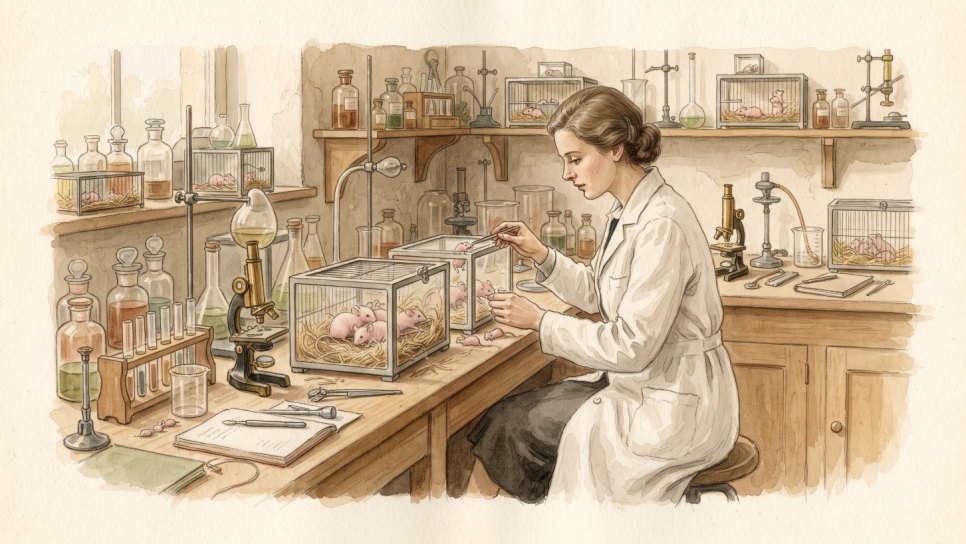
Picture a newborn mouse, a few hours old, eyes still shut, pink and hairless. It is carried from one cage to another, to the side of a completely different mother. To an onlooker it is a trivial handling step. Yet it would shake the prevailing assumption of the time about where the disease came from. The experiment at the center of this article rests on a movement that quiet.
At the Jackson Laboratory in Bar Harbor, the mice belonged to strains kept pure through generations of brother-sister mating. In some strains most females developed mammary tumors as they aged; in others, tumors were rare. The difference was clear, and most researchers, according to one secondary account, assumed it was genetic: everyone wanted to study the genes.
Crossbreeding experiments blurred this picture. Clarence Little, the laboratory's founding director, reported an extrachromosomal influence in Science on 17 November 1933; in Amsterdam, Korteweg was describing a similar factor in the same years. Murray and Little published the results of reciprocal crosses in 1935. According to a historical review, the offspring's fate depended more on the mother's strain than on the father's, and the weight of the extrachromosomal factor was six times that of the chromosomal one. The mother's effect could arrive by two routes: through the egg, or after birth, through something passing from her body to the pups. It was Bittner who tested the second route.
Taking the pups away from their mothers
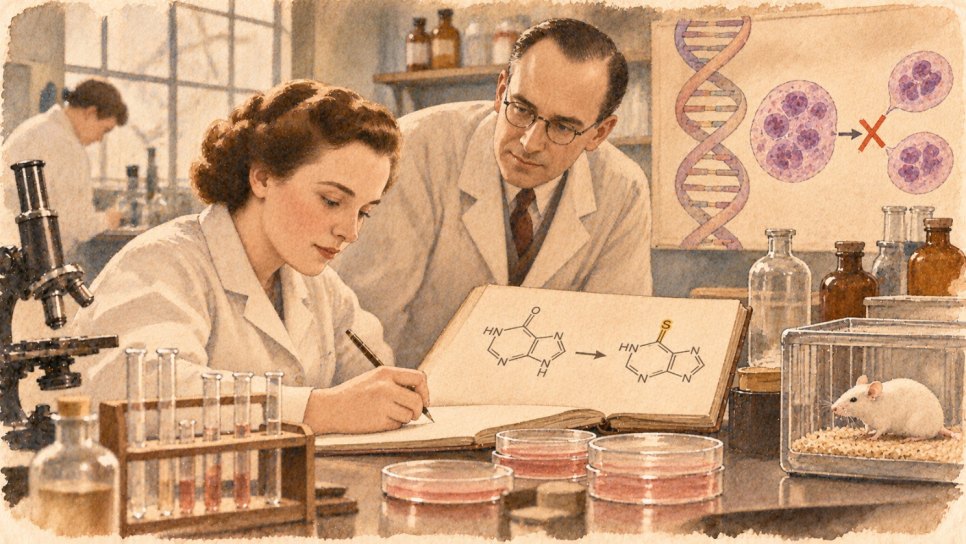
Bittner took the pups of a strain with a very high cancer rate away from their own mothers and let females of a strain in which breast cancer was rare nurse them. He also did the reverse. The two-way result was too clear for heredity alone to explain: pups of the high-risk strain nursed by low-risk mothers were largely protected as adults; pups of the low-risk strain nursed by high-risk mothers developed many tumors. The paper was a single page in volume 84 of Science (page 162) and its title was cautious: "some possible effects of nursing." Bittner named the agent in the milk the "milk factor."
According to a summary of a later study of his, the numbers were striking. When pups of the high-risk strain A were given to a low-risk mother within the first 24 hours after birth, tumor incidence fell from 90 percent to 8 percent. When the pups were handed over later, it stayed around 87 percent. Timing mattered: the agent was acquired early in life, during nursing. A change of cage could send two groups of mice with the same genes toward two different fates.
WHAT WAS THE MILK FACTOR? —
"Extrachromosomal" means "outside the genes." The agent was passed on not with the egg and sperm but with the mother's milk. Yet genes still mattered: the same milk produced almost no tumors in a strain that was not susceptible. A triad emerged: the strain's genes, the hormonal environment, and the milk agent.
The hormone link is here too. In a later study, Bittner suggested that the milk influence might also be necessary for tumors provoked by estrogen. This does not invalidate Lacassagne's finding from Day 105; it only shows how decisive a mouse strain's background can be in interpreting a result. So the answer to the question of Day 107 is this: hormone, gene and milk agent could meet in the same mouse. Looking for a single "cause" would have meant looking at only one leg of this triad. Science catches the hidden variable behind a finding in just this way.
Until the agent got a name
What was the agent? According to one source, in 1945 Andervont was the first to suggest that it might be a virus. In 1947 Mühlbock used the same word, with a question mark, in an annual report. The first visual trace came in 1948. Porter and Thompson examined, under the electron microscope, epithelial cells cultured from the mammary tumors of C3H mice, a strain with a high tumor incidence. In three of six tumors they saw a spherical particle associated with the cells: a dense center about 75 millimicrons across, the whole particle averaging 130. The authors were cautious: the findings were "consonant" with the view that the particles represented the milk agent. This was consistency, not proof; the results still had to be tested in tissues free of the agent.
The next twenty years were years of naming and sorting. Between 1962 and 1969 Bentvelzen separated these viruses into MTV-S (the Bittner virus), MTV-L and MTV-P (the Mühlbock virus). In 1969 he also showed that the infectious virus could be transmitted through the germ cells; that is, the virus could settle in the host's DNA as a copy called a "provirus" and pass from generation to generation. So the 1930s question "genes or milk?" got the answer "both": the same virus could travel in milk and also be inherited. In the early 1970s the discovery of reverse transcriptase allowed the agent to be classified as a retrovirus. Today it is called the mouse mammary tumor virus, MMTV for short.
Pups switched between mothers. Bittner's cross-nursing experiment: tumors were few when a pup of the high-risk strain grew up with a low-risk mother, and many when a pup of the low-risk strain grew up with a high-risk mother.
LIMIT: NO LEAP FROM MOUSE TO HUMAN —
These experiments were done in mice. There is no evidence that human milk carries breast cancer. Studies searching human samples for MMTV-like sequences remain contested. In 2017 one team found an MMTV-like env sequence in 10 of 86 breast samples (11.6 percent). But the rate in breast cancer samples (4 of 49, 8.2 percent) was lower than in normal breast tissue (6 of 37, 16.2 percent); the difference was not significant (p=0.249). The authors thought some of the positives came from mouse DNA in the building, and they could not confirm a causal role.
More importantly, the human data say the opposite. In a reanalysis of 47 studies from 30 countries (50,302 women with breast cancer, 96,973 controls), each 12 months of breastfeeding was associated with a relative breast cancer risk about 4.3 percent lower (confidence interval 2.9-5.8; Lancet 2002). This is a relative reduction; the absolute effect depends on a person's baseline risk. Bittner's finding in mice is no reason to avoid breastfeeding.
What remains
- The idea that genes, hormones and a virus can work together
- Cross-nursing as a way to separate what is inherited from what is acquired
- The value of MMTV as a model of mammary tumors
What falls, or was never shown
- The assumption that strain differences come from genes alone
- The expectation that breast cancer has a single cause
- The claim that human milk carries cancer (never proven)
1982: when the virus settles next to a gene
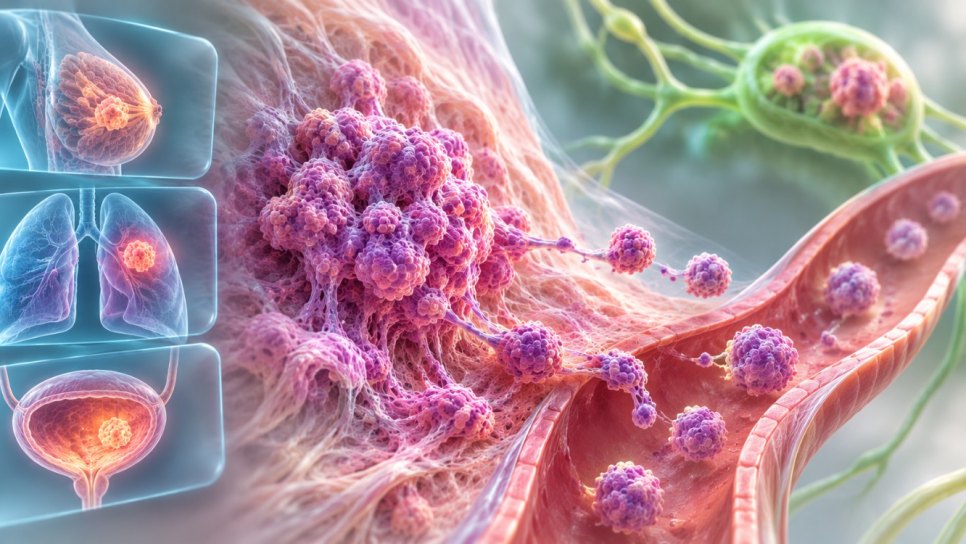
In 1982, in the journal Cell, Nusse and Varmus reported that many tumors caused by MMTV in mice carried the virus's DNA integrated into the same region of the host genome. This detail was a major clue: the virus did not settle at random but next to a host gene common to the tumors, and it affected that gene. Put simply, a virus could land beside a gene and make it work harder than normal. In later years the gene became known as Wnt1. The agent sought in milk in 1936 thus led, half a century later, to the discovery of a cancer gene as well: the virus was not only a cause of the tumor but also a flare marking where the gene lay. We will tell the whole story of the oncogene era in later days of the series.
What is left of this story today?
This story has no verified specific link to Turkey; the general lesson is this: the worry "can cancer pass through milk?" can arise again in any society. Patients and families often ask "is this cancer hereditary or contagious?" Bittner's story also shows why that question cannot be answered with a plain yes or no: heredity, hormones and environment can be intertwined. The answer is that a mouse study cannot be carried over to humans. Recommendations on breastfeeding rest not on mouse experiments but on the large human data above: breastfeeding is one of the factors that lower the risk of breast cancer.
FROM A MOUSE CAGE TO A CANCER GENE
WHAT HAS BEEN VERIFIED IN THIS ARTICLE, AND WHAT REMAINS OPEN
- Citation: Bittner JJ. Science 1936;84(2172):162 (one page); doi:10.1126/science.84.2172.162. The text of the paper itself could not be accessed; the details of the experiment rest on secondary accounts (a history file of the Dutch Society for Medical Microbiology, Jackson Laboratory records, a science blog).
- Little 1933, Murray-Little 1935, Korteweg: the dates and the "six times" ratio come from a single secondary review (NVMM); the primary papers were not read in this work. Korteweg's first name and citation were not verified.
- 90 percent to 8 percent: from the summary of Bittner's later study ("Further studies on active milk influence in breast cancer production in mice"). The year and volume in the journal record (probably Proc Soc Exp Biol Med, 1940) could not be verified; the figures are reported "according to the summary."
- "First suggestion of a virus": the distinction between Andervont 1945 and Mühlbock 1947 rests on one source; the word "first" is hedged for that reason. Wikipedia's statement that the agent was proved to be a virus in 1966 was not used because it does not fit this chronology.
- Porter-Thompson: J Exp Med 1948;88(1):15. Three of six tumors, 75 and 130 millimicrons, and the word "consonant" are from the abstract. The last page number was not verified.
- Bentvelzen 1962-69 and reverse transcriptase: according to the NVMM review; that source dates reverse transcriptase to 1971, the common view is around 1970, so "early 1970s" was written.
- MMTV-like sequences in humans: Perzova et al., Virol J 2017 (doi:10.1186/s12985-017-0862-x). The numbers are from this paper; the authors summarize the result as "maybe, but probably not." The subject is still disputed.
- Breastfeeding: Collaborative Group on Hormonal Factors in Breast Cancer, Lancet 2002;360:187-195; about 4.3 percent per 12 months (confidence interval 2.9-5.8). The absolute effect was not calculated here.
- 1982: Nusse R, Varmus HE. Cell 1982;31:99-109; the title of the paper was verified. That the gene was later named Wnt1 was not separately verified in this work.
- Bittner: 1904-1961; research associate at the Jackson Laboratory, deputy director in 1940, University of Minnesota in 1943 (Wikipedia).
A Nation's Cancer Institute: The National Cancer Institute Act of 1937
Bittner's mice and Graham's operating room had something in common: both were ceasing to be the work of a single curious scientist. In 1937 the United States Congress treated cancer research as the business of a national institution and founded the National Cancer Institute. On Day 109 we will ask why that decision was taken in that year, what was and was not done in its early years, and what it meant to be "a nation's cancer institute."
Author's note: This article joins the "cause" thread of the series: tar (Day 99), hormone (Day 105) and virus (Day 106) meet here in the milk of a mouse. Because the details of Bittner's experiment come from secondary sources, the numbers are marked "according to the summary." These findings hold for mice; they cannot be carried directly to human breast cancer.
Sources and Further Reading
- Bittner JJ. Some possible effects of nursing on the mammary gland tumor incidence in mice. Science 1936;84(2172):162.
- Bittner JJ. The milk-influence of breast tumors in mice. Science 1942;95(2470):462.
- Porter KR, Thompson HP. A particulate body associated with epithelial cells cultured from mammary carcinomas of mice of a milk-factor strain. Journal of Experimental Medicine 1948;88(1):15.
- Nusse R, Varmus HE. Many tumors induced by the mouse mammary tumor virus contain a provirus integrated in the same region of the host genome. Cell 1982;31:99-109.
- Perzova R, Abbott L, Benz P, et al. Is MMTV associated with human breast cancer? Maybe, but probably not. Virology Journal 2017; doi:10.1186/s12985-017-0862-x.
- Collaborative Group on Hormonal Factors in Breast Cancer. Breast cancer and breastfeeding: collaborative reanalysis of individual data from 47 epidemiological studies in 30 countries. The Lancet 2002;360:187-195.
- Nederlandse Vereniging voor Medische Microbiologie (NVMM). Thema Geschiedenis van de medische microbiologie: muizenstammen (historical review, online).
- Mukherjee S. The Emperor of All Maladies: A Biography of Cancer. New York: Scribner, 2010. (General framework for the debate on viruses and cancer.)
This article is Day 108 of the 365 Days of Cancer History series. In 1936, at the Jackson Laboratory, John Bittner switched pups between high-risk and low-risk mouse strains and showed that susceptibility to mammary tumors could be carried not only by genes but by an agent passed on through nursing. That agent was later recognized as the mouse mammary tumor virus (MMTV). These findings were obtained in mice; there is no evidence that human milk carries cancer, and according to human data breastfeeding is associated with a lower risk of breast cancer. The article is written from a historical-popular perspective; it contains no diagnostic or treatment guidance, and you should consult your physician about your own health. Dates and data are drawn from Bittner 1936, Porter-Thompson 1948, Nusse-Varmus 1982, the Collaborative Group 2002 and related sources; details that rest on secondary sources are noted in the fact-check notes.
Was this article helpful?
Your feedback helps us improve our content.