
Cancer Facts in Numbers – 2018: One in Every 6 People Dies of Cancer

In this article
Key facts
- Cancer is the second leading cause of death worldwide and, in 2018, was responsible for an estimated 9.6 million deaths. Globally, of every 6 deaths, approximately 1 is due to cancer.
- Approximately % 70 of cancer deaths occur in low- and middle-income countries . Approximately one-third of cancer deaths result from the 5 leading behavioral and dietary risks: high body mass index, low fruit and vegetable intake, lack of physical activity, tobacco use and alcohol use.
- Tobacco use is the most important risk factor for cancer and is responsible for approximately % 22 of cancer deaths.
- Hepatitis and human papillomavirus (HPV) infections, among others, cause cancers that account for % 25 of cancer cases in low- and middle-income countries.
- Late diagnosis and lack of access to appropriate treatment remain widespread. In 2017, only % 26 of low-income countries reported having pathology services in public hospitals. More than % 90 of high-income countries have access to standard treatments, compared with fewer than % 30 of low-income countries.
- Cancer has a significant and growing economic impact. In 2010, the total annual economic cost of cancer was estimated at approximately 1.16 trillion US dollars.
- Of every 5 low- and middle-income countries, only 1 has the medical data needed to guide cancer policy.
Canceris a general term for a large group of diseases that can affect any part of the body. Other terms referring to cancer are malignant tumors and neoplasms. A defining feature of cancer is the proliferation of abnormal cells beyond their normal boundaries; they can then invade adjacent organs and spread to other organs. This process is called metastasis . Metastases are the main cause of cancer-related deaths.
- Related topics: Common and rare cancer types and oncology terms whose meanings are often queried
The scale of the cancer problem
Cancer is a leading cause of death worldwide; in 2018, it resulted in approximately 18.1 million new cancer cases and 9.6 million deaths. These figures have increased compared with the previously published World Cancer Statistics (2012); in 2012, there were 14.1 million new cancer cases and 8.2 million cancer-related deaths annually. These figures should not be interpreted as cancer "frequency".
The most common cancers are (number of new cancer diagnoses in 1 year):
- Lung (2.09 million cases)
- Breast (2.09 million cases)
- Colorectal (1.8 million cases)
- Prostate (1.28 million cases)
- Skin cancer (non-melanoma) (1.04 million cases)
- Stomach (1.03 million cases)
The most common causes of cancer death are:
- Lung (1.76 million deaths)
- Colorectal (862 000 deaths)
- Stomach (783 000 deaths)
- Liver (782 000 deaths)
- Breast (627 000 deaths)
What causes cancer?
Cancer arises when normal cells transform into tumor cells in a multistep process that generally progresses from a precancerous lesion to a malignant tumor. The main factors causing cancer are shown in the figure below:
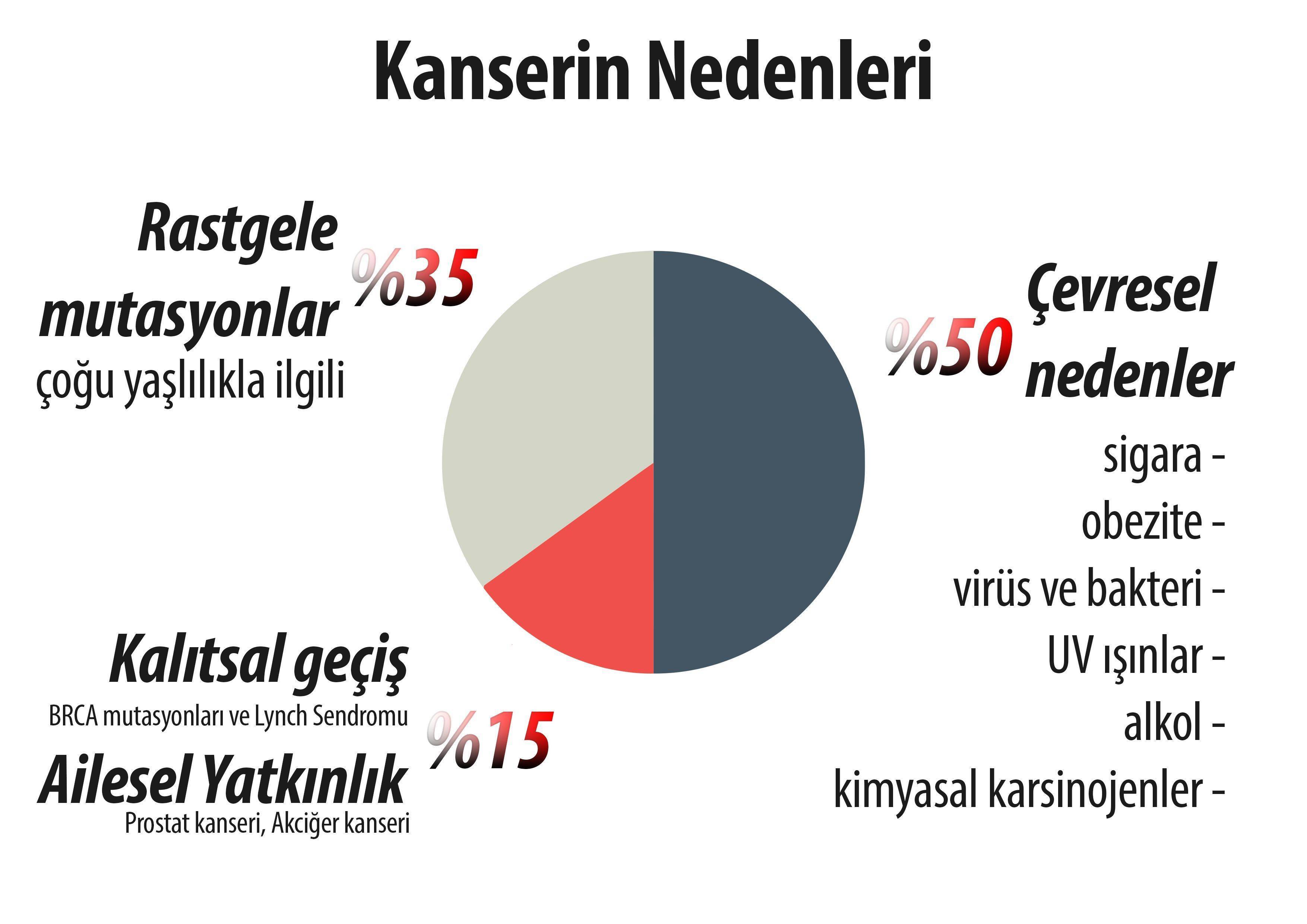
In other words, a person's genetic background and external factors determine cancer risk.
Examples of environmental factors include:
- Solar or artificial ultraviolet rays and ionizing radiation,
- Asbestos, components of tobacco smoke, aflatoxin (a food contaminant) and arsenic (a drinking-water contaminant), among other chemical carcinogens and
- Certain viruses, bacteriaor parasites causing infections, which are biological carcinogens.
The World Health Organization (WHO), through its subsidiary International Agency for Research on Cancer (IARC), continues to classify cancer-causing agents.
- Related topic: The widespread belief in MADE-UP causes supposedly responsible for cancer is concerning
Aging is another fundamental factor in cancer development. Cancer incidence (frequency) rises dramatically with age. There are 3 main reasons why cancer risk increases with age:
- Accumulation of cellular damage,
- Declining immune system function
- Less effective cellular repair mechanisms
- Related topic: The greatest cancer risk factor: Age! Turkish Scientist Besim Öğretmen Finds a New Link Between Cancer and Aging
Risk factors for cancer
Tobacco use, alcohol use, unhealthy diet and physical inactivity are, worldwide, the most important cancer risk factors, and these are also 4 shared risk factors for other noncommunicable chronic diseases (diabetes, cardiovascular disease and dementia), not just cancer.
Below is our video explaining the common causes of cancer and noncommunicable chronic diseases:
Some chronic infections are cancer risk factors and have a major impact in low- and middle-income countries. Of cancers diagnosed in 2012, approximately % 15 were caused by carcinogenic infections, including Helicobacter pylori, human papillomavirus (HPV), hepatitis B virus, hepatitis C virus and Epstein–Barr virus 3.
Hepatitis B and C viruses and some HPV types increase the risk of liver and cervical cancer, respectively. HIV infectiongreatly increases the risk of cancers such as cervical cancer.
- Related topic: Metagenomics! How do microorganisms such as bacteria and viruses cause cancer?
What should be done to reduce the cancer burden (frequency and number)?
Currently, % 30-50 of cancers can, by avoiding risk factors and implementing existing evidence-based prevention strategies, be prevented. The cancer burden can also be reduced through early cancer diagnosis and treatment of patients who develop cancer. Many cancers have a high chance of cure if diagnosed early and treated adequately.
Below is our video explaining how half of all cancers can be prevented:
Modify and avoid risk factors
Modifying or avoiding key risk factors can substantially reduce the cancer burden. These risk factors include:
- Tobacco use, including smoking and smokeless tobacco
- Being overweight or obese
- An unhealthy diet with low fruit and vegetable intake
- Lack of physical activity
- Alcohol use
- Sexually transmitted HPV infection
- Infection with hepatitis or other carcinogenic infections
- Ionizing and ultraviolet radiation
- Urban air pollution
- Domestic use of solid fuels
Tobacco use is the single most important cancer risk factor, accounting for approximately %22 of cancer-related deaths worldwide on its own as a cause.
To prevent cancer, people should:
- Avoid the risk factors listed above;
- Against HPV and hepatitis B viruses, get vaccinated;
- control occupational hazards;
- Reduce exposure to ultraviolet radiation;
- Reduce exposure to ionizing radiation (occupational or medical diagnostic imaging).
Vaccination against HPV and hepatitis B viruses alone can prevent 1 million cancer cases every year.
- Related topics:
Early cancer diagnosis
Early diagnosis consists of 3 steps that should be integrated and delivered promptly:
- Awareness and easy access to healthcare
- Clinical evaluation, diagnosis and staging
- Access to treatment.
Early diagnosis applies in all settings and to most cancers. Without early diagnosis, patients are diagnosed at a late stage when curative treatment is no longer an option. Programs can be designed to reduce delays and barriers to care, allowing patients timely access to treatment. When early cancer diagnosis is discussed, the most effective method and the first that comes to mind is cancer screeningas the method.
Related Topics:
- Current Cancer Screening Programs: Which Tests Allow Early Diagnosis of Which Cancers?
Sources
who.int/news-room/fact-sheets/detail/cancer
12 September 2018
Was this article helpful?
Your feedback helps us improve our content.




Reader comments
Share your comment
Your name and comment are published only after administrator approval. Your email address is never shown to visitors.
Be the first to comment.