
Immunotherapy Makes a Difference in First-Line Treatment of Endometrial (Uterine) Cancer

In this article
Endometrial cancer is the most common type of uterine cancer and one of the most common gynecological cancers in women. It begins in the endometrium, the uterus’s inner lining, and usually occurs after menopause.
Endometrial cancer is one of the few cancers with rising incidence and mortality. It is the third most common cancer and the fourth leading cause of cancer death among women worldwide.
More than half of endometrial cancer patients are diagnosed at an early stage because it typically causes noticeable symptoms such as abnormal vaginal bleeding. These symptoms generally prompt women to seek medical help, enabling earlier diagnosis. Nevertheless, approximately 25-30% are diagnosed at stages 3 and 4. Survival for women with advanced or metastatic endometrial cancer has changed little over the past 40 years, reflecting limited advances in systemic treatment.
A New Era in Uterine Cancer Treatment
However, results from two separate randomized phase 3 clinical trials show that adding a new treatment to standard chemotherapy for advanced or recurrent endometrial cancer, namely immunotherapy, helps achieve significantly better outcomes.
One study added pembrolizumab (Keytruda) to chemotherapy, and the other added dostarlimab (Jemperli). Both were presented at the Society of Gynecologic Oncology 2023 Annual Meeting on Women's Cancer and published simultaneously on 27 March in the New England Journal of Medicine.
These two papers mark a new era in endometrial cancer treatment. Combining immunotherapy with standard chemotherapy provides a more effective first-line systemic treatment option for advanced or recurrent disease.
Dostarlimab had already received approval in 2021 from the FDA (Food and Drug Administration of the United States) for “second-line” treatment of advanced or recurrent endometrial cancer with mismatch repair-deficient (dMMR) tumors. The two new studies show clinically meaningful benefit from adding immunotherapy to standard chemotherapy in mismatch repair-proficient (pMMR) patients too.
What Are dMMR and pMMR?
dMMR and pMMR concern DNA repair mechanisms in endometrial tumors. MMR stands for “Mismatch Repair,” a mechanism that corrects mismatched DNA base pairs.
dMMR (Mismatch Repair-deficient) tumors have lost this mechanism’s function and cannot correct mismatched DNA base pairs. This causes a genetic alteration called high microsatellite instability (MSI-H). Such tumors tend to be more aggressive and more sensitive to the immune system, so they may respond better to immunotherapy.
pMMR (Mismatch Repair-proficient) tumors have a functioning MMR mechanism that corrects mismatched DNA base pairs. These are called microsatellite stable (MSS) and tend to show a weaker immune response. Understanding how immunotherapy works in these tumors is therefore important.
Details of the Dostarlimab Trial
The phase 3 dostarlimab study, RUBY, showed that patients with dMMR disease benefited most from adding the immunotherapy to standard chemotherapy. This subgroup represented 24% of participants and had a 72% lower risk of progression or death. In the entire group, adding dostarlimab reduced progression or death risk by 36%.
The trial enrolled 494 patients with stage III-IV or first recurrent endometrial cancer receiving standard carboplatin and paclitaxel chemotherapy. Patients were randomized to dostarlimab (1000 mg) or placebo every 6 weeks for up to 3 years. Of these, 118 (23.9%) had dMMR and high microsatellite instability (MSI-H) tumors.
- In the dMMR-MSI-H subgroup, the estimated 24-month progression-free survival rate was 61.4% with dostarlimab and 15.7% with placebo.
- For the entire group, 24-month progression-free survival was 36.1% versus 18.1%.
- A prespecified exploratory progression-free survival analysis also showed clinically meaningful benefit in pMMR and microsatellite-stable (MSS) patients.
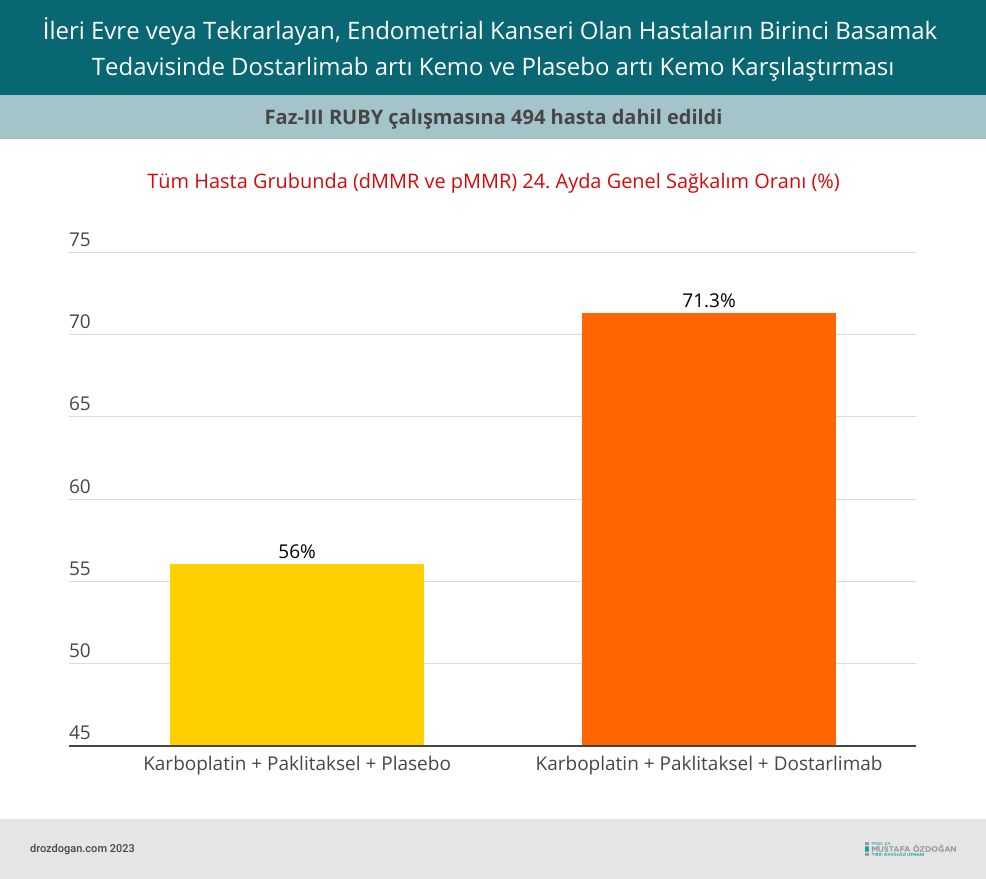
- Overall survival also favored dostarlimab: at 24 months, 71.3% of patients receiving it were alive, compared with 56% receiving placebo.
- In the dMMR-MSI-H group, the overall response rate was 77.6% with dostarlimab and 69% with placebo.
- In the pMMR-MSS population, the respective rates were 68.1% and 63.4%.
The most common side effects were nausea, hair loss and fatigue. Side effects were more severe with dostarlimab than placebo. Quality of life was assessed in pMMR patients and was similar in both groups.
Details of the Pembrolizumab Trial
NRG-GYO18 enrolled 816 patients with measurable stage III or IVA disease, stage IVB disease or recurrent endometrial cancer. They were randomized to pembrolizumab or placebo with standard paclitaxel and carboplatin chemotherapy.
Patients were divided into two cohorts according to whether their tumors were dMMR or pMMR. Previous chemotherapy was allowed only if it had been given as adjuvant (postoperative preventive) treatment at least 12 months before this treatment.
The primary outcome was progression-free survival in the two disease groups.
- In the dMMR group, median progression-free survival was not reached with pembrolizumab because more than half the patients continued responding, compared with 7.6 months with placebo (HR, 0.30; P < 0.001);
- in the pMMR group, it was 13.1 months versus 8.7 months (HR, 0.54; P < 0.001).
Quality of life was assessed at baseline in the pMMR group and was similar between pembrolizumab and placebo (86% and 87%, respectively) at 6 weeks after randomization. Assessments at later prespecified intervals (weeks 18, 30 and 54) are ongoing.
Side effects were as expected for pembrolizumab and combination chemotherapy and were similar in both groups. In the dMMR cohort, adverse events from any cause occurred in 98.2% with pembrolizumab and 99.1% with placebo; in the pMMR cohort, the rates were 93.5% and 93.4%, respectively. In dMMR patients, grade 3 or higher events occurred in 63.3% with pembrolizumab versus 47.2% with placebo. Similar findings were seen in pMMR patients: 55.1% versus 45.3%.
Conclusion
Adding immunotherapy to chemotherapy offers a more effective treatment option for advanced or recurrent endometrial cancer. Two randomized phase 3 trials showed significant improvements in progression-free survival rates and quality of life with pembrolizumab and dostarlimab. These findings mark a new era in endometrial cancer treatment.
However, questions remain about whether immunotherapy is the best option for every patient, whether other drugs could enhance immune checkpoint inhibition in pMMR tumors, and the optimal treatment sequence. It is also not yet known how overall survival analyses will affect decisions or under what conditions FDA approvals will be granted. Further research and clinical trials are therefore needed as immunotherapy and endometrial cancer treatment advance.
*
How Is dMMR Tested?
Testing for dMMR (mismatch repair-deficient) tumors generally involves taking tissue samples for examination in molecular pathology or genetics laboratories. Two main methods are used:
-
Immunohistochemistry (IHC): This detects absent or low levels of proteins associated with dMMR. Antibodies target specific proteins to show whether they are present or absent. The MMR proteins are MLH1, MSH2, MSH6 and PMS2. Absent or low levels of one or more may indicate a dMMR tumor.
-
Microsatellite instability (MSI) testing: This compares DNA samples from tumor and normal tissue to identify changes in microsatellite regions, which are short repeated DNA sequences. Such changes can indicate impaired MMR. Results generally fall into three categories: MSI-high (MSI-H), MSI-low (MSI-L) and microsatellite stable (MSS). MSI-H indicates dMMR tumors.
Both methods are generally used together because results from one can be confirmed by the other, helping obtain more accurate and reliable diagnoses of dMMR tumors.
Sources
2. Ramez N. Eskander, Michael W. Sill, Lindsey Beffa, et al. Pembrolizumab plus Chemotherapy in Advanced Endometrial Cancer. NEJM March 27, 2023
Was this article helpful?
Your feedback helps us improve our content.




Reader comments
Share your comment
Your name and comment are published only after administrator approval. Your email address is never shown to visitors.
Be the first to comment.